


Yes, you can retake A levels, but only in the summer exam series, so the next chance starts on 10 May 2027 and results come out on 12 August. In England, you sit every paper in the subject again. A science practical or coursework mark can usually come with you. A free place back at your old sixth form isn't guaranteed. England's funding rules don't pay for a year repeated just to raise grades for university.
Whether the year is worth it turns on things you can find out before Christmas: what you'd sit again, who'd pay, and whether the universities you want will count the new grades.
On this page
The only sitting is in summer
A levels in England are sat once a year. AQA, the board that sets and marks over half of all the GCSEs and A levels taken in England, publishes a fee list for November 2026 and January 2027. It covers GCSEs, the Extended Project, Level 3 Applied General certificates and Entry Level certificates. There's no AS or A level on it.
AQA's summer 2027 A level timetable starts on Monday 10 May and uses the common exam slots that all the boards agree through the Joint Council for Qualifications (JCQ). It runs into mid June, with maths paper 3 on 16 June and chemistry paper 3 the next day. Results reach students on Thursday 12 August 2027.
So if you missed your grades this August, your resit is in May and June 2027. The autumn series you may have heard about is for GCSE English and maths resits in November, not A levels.
The January and October exams you'll see advertised
Search for a quicker route and you'll find exams in other months. Pearson runs its International A levels in January, May to June and October, across 21 subjects, though not every subject sits in every month. They're modular, so you take them in units. Cambridge International A levels have a November series too, and Exam Centre London lists Cambridge November 2026 A levels for private candidates.
They're separate qualifications, each with its own syllabus. A switch only makes sense if the universities you're applying to accept them and a centre near you offers them. It may not even get round a resit rule. For its law degrees, King's College London counts taking the same subject again at the same level "even within a different qualification" as a resit. Ask the universities first, and only then look for a centre.
You sit the whole subject again, but some work can come with you
A levels in England are linear, which means the grade comes from exams at the end rather than from units banked along the way. AQA now takes "a single entry" for the subject, so you sit every paper again in the same summer. What can come with you is the work that isn't an exam. AQA says that when resitting, private candidates "will be able to carry forward a previous result" for non-exam assessment, its term for coursework, practicals and speaking tests. Retaking biology, chemistry, geology or physics? You can ask to carry forward your practical endorsement result (a separate pass for lab skills, printed on your certificate beside the grade) "even if it was awarded by a different exam board".
Redoing coursework is a bigger ask. The centre has to supervise it, check that it's your own work and mark it, and AQA says it should only take a private candidate if it's willing to do all that. Geography adds evidence of four days of fieldwork. How much of this touches you depends on the kind of subject.
| Kind of subject | Examples | What you sit again | What can come with you | What the centre has to arrange |
|---|---|---|---|---|
| Exams only | Maths, psychology, economics, sociology | Every paper, in one summer | Nothing, because the grade is all exams | A desk in the exam room |
| Sciences | Biology, chemistry, physics | Every written paper | Your practical endorsement result, even from a different exam board | The practicals, if you don't have a result to bring |
| Coursework subjects | English literature, English language, history, geography | Every written paper | Your coursework mark from before | Supervising, checking and marking new coursework, if you're redoing it |
| Languages | French, German, Spanish | Every written paper | Your speaking test mark from before | Your speaking test, if you're taking it again |
From AQA's rules for private candidates. Pearson Edexcel, OCR and Eduqas set their own, so check with the exams officer for your board.
One worry worth settling now. Don't expect the first grade to disappear from your applications. Bristol's medical school, for one, asks applicants for "a full academic history from age 16 onwards, including details of any retakes".
Wales and Northern Ireland let you resit single units
A levels approved by Qualifications Wales (WJEC's, which centres in England can't offer) and CCEA's in Northern Ireland work differently. They're built from AS and A2 units. CCEA sits every unit in the summer only, and WJEC's maths specification runs on the same summer calendar.
In both systems you can resit an individual unit once, and the better of your two marks counts. Want a third go at a unit? That's a "fresh start". You sit every exam unit again, and earlier exam results don't count towards the new grade. WJEC lets coursework marks be carried forward for the life of the specification. In both, missing a unit you were entered for doesn't use up an attempt.
CCEA's worked example puts the AS units at 40% of the A level. After cashing in (asking the board for your overall grade), you can repeat the A2 units once and cash in again. Scotland's main school qualifications are Highers and Advanced Highers.
Will your old school take you back for free?
You may have read that A level retakes are free if you're under 19. The Department for Education's funding rules for England say something tighter. The money covers students aged 16, 17 or 18 on 31 August 2026, but resits and retakes "are not generally eligible for funding as the activity has already been funded".
A school or college may fund a repeat only for exceptional reasons outside the student's control. The rules list three: long-term sickness with medical evidence, significant personal or family circumstances, or a change of career plan that needs different subjects. Then comes the sentence aimed squarely at you: "Funding is not available for students repeating a year solely to improve a grade for higher education applications."
If your repeat is funded, you shouldn't be charged exam or tuition fees. For 16 to 18-year-olds at DfE-funded schools and colleges, tuition is still free. An unfunded exam resit can carry a fee. Ask whether you'd pay exam fees, and we'd get the answer in writing. These are England's rules. In Wales or Northern Ireland, ask the school or college how it treats a repeat year.
If you're 19 or over
Adults resitting A levels have a different route. GOV.UK's Advanced Learner Loan covers course fees for a level 3 qualification, such as A levels, at an approved college or training provider in England. You need to be 19 or older on the first day of the course. You can take a loan for each A level course, up to four A levels. The minimum loan is £300, and it's paid straight to the college.
It covers fees, not living costs. Interest runs from the first payment, and you only repay once your income is over the threshold. GOV.UK also says a level 3 learner may get a grant from the adult skills fund instead, which isn't repaid, so ask the college about that first. To apply, you need the college's "learning and funding information" letter.
Two catches. The loan pays course fees, so it fits a taught resit course, and you shouldn't assume it covers a private exam entry. And GOV.UK says different funding applies if you study in Wales or Northern Ireland.
What a resit costs when you sit it privately
If you're not going back to a school or college, you'll resit A levels privately, as a private candidate. In AQA's words, that's someone who "enters for exams through an AQA-approved school or college but is not enrolled as a student there". AQA also warns that "not every school/college can take private candidates". You pay the centre, and its price has to cover AQA's own fee. For summer 2027 that's £150.30 for maths, £121.90 for biology, chemistry or physics, £113.40 for English literature and £114.60 for psychology.
| Subject (AQA code) | AQA's fee to the centre | Exam Centre London | David Game College | Excel Exam Centres | Nottingham College |
|---|---|---|---|---|---|
| Maths (7357) | £150.30 | £390 | £415 | £320 | £450, three papers at £150 |
| Chemistry, practical already passed (7405) | £121.90 | £390 | £380, written papers only | £320 | £450, three papers at £150 |
| Chemistry, practical done again (7405) | £121.90 | £1,290 | Doesn't run the practical | £320, plus £800 for the practicals | Doesn't run practicals |
| English literature A, coursework carried over (7712) | £113.40 | £390 | AQA's version isn't on its list | £320, and it lists a £150 coursework-checking fee | £300, two papers at £150 |
Each centre's standard price for summer 2027 from its own price list, before its entry deadline. Nottingham College's fee table says £150 a paper, though its worked example still uses £140. The totals use £150. AQA's figure is what it charges the centre, and every centre's price has to cover it. Late entries cost more everywhere.
Science and coursework are where the money goes. Exam Centre London charges £1,290 for AQA chemistry with the practical, and £900 for the practical on its own. Excel Exam Centres lists practicals at £800 a subject ("conditions apply"), beside its £320 exam price. David Game College and Nottingham College take science and coursework candidates for the written papers only. English literature tells the same story: £840 at Exam Centre London with new coursework, against £390 with the old mark carried over. Languages with a speaking test cost more too, at £520 for French at David Game College.
So if you need the practical, a cheap centre that only takes written papers is no bargain. It can't run the practical.
Late entries cost more again. AQA charges centres a late fee equal to the whole entry fee from 22 February 2027, and one and a half times the entry fee after 21 April. At Exam Centre London, maths rises from £390 to £555 and then £720. Tuition is on top of all of it, and if maths is the grade you're chasing, start with a maths tutor near you.
Do universities count a resit?
It depends on the university and the course, and the rule usually sits on each course's own page. Imperial considers retaken exams for every course except MBBS medicine. King's College London doesn't accept resit students for its law degrees without significant mitigating circumstances. It treats a foundation year taken after low grades as a resit too. Medicine runs all the way from "not considered" to "accepted".
| University and course | Resits? | What it says |
|---|---|---|
| Imperial College London, most degrees | Considered | Retaken exams "may still be considered" for every course except MBBS medicine, and resit grades "may be noted" |
| King's College London, law degrees | Not accepted | Only with significant mitigating circumstances in your first sitting, and a foundation year after low grades counts as a resit |
| University of Birmingham, medicine | Not considered | Only after very serious life events, with independent evidence sent by the UCAS deadline |
| University of Bristol, medicine | Considered | If your chemistry grade is below its requirement, you must resit it or take another suitable qualification |
| University of Leeds, medicine | Accepted | One resit per A level without mitigating circumstances, and a third attempt only with evidence |
| Lancaster University, medicine | Considered | A*AA within three years of A level study, and at least ABB first time if you apply during your resit year |
| Newcastle University, medicine | Accepted, with conditions | Only from people who applied there before, one retake per subject, and one grade above the usual offer, so AAA becomes A*AA |
From each university's own course pages and admissions policies for 2027 entry.
These rules belong to each university and change every year, so read your own course's page before you pay for a resit.
If a course you're eyeing makes its offer in points rather than grades, check what your resit grades are worth in UCAS points before you decide which subjects to resit.
If you're aiming for medicine
UCAS's 15 October 2026 deadline for most 2027-entry medicine courses has passed. If you haven't applied, you'll usually be aiming for 2028 entry with the new grades in hand. Lancaster lets people apply during a resit year only if they got at least ABB the first time, unless its panel accepts exceptional circumstances. Birmingham will only weigh resit grades if you send independent evidence of very serious life events by the UCAS deadline. Newcastle takes resits only from people who applied there before. Each school republishes its rules for every entry year, so read the 2028 version when it appears.
Your resit year, from autumn to results day
The dates that decide a resit come months before the exams. Centres close their entries first. David Game College's standard entries close on 1 February 2027, and Excel Exam Centres adds a late fee from 6 February. Nottingham College takes entries from 24 November 2026 to 12 February 2027, and Exam Centre London's deadline is 15 February. AQA's own deadline is 21 February. If you're redoing coursework or a practical, your centre has to send the marks to AQA by 15 May, and speaking tests are due by 1 June. For the paper-by-paper dates in between, check the full summer 2027 timetable.
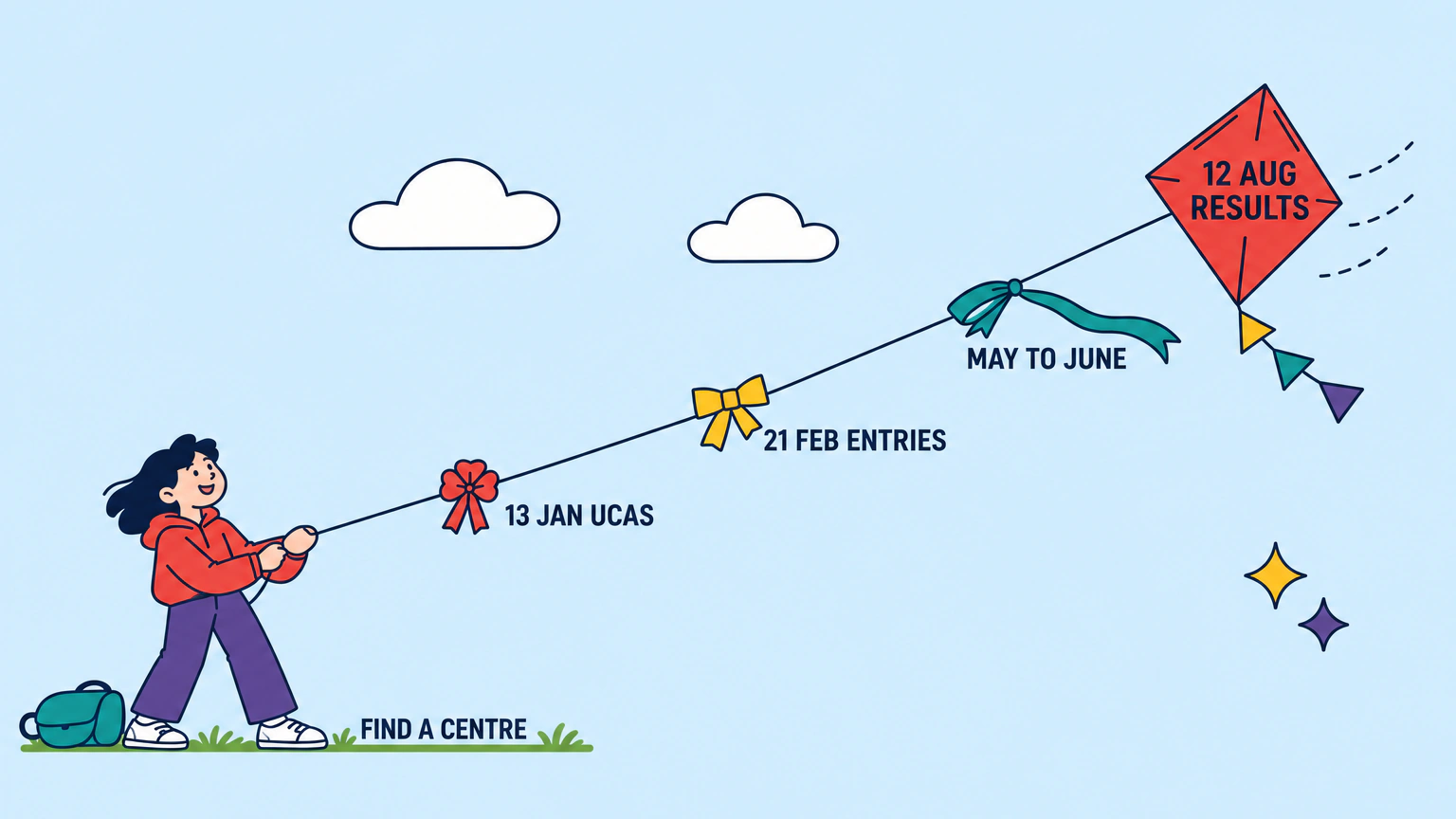
Then there's the money if plans change. Exam Centre London refunds before its first deadline, less £30 a paper, and issues no refunds after it "regardless of personal circumstances". Excel refunds before its entry deadline, less £40 a paper, and nothing after. Nottingham College says all its fees are non-refundable. AQA gives centres no credit for an entry withdrawn after 21 April 2027, apart from partial refunds it may consider on medical grounds. Book when you're sure.
Plan ahead if you need extra time or a computer in the exam. These access arrangements need evidence, and centres can set early cut-offs for them. David Game College's deadline for those requests was 1 September 2026, so it has already passed. Nottingham College takes requests for an assessment between 12 October 2026 and 29 January 2027, and the assessment costs up to £250.
Five things to settle before Christmas:
- Read the resit rule on every course page you're aiming at, for the year you'd start. If a page says nothing, email the admissions team and keep the reply.
- Ask your old school or college whether it would take you back, and whether you'd pay. Get the answer in writing, so nobody's memory decides it in September.
- If you're resitting a science, find your practical endorsement result before you choose a centre. It's on your old Statement of Results or certificate, and it decides whether you need a centre that runs practicals.
- Enter before your centre's own cut-off. The earliest of the four we read was 1 February 2027. Ring round now, because AQA warns that finding a centre that takes private candidates "can take some time".
- If you're applying to university this cycle, send your UCAS application by 13 January 2027. That's UCAS's equal consideration date for most undergraduate courses.
Questions people ask about retaking A levels
Can you retake A levels in November or January?
Not UK A levels. AQA's November 2026 and January 2027 fee list covers GCSEs, the Extended Project and a few other qualifications, with no A level on it, so the next sitting is May and June 2027. November is for GCSE English and maths resits. Pearson's International A levels do run in January and October. But they're a different qualification, so check your universities accept them first.
Can you resit just one A level paper?
Not in England. A levels there are linear, so AQA takes a single entry for the whole subject and you sit every paper again in the same summer. A coursework mark or a science practical result can come with you. Wales and Northern Ireland are different. WJEC and CCEA A levels are built from units, and you can resit each unit once.
Can you retake A levels for free?
Sometimes, but don't count on it. England's 16 to 19 funding rules say retakes generally aren't funded, and a year repeated only to improve grades for university isn't funded at all. The exceptions are long-term illness with medical evidence, significant personal or family circumstances, or a change of career that needs different subjects. For 16 to 18-year-olds at DfE-funded schools and colleges, tuition is still free. An unfunded exam resit can carry a fee. Ask your old school or college whether you'd be charged.
Can you retake A levels at any age?
Yes. AQA describes a private candidate simply as someone who enters through an approved school or college without being a student there, whether they're self-taught, home-schooled or tutored. If you'd rather take a taught course and you're 19 or over on its first day, GOV.UK's Advanced Learner Loan can cover the fees for up to four A levels at an approved college in England.
How much does it cost to resit an A level?
As a private candidate, you pay the centre's price, which covers the exam board's fee. AQA's fee to centres for A level maths in summer 2027 is £150.30, and the four centres we looked at charge £320 to £450 for it. A science where you redo the practical costs far more. Exam Centre London charges £1,290 for chemistry with the practical, against £390 without it.
When do you have to enter for summer resits?
AQA's entry deadline for summer 2027 is 21 February, with late fees from the next day and very late fees after 21 April. Your centre's own cut-off comes first. Of the four we looked at, the earliest was David Game College on 1 February 2027. Coursework or a practical you're redoing has to be marked and with AQA by 15 May.
Do universities accept A level resits?
It depends on the course, and the rules sit on each course's own page. Imperial considers retaken exams for everything except its MBBS medicine degree. King's College London doesn't accept resit students for law without significant mitigating circumstances. Medicine varies most. Leeds accepts one resit per A level, and Birmingham considers resits only after very serious life events.