

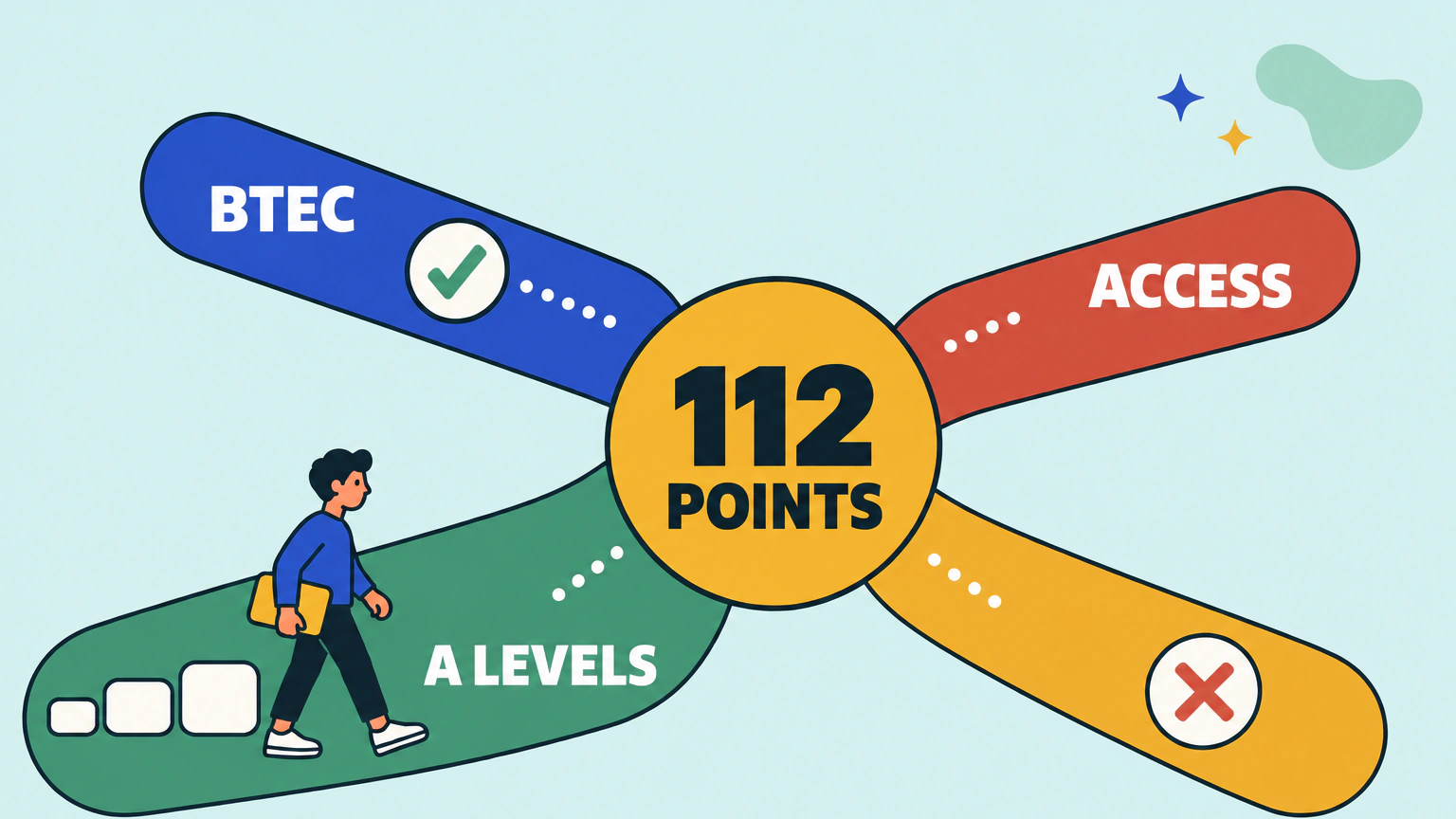
112 UCAS points is BBC at A level. It's also A*BE, A*CD, AAE, ABD and ACC, because the Tariff counts points rather than one particular set of letters. On a BTEC National Extended Diploma the same 112 is DMM.
Six ways, not one. A*CD and BBC both total 112.
On this page
- What 112, 120 and 128 points actually ask for
- The one line of arithmetic the whole Tariff runs on
- What each qualification is worth, grade by grade
- The same total on a different route
- Topping up with an EPQ, an AS or Core Maths
- Before you count on a points total
- Which Tariff table applies to you
- Common questions
What 112, 120 and 128 points actually ask for
Start with 112, 120 and 128, then work backwards from the number.
Read a total as a sum, not as one fixed set of letters. A course asking for 112 points may accept BBC or A*BE, but its full offer can still name a subject, a minimum grade or which qualifications count.
It also changes what a near miss looks like. Drop a grade in one subject and you haven't fallen off the map. You've landed on a different total, and the gap is usually smaller than it feels at the time.
| Points | Every set of three A level grades that reaches it | Ways |
|---|---|---|
| 168 | A*A*A* | 1 |
| 160 | A*A*A | 1 |
| 152 | A*A*B, A*AA | 2 |
| 144 | A*A*C, A*AB, AAA | 3 |
| 136 | A*A*D, A*AC, A*BB, AAB | 4 |
| 128 | A*A*E, A*AD, A*BC, AAC, ABB | 5 |
| 120 | A*AE, A*BD, A*CC, AAD, ABC, BBB | 6 |
| 112 | A*BE, A*CD, AAE, ABD, ACC, BBC | 6 |
| 104 | A*CE, A*DD, ABE, ACD, BBD, BCC | 6 |
| 96 | A*DE, ACE, ADD, BBE, BCD, CCC | 6 |
Why 112 has six answers and 168 has only one
Totals in the middle of the range have lots of routes into them. At the top there are almost none.
168 is A*A*A* and nothing else, because there's no grade above an A*. 160 has a single route too. By the time you reach 136 there are four, and from 120 downwards there are six each. The lower the target, the more ways there are to get there.
That matters on results day. A mid-range offer is far more forgiving of one weak subject than the letters suggest, because an E in your third subject still lands you on 112 as long as the other two come in at an A* and a B. A top offer gives you no slack at all.
The one line of arithmetic the whole Tariff runs on
The Tariff's main model multiplies two smaller numbers together. Once you know which two, you can check the figures for the qualifications below.
The two numbers are the size band and the grade band. Size band is how big the qualification is. Grade band is how well you did. Multiply them and you have the points.
It holds for A levels, AS, the Extended Project, Core Maths, BTEC Nationals and the Scottish qualifications. It also works for almost every entry in UCAS's main table, with a small number of non-standard allocations. If you've ever wondered how GCSE grade boundaries are set, it's the same habit of mind. A grade looks like a letter and behaves like a number.
Size band times grade band, and nothing else
Size band comes from how much teaching the qualification takes, counted in guided learning hours. An A level runs to 360 hours, which puts it in size band 4. Grade band comes from the grade itself, and an A is grade band 12.
4 times 12 is 48. That's an A at A level, and you can run that sum for any grade on the sheet.
Now try it on a different route. A Scottish Higher isn't measured in hours at all. It's measured in SCQF credits, 24 of them, which puts it in size band 3. A grade A at Higher is grade band 11. 3 times 11 is 33, and 33 is exactly what UCAS gives a Higher at A.
Two different measuring sticks. One formula.
Pro tip: here's a sense check you can run on any conversion you find online. Every A level grade is worth a multiple of eight, so a total built only from A levels divides by eight. If a page pairs a points total with a grade string that doesn't add up, the arithmetic is wrong, not the Tariff.
Two things that formula explains straight away
First, the Extended Project. An EPQ uses exactly the same grade bands as an A level at half the size, so it's worth exactly half an A level at the same grade. An A level A is 48 and an EPQ at A is 24. An A* at A level is 56 and an A* EPQ is 28. No exceptions and no rounding.
Second, the one that surprises parents. An A at AS and a B at A level sit in the same grade band, band 10. The AS is worth less only because it's half the size, 20 points against 40. Nobody has marked your child down for taking the AS. The qualification is simply smaller.
What each qualification is worth, grade by grade
Keep the formula in view and you never have to take a points figure on trust, ours included. Here are the building blocks, with the hours and the size band sitting beside the points.
One gap worth naming first. Music grades carry Tariff points too, from Grade 6 upwards, and they run on their own board-by-board scale. We've kept them out of this table on purpose and written up what music grades are worth separately.
| Qualification | Guided learning hours | Size band | Points at each grade, highest first |
|---|---|---|---|
| A level | 360 | 4 | A* 56, A 48, B 40, C 32, D 24, E 16 |
| AS | 180 | 2 | A 20, B 16, C 12, D 10, E 6 |
| Extended Project (EPQ) | 120 | 2 | A* 28, A 24, B 20, C 16, D 12, E 8 |
| Core Maths | 180 | 2 | A 20, B 16, C 12, D 10, E 6 |
| BTEC National Extended Certificate | 360 | 4 | D* 56, D 48, M 32, P 16 |
| Scottish Higher | 24 SCQF credits | 3 | A 33, B 27, C 21, D 15 |
| Scottish Advanced Higher | 32 SCQF credits | 4 | A 56, B 48, C 40, D 32 |
The Welsh Baccalaureate Skills Challenge Certificate belongs in that company too. It's size band 4, the same as an A level, and it scores like one.
Those are the pieces. Putting them together for your own offer is the fiddly part, so pick your total, pick your route, and see what actually reaches it.
What makes your total?
Pick the number your offer asks for, then pick what you're taking.
6 results
6 ways to reach 112 on three A levels
A*BE
56 + 40 + 16 = 112
A*CD
56 + 32 + 24 = 112
AAE
48 + 48 + 16 = 112
ABD
48 + 40 + 24 = 112
ACC
48 + 32 + 32 = 112
BBC
40 + 40 + 32 = 112
Grades are one thing a course asks for. Plenty of offers also name a subject or a minimum grade, so read the course page as well.
A single total usually has more than one answer. And some routes can't reach a given total at all.
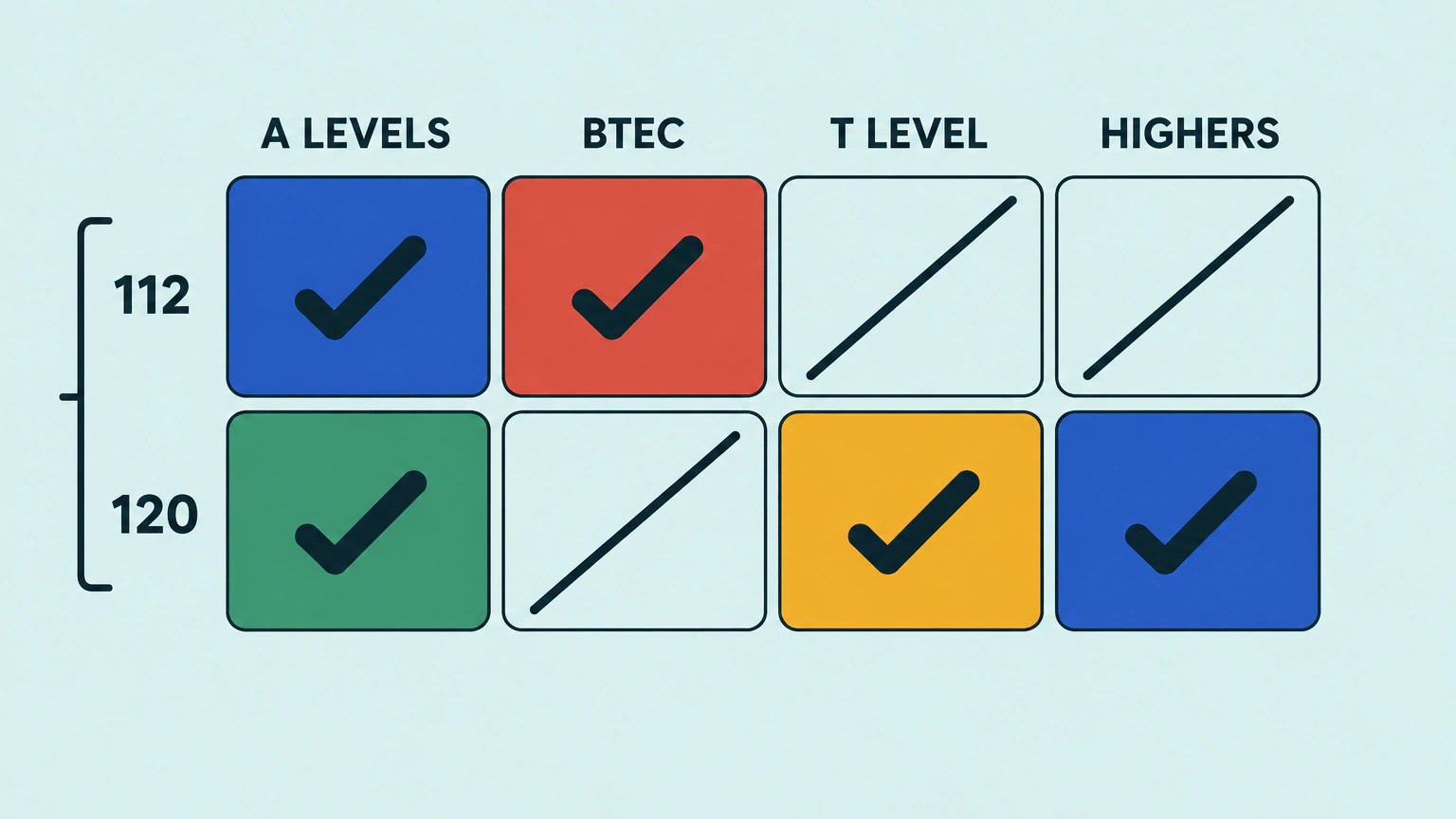
| Points total | A levels | BTEC | T Level | Highers |
|---|---|---|---|---|
| 112 | Yes | Yes | No | No |
| 120 | Yes | No | Yes | Yes |
The same total on a different route
A points offer looks neutral between qualifications. It isn't.
Take the same totals across five routes and the picture changes completely. On three A levels, 112 has six answers. On a BTEC National Extended Diploma it has exactly one, DMM, because the whole diploma is graded as a single three-letter result rather than subject by subject. On a T Level there's no 112 at all.
That isn't a quirk of the tables. A course page quoting one number is quietly asking something different of a sixth former in Leeds, a BTEC student in Cardiff and a Higher candidate in Glasgow.
| Points | Three A levels | BTEC National Extended Diploma | T Level, full award | Scottish Highers, four subjects | Access to HE Diploma |
|---|---|---|---|---|---|
| 168 | A*A*A* | D*D*D* | Distinction* | No four Highers reach it | Above the maximum |
| 144 | AAA, A*AB or A*A*C | DDD | Distinction | No four Highers reach it | D45M0P0, the maximum |
| 128 | 5 sets, including ABB | DDM | Nothing lands here | No four Highers reach it | 3 credit profiles |
| 120 | 6 sets, including BBB | Nothing lands here | Merit | AAAC or AABB | Not an Access total |
| 112 | 6 sets, including BBC | DMM | Nothing lands here | No four Highers reach it | 6 credit profiles |
| 96 | 6 sets, including CCC | MMM | Pass, with A* to C in the core | 5 sets, including BBCC | 8 credit profiles |
The Access to HE column counts published grade profiles, which set out how many of the 45 graded credits are at distinction, merit and pass.
The totals your route simply cannot reach
A minute's checking can save a wasted application.
A BTEC National Extended Diploma lands on ten totals and skips everything between them, so there's no 120 on that route, and no 104 or 136 either. A full T Level has four overall grade names, with Pass split into two Tariff totals by the core grade: 72, 96, 120, 144 and 168. It can't make 112 or 128. An Access to HE Diploma has no 104, no 120 and no 136, because its grade profiles step in threes and fours.
If your offer sits in one of those gaps, don't guess. Ask the admissions office what it wants from your qualification route, and get the answer in writing.
Why Scottish Highers land on a different grid
Highers don't run on eights. A Higher is worth 33 at A, 27 at B, 21 at C and 15 at D, and not one of those is an even number. Four of them at A come to 132, and that's the ceiling before Advanced Highers come into the sum.
So four Highers reach 96 and they reach 120, and they can't make 112, 128 or 144 at all. An offer written in those numbers was written for an A level grid.
If you're applying from Scotland, do two things. Use your Advanced Higher points instead of Higher points in the same subject, because at 56, 48, 40 and 32 they change the picture fast. Then ask the course directly what it wants from a Scottish applicant, because a bare points figure may not translate cleanly onto four Highers alone.
One more thing on geography, because it cuts both ways. T Levels are England's route and Highers are Scotland's, so the same number on the same course page asks different things in different parts of the UK. We can't tell from here which of these your own school or college actually runs. Ask, before you plan around any of it.
Topping up with an EPQ, an AS or Core Maths
If you're adding something to three A levels, three options worth checking are the Extended Project, an AS and Core Maths. The Extended Project runs from 28 points at A* down to 8 at E. An AS and Core Maths both run from 20 at A down to 6 at E.
Now the warning, and it's the one that catches families out. A course can count those towards a points total. It can exclude them entirely. Or it can use them only as the basis for a reduced offer, which is a different thing again. The course page or admissions office can tell you which.
So ask in a form that can't be answered vaguely. Not "do you accept the EPQ", which gets you a cheerful yes and tells you nothing. Ask this instead: "If I'm predicted BBC plus an A in the EPQ, does that meet your 112 point offer?" Put it in writing and keep the reply.
If the gap turns out to be one grade in one subject, start now rather than waiting for results day. If maths is the subject, maths tutors near you is one place to look for help.
Before you count on a points total
The Tariff is a useful translation layer, and it is not the offer.
Before you count on any total: three things UCAS says about its own Tariff. A qualification carrying Tariff points doesn't mean a course will accept it. A course that uses the Tariff may still accept qualifications carrying no points at all. And some employers use the Tariff in their own hiring: "This is not encouraged by UCAS." Read the entry requirements on the course page.
Six things to check before you treat a points total as your target
- Find the total your course page quotes, not the one a league table quotes. Open the course on the university's own site and read its entry requirements.
- Check whether the offer also names a subject or a minimum grade. "112 points including a B in maths" is a different offer from "112 points".
- Check whether your qualification appears in the Tariff tables at all. Plenty don't, and a course may still take one that doesn't.
- Check whether the course counts an EPQ, an AS or Core Maths towards the total, excludes them, or uses them only for a reduced offer.
- Check which entry year you're applying for, 2026 or 2027, because the two tables aren't identical.
- Ask the admissions office in writing if any of that is unclear, and keep the reply on file.
Two more things sit outside the arithmetic altogether. A course can ask for an English language qualification alongside a points total, particularly if you were taught in another language, and that requirement doesn't convert into points at all. If that's you, English language classes are a separate box to tick rather than a top-up.
And a word about us. We're a directory of tutors and classes, not an admissions office, and a points total is never the whole offer, so read the course page before you count on anything here. If you want to know what we do and don't check before a tutor appears on our pages, that's how we work.
Which Tariff table applies to you
Two Tariff tables are live at the moment, and that's a real trap rather than a technicality. The 2026 entry table still matters while Clearing is open for this year's applicants. The 2027 entry table is for applicants starting university in 2027.
They're nearly the same. Ten rows changed between them, and every one of those rows is an International Baccalaureate certificate value, all of them moving upward for 2027 entry. If you aren't taking IB certificates, the numbers you need are identical in both.
The rule of thumb is simple. Read the table for the year you'd start the course, not the year you're sitting the exams. UCAS publishes both files on its UCAS Tariff points page, and both are free to download.
Common questions
What grades are 112 UCAS points?
Six sets of three A level grades reach 112: A*BE, A*CD, AAE, ABD, ACC and BBC. Most pages print BBC and stop, which leaves five real answers out. On a BTEC National Extended Diploma, 112 is DMM.
Is 120 UCAS points good?
In grades, 120 UCAS points is BBB, or A*AE, A*BD, A*CC, AAD or ABC. It isn't a universal pass line.
How many UCAS points is an A at A level?
- An A level sits in size band 4 and a grade A sits in grade band 12, so 4 times 12 gives 48. Every other A level grade works the same way: A* is 56, B is 40, C is 32, D is 24 and E is 16. That's why a total built from A levels always divides by eight.
Do universities really use UCAS points?
Some courses write their offers in points, while others use qualifications and grades. Some accept both. UCAS is blunt about the limits. A qualification carrying points doesn't mean a course will accept it, and a course that uses the Tariff may still take qualifications carrying no points at all. The course page is the only thing that settles it.
How many UCAS points is an EPQ worth?
An Extended Project runs from 28 points at A* down to 8 at E, which is exactly half an A level at the same grade. It uses the same grade bands at half the size. Whether a course counts it towards your total is the course's decision, though. Some add it, some exclude it, and some use it only to lower an offer.
Why don't my Scottish Highers add up to a round number?
Because Highers run on different numbers. A Higher is worth 33, 27, 21 or 15, while every A level grade is a multiple of eight. Four Highers land on 96 and 120, but not on the A level totals 104 or 112 in between. A points offer may not map cleanly onto four Highers.
So open the course page, find the exact wording of the offer, and check it against your own route rather than against a chart. If the number sits in a gap your route can't reach, take that question to the admissions office. And if you're one grade away, start that conversation this term rather than next August.