


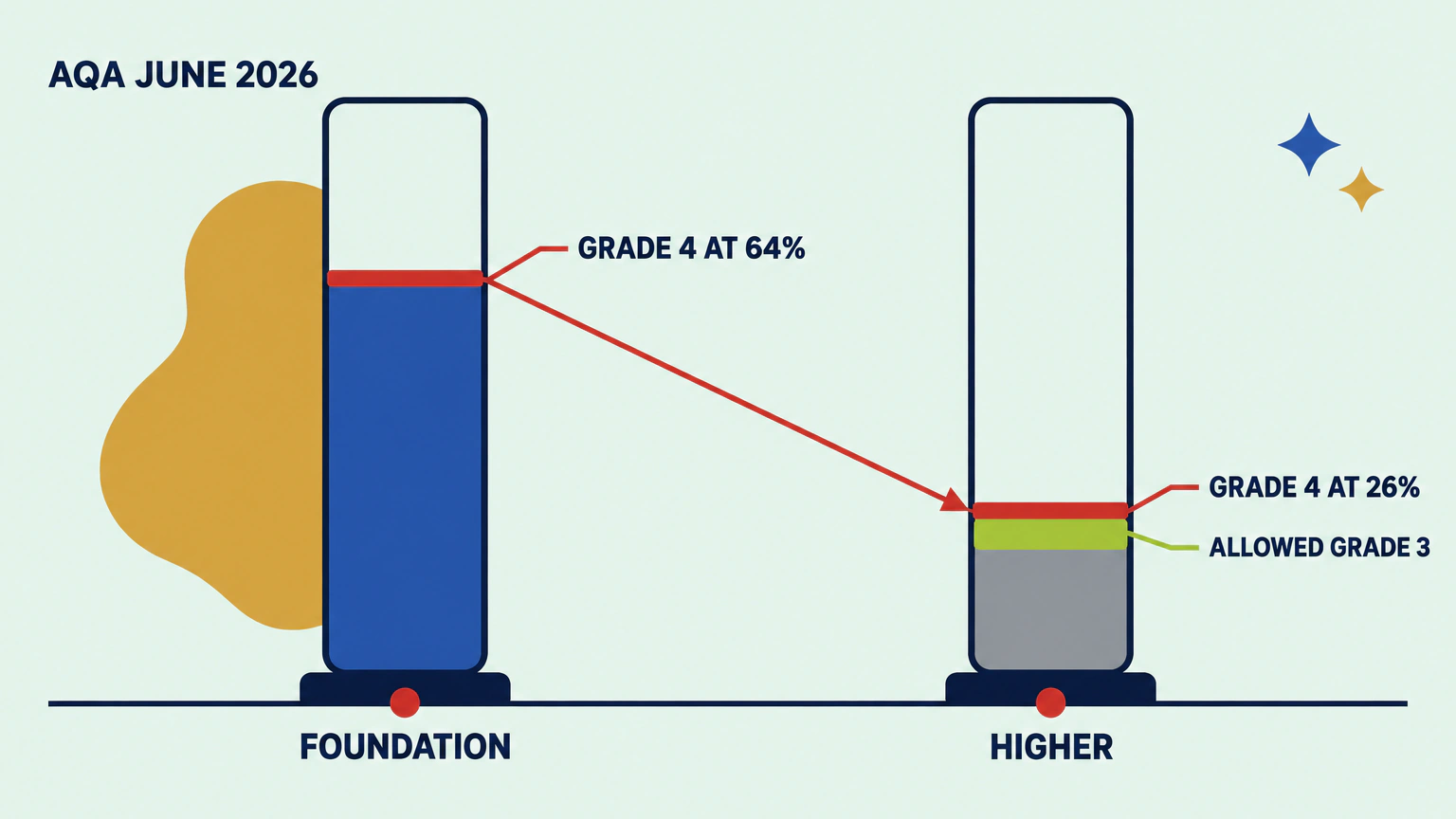
In June 2026 a grade 4 in GCSE maths took 154 of 240 marks on AQA's Foundation papers and 151 on Edexcel's, close to two thirds of the total. On the Higher papers the same grade 4 took only 63 and 50. A mark a little under the Higher line still earns a grade 3, and only below the grade 3 boundary does a result become a U.
Three things decide which number is yours: the board that wrote the papers, the tier you sat, and the series they came from. Get one of them wrong and you're reading somebody else's boundary.
On this page
- How many marks you needed for a grade 4 in June 2026
- Foundation or Higher: where the grade 4 actually sits
- There's no pass mark out of 80
- Boundaries can move between series, so treat last year's as a rough guide
- What a grade 4 is worth, and where this scale doesn't apply
- A few marks short of a 4? What you can do this autumn
- Your questions about GCSE maths grade boundaries
How many marks you needed for a grade 4 in June 2026
A boundary is the lowest total mark that earned a grade, and it's set after the papers are marked rather than before. Pearson says it plainly: "A grade boundary is the minimum mark at which a numbered grade (between 9 and 1) can be achieved." Here is where the lines fell.
| Board and tier | Total marks | Grade 3 | Grade 4 | Grade 5 | Grade 7 |
|---|---|---|---|---|---|
| AQA Foundation (8300F) | 240 | 115 (48%) | 154 (64%) | 187 (78%) | Not available |
| AQA Higher (8300H) | 240 | 46 (19%) | 63 (26%) | 97 (40%) | 166 (69%) |
| Pearson Edexcel Foundation (1MA1) | 240 | 110 (46%) | 151 (63%) | 181 (75%) | Not available |
| Pearson Edexcel Higher (1MA1) | 240 | 34 (14%) | 50 (21%) | 82 (34%) | 146 (61%) |
| OCR Foundation (J560) | 300 | 96 (32%) | 133 (44%) | 183 (61%) | Not available |
| OCR Higher (J560) | 300 | 38 (13%) | 57 (19%) | 94 (31%) | 170 (57%) |
| Eduqas Foundation (C300) | 240 | 88 (37%) | 121 (50%) | 154 (64%) | Not available |
| Eduqas Higher (C300) | 240 | 13 (5%) | 28 (12%) | 57 (24%) | 116 (48%) |
Each figure is the lowest total mark across all papers that earned the grade. Percentages are that mark as a share of the total, rounded to the nearest whole number. On Higher tier, grade 3 is the only grade awarded below 4.
Now find your own row. Ask the school which board set the papers and which tier was sat, then read across. Every figure there is a whole-qualification total, added up across all the papers in the set. Each board publishes its own tables on results day, so you can check yours at AQA, Pearson Edexcel, OCR or Eduqas.
Why OCR's numbers look so much lower
OCR sets three papers marked out of 100, so its boundaries run out of 300. AQA and Edexcel each set three papers of 80, and Eduqas sets two of 120, which puts all three out of 240. Compare OCR by the percentage, never by the raw mark. Its Foundation grade 4 of 133 out of 300 is 44%, the smallest Foundation share of the four, and it buys exactly the same grade as AQA's 154.
Why each board needs a different mark for the same grade
Every board writes its own papers, so every boundary reflects how hard those particular papers turned out to be. Ofqual is blunt about what that does and doesn't mean: "It is no more difficult to achieve a grade in a subject from one year to the next, or between different exam boards." Pearson adds that its boundaries are compared with other boards' "in a process overseen by the regulator".
The practical rule is short. Only ever hold a mark against your own board's boundary, for your own tier and your own series. Eduqas needed 28 marks for a Higher grade 4 in June 2026 and AQA needed 63, and reading that gap as a bargain is the easiest mistake on this whole subject.
Foundation or Higher: where the grade 4 actually sits
Somewhere in Year 10 or Year 11 a school decides which tier each student sits, and most families hear the outcome rather than the reasoning behind it. Only grades 4 and 5 are designed to be accessible on both tiers. Ofqual's condition spells it out: "Grades 4 and 5 are the only grades that are designed to be accessible by Learners who have taken either foundation tier or higher tier assessments." So a grade 4 is on offer either way. It just sits in a completely different place on each paper.
Foundation tops out at a grade 5
A Foundation candidate is awarded a grade from 1 to 5, or is unclassified, however well the papers go. That ceiling is Ofqual's rule and not the board's choice. It also costs real marks. In June 2026 a grade 5 took between 61% of the Foundation marks at OCR and 78% at AQA, so a student going for a 5 on Foundation needs a high score on a paper that can't go any higher. Foundation is the right paper for plenty of students. But a sixth form or a course asking for a 6 has quietly put Higher on the list.
Higher still gives a grade 3 if you just miss a 4
The revision pages get this part wrong, and the mistake changes what a tier decision actually risks.
Ofqual's condition for Higher tier says a student "must be awarded a grade within the range of 4 to 9, or be unclassified. However, if the mark achieved by such a Learner is a small number of marks below the 4/3 grade boundary, that Learner may be awarded a grade 3."
Every board printed that grade 3 line in June 2026. It was 46 marks on AQA, 34 on Edexcel, 38 out of 300 on OCR and 13 on Eduqas. Set those against each board's grade 4 and the band between them runs 15 to 19 marks wide. A Higher student who lands inside it gets a 3 on the certificate.
You'll still find pages saying that a Higher candidate below the grade 4 line is automatically ungraded. The regulator's own condition says otherwise, and so does every board's published table. If a tier conversation at school has been built on that idea, it's been built on the wrong risk.
Higher's safety net has a floor
On Higher, a total just under the grade 4 line still earns a grade 3. In June 2026 that band was 15 to 19 marks wide, depending on the board. Below it the result is U, not a grade 2, because Higher papers don't award grades 1 and 2.
Why a 4 on Higher needs so few marks
Those low numbers aren't generosity. They come from where the marks are aimed. Ofqual requires half the marks on a Higher paper to be targeted at grades 4 to 6 and half at grades 7 to 9. On Foundation, half are aimed at grade 1 up to the lower half of grade 3, and half at the upper half of grade 3 up to grade 5. At least a fifth of the marks on each tier come from questions shared by both, pitched at grades 4 and 5.
That's why a Higher grade 4 in June 2026 cost between 12% of the marks at Eduqas and 26% at AQA. Same grade. Far fewer marks, much harder questions, and a floor underneath if it goes wrong.
There's no pass mark out of 80
People go looking for a pass mark on a single paper, and there isn't one to find. A GCSE maths grade comes from the total across every paper in the set, and no single paper carries a pass mark of its own. AQA puts it in one line: "The sole determinant of a candidate's grade on a linear exam is his/her total subject mark."
All four boards do publish notional paper-by-paper figures for illustration. AQA's and Pearson's papers are each marked out of 80, which is the question people are actually asking. OCR's papers are out of 100 and Eduqas sets two of 120, so an out-of-80 answer exists only for AQA and Pearson.
| Board and tier | Paper 1, out of 80 | Paper 2, out of 80 | Paper 3, out of 80 | Whole qualification, out of 240 |
|---|---|---|---|---|
| AQA Foundation | 53 | 46 | 55 | 154 |
| AQA Higher | 22 | 19 | 22 | 63 |
| Pearson Edexcel Foundation | 53 | 49 | 49 | 151 |
| Pearson Edexcel Higher | 18 | 17 | 15 | 50 |
The paper figures are notional, published by each board for illustration only. Only the whole-qualification total decides the grade.
A Foundation student who scored 40 on AQA's Paper 2 hasn't failed anything, because 46 was only a notional figure and a strong Paper 3 can still carry the total past 154. The paper figures earn their keep somewhere else. They show which paper dragged a total down, and that's how a teacher or a tutor uses them.
Boundaries can move between series, so treat last year's as a rough guide
A boundary belongs to the papers sat that series, and the next set may be harder or easier. Ofqual says only that "New grade boundaries are set each year to reflect the difficulty of each paper". Across the last three series one board's Foundation grade 4 moved by as much as ten marks, while AQA's Higher grade 4 didn't shift at all.
| Board and tier | June 2025 | November 2025 | June 2026 |
|---|---|---|---|
| AQA Foundation, out of 240 | 160 | 158 | 154 |
| AQA Higher, out of 240 | 63 | 63 | 63 |
| Pearson Edexcel Foundation, out of 240 | 144 | 143 | 151 |
| Pearson Edexcel Higher, out of 240 | 53 | 51 | 50 |
| OCR Foundation, out of 300 | 134 | 140 | 133 |
| OCR Higher, out of 300 | 47 | 57 | 57 |
| Eduqas Foundation, out of 240 | 111 | 121 | 121 |
| Eduqas Higher, out of 240 | 27 | 30 | 28 |
November is a resit series, open only to students aged 16 or over on 31 August, so its entrants differ from a June cohort.
What moved in 2026, and what didn't
Ofqual runs a National Reference Test each year, and the 2026 test showed a small but sustained rise in maths attainment at grade 7. The regulator's response was to tell the boards to "reflect this evidence of improvement in their setting of grade boundaries, in the upper grade range. It means those grade boundaries are lower than they otherwise would have been."
That isn't the same as saying the boundaries fell. AQA's Higher grade 7 actually rose, from 164 in June 2025 to 166 in June 2026. Ofqual's point is about where the line would otherwise have gone, not about where it ended up. Lower down the scale, nothing shifted: "At grade 4 results are stable as attainment is stable."
Nobody is competing for a fixed number of passes, which is worth holding on to while you stare at a mock total. Ofqual says it outright: "There are no quotas for the number of students who must pass or fail a subject each year."
How to mark a mock against the boundaries
Use the boundaries from the series the paper was sat in, so a June 2025 paper goes with the June 2025 figures. Add up every paper in the set before you compare anything with anything. Then treat a total that lands near a line as borderline in both directions, because these lines do move.
Two traps come from the papers themselves rather than from the numbers. A predicted or revision paper built out of the topics that come up most often leaves out content the real exam will test, so a score on one doesn't map onto real boundaries at all. And a paper written for one board's Paper 1 is thin practice for a student sitting a different board, because the papers aren't built the same way.
- Ask the teacher which board and which tier the mock papers came from, because a mark only means something against that board's boundaries.
- Add the marks from every paper in the set, then compare the total with the boundary, never one paper on its own.
- If it was a real past paper, use the boundaries from the series it was sat in, so a June 2025 paper goes with the June 2025 figures.
- Treat a score on a predicted or revision paper as practice, since it leaves out topics a real paper will test.
- If the total lands within ten marks of the grade 4 line, read it as borderline either way, because one board's Foundation grade 4 moved by ten marks in a year.
What a grade 4 is worth, and where this scale doesn't apply
A grade 4 is the line most people mean when they say pass. The Department for Education "recognises grade 4 and above as a 'standard pass' in all subjects", and treats "a grade 5 and above in English or maths as a 'strong pass'" in its headline school measure. Against the old letters, Ofqual lines up the bottom of a grade 4 with the bottom of the old grade C, and the bottom of a grade 7 with the bottom of the old grade A. Employers, colleges and universities still set whatever grades they want, so a standard pass and an entry requirement are two separate things. Families weighing a maths grade against everything else on a sixth-form application usually hit the same question with music, and what music grades are worth in the UK works the same way. We list tutors by town across England if a gap needs closing before then.
One limit matters more than it looks. These are England's 9 to 1 GCSE boundaries, and nothing else. Ofqual says plainly that "Wales and Northern Ireland use different GCSE grading scales". In Wales, WJEC's GCSE Mathematics and Numeracy is a double award "reported on an eight grade scale from A*A*- GG", so none of these boundaries touch it, and we list tutors in Wales separately. Northern Ireland runs both scales at once. CCEA says learners there "can access Letter (A*-G) and Number (9-1) graded GCSEs" from AQA, OCR, Pearson or Eduqas, so a student sitting 9 to 1 papers from one of those four boards reads these same boundaries, and tutors across Northern Ireland are listed too.
A few marks short of a 4? What you can do this autumn
A 3 on the slip with the boundary a handful of marks away is a miserable place to sit. There are two routes out of it, both of them running through the school or college, plus one rule that decides whether maths carries on anyway.
Boards, tiers and deadlines differ, so ask your school's exams officer to confirm yours before you rely on any figure here.
Asking for a review of marking
A review of marking is for a suspected mistake, not for being close. Ofqual is direct about it: "An awarding organisation cannot give you extra marks just because your mark was close to a grade boundary."
The school or college asks the board, with the student's permission, and most boards won't take a request straight from a student. Private candidates can contact their board themselves. The school can ask for a copy of the marked paper first, through the board's access to scripts service, which is the sensible order to do it in. A review can move a mark up or down, and the grade with it. The board may charge a fee if the grade doesn't change, and charges nothing if it does. Each board publishes its own deadlines, so the exams officer is the first call.
Resitting in November, and who has to keep studying maths
November GCSE maths exists for one group only. Ofqual's rule: "For GCSE English language and GCSE maths, exams are available in November, but only for students who were aged 16 or above on 31 August of that year." A resit means the whole qualification again, every paper in the same series.
Dates come from each board, and these are AQA's for 2026. Its maths papers are on 4, 6 and 9 November, entries close at centres on 4 October with late fees after that, and results reach students on 13 January 2027. Anyone with Pearson, OCR or Eduqas needs to check that board's own calendar, because we haven't.
Then there's the condition of funding, which catches a lot of families off guard. DfE puts the main rule plainly for 16 to 19 study in England: "Full-time students who have a GCSE grade 3 must study towards a maths and/or English GCSE". A narrow exemption covers some students with SEND and an EHC plan who are assessed as unable to study any approved maths qualification. Students with a grade 2 or below "can study towards a pass in Functional Skills level 2 or they can study towards a GCSE grade 9 to 4". DfE tells colleges to consider readiness rather than enter everyone, so whether a student sits in November is their call.
So ask the exams officer about entry first. If extra help makes sense before the papers, find a maths tutor near you, and check whether a private maths tutor needs a DBS check before anyone starts weekly sessions.
Your questions about GCSE maths grade boundaries
How many marks is a 4 in GCSE maths Foundation?
In June 2026 it took 154 out of 240 on AQA, 151 on Edexcel and 121 on Eduqas, and 133 out of 300 on OCR. There's no single national figure, because each board sets its own line against its own papers, and boundaries can move between series. Check which board set the papers before you use any of these.
What percentage do you need for a grade 4 in GCSE maths?
There's no fixed percentage. In June 2026 a Foundation grade 4 took between 44% of the marks at OCR and 64% at AQA. On Higher the same grade took between 12% at Eduqas and 26% at AQA, because Higher papers aim their marks much further up the scale. The share is a consequence of the paper, not a target.
How many marks out of 80 do you need to pass maths Foundation?
No paper has a pass mark out of 80. The grade comes from the total across all three papers. AQA does publish notional figures for illustration, and in June 2026 its Foundation grade 4 sat at 53, 46 and 55 across the three papers. They add to 154, and only that total counts.
Is a grade 3 a pass in GCSE maths?
Not by the Department for Education's measure, which treats grade 4 and above as a standard pass. A 3 is a real grade and it goes on the certificate. But it sits below that line. England's 16 to 19 funding rule routes a full-time student with grade 3 in maths towards the GCSE.
What is a grade 4 equivalent to in the old GCSE grades?
Ofqual lines the bottom of a grade 4 up with the bottom of the old grade C, and the bottom of a grade 7 with the bottom of the old grade A. The two scales aren't a straight swap anywhere else, and employers, colleges and universities set their own requirements whichever scale they grew up with.
Do you have to resit GCSE maths if you get a 3?
In 16 to 19 study in England, grade 3 falls under the GCSE route in the funding rule. Whether that means sitting the November series is the college's decision, and only students aged 16 or over on 31 August can enter it at all.
Are grade boundaries the same for every exam board?
No, and they aren't meant to be read across. Each board writes its own papers, so each boundary reflects how those papers turned out. Ofqual's position is that "It is no more difficult to achieve a grade in a subject from one year to the next, or between different exam boards." Hold your mark against your own board's line only.