

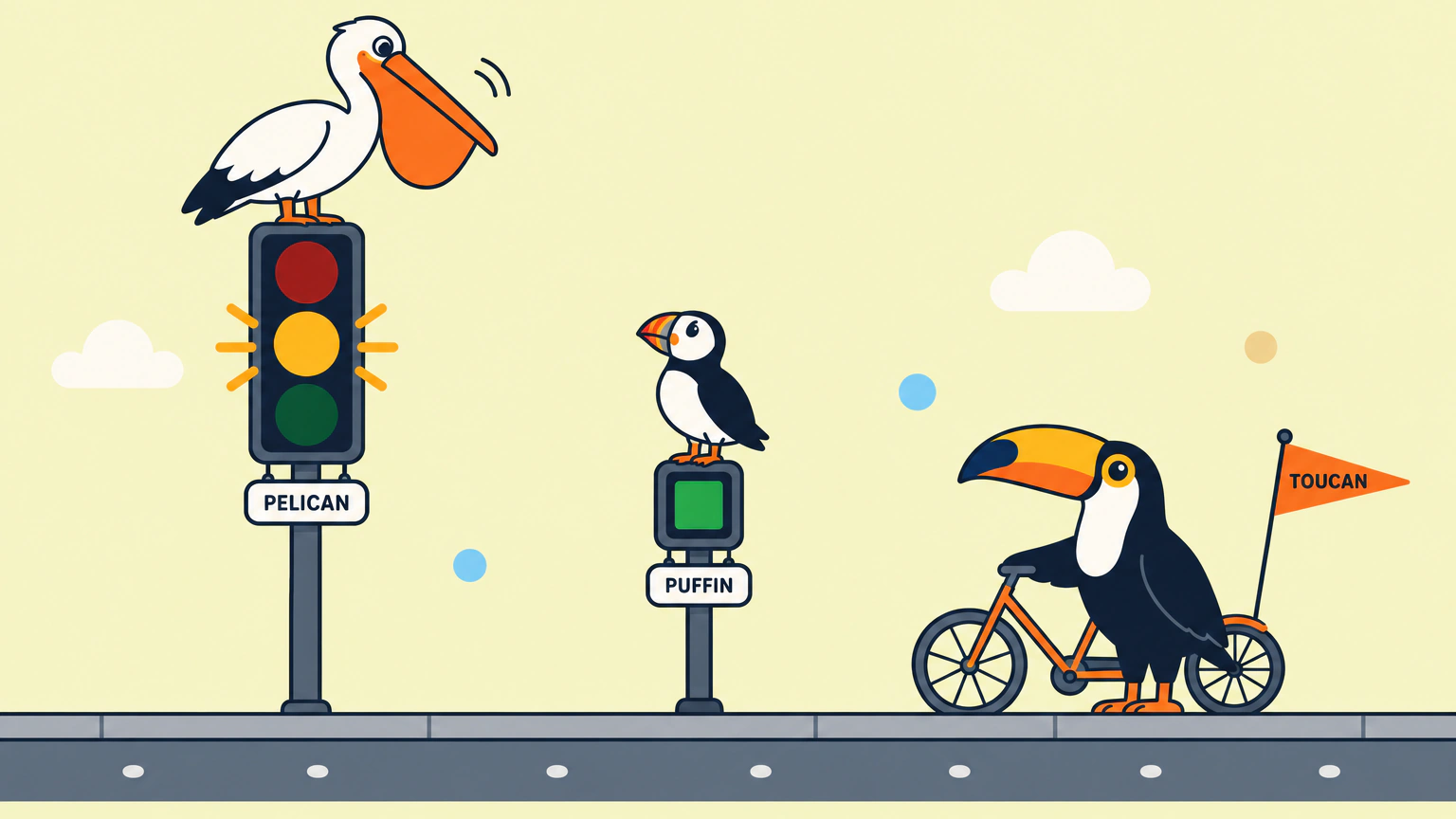
A pelican crossing is a push-button light crossing where a flashing amber follows the red. While it flashes, you must give way to anyone still on the crossing, and you can go only once it's clear. Great Britain stopped allowing new pelican crossings in October 2016, so the ones left are slowly being replaced by newer crossings such as the puffin, which runs like ordinary traffic lights and has no flashing amber at all.
On this page
- What a pelican crossing is, and how you spot one
- Are pelican crossings being phased out?
- Pelican, puffin, toucan or zebra: what each one asks of you
- Must or should: where the law starts at a zebra crossing
- What a crossing mistake can cost you
- How examiners mark crossings on your driving test
- Common questions
What a pelican crossing is, and how you spot one
A pelican is a light crossing that people on foot control. They press a button, and traffic gets a red light. Their red and green figures sit on the far side of the road, facing them, which is the quickest way to tell a pelican from a puffin. The green figure flashes just before it goes out, telling anyone on the kerb not to start.
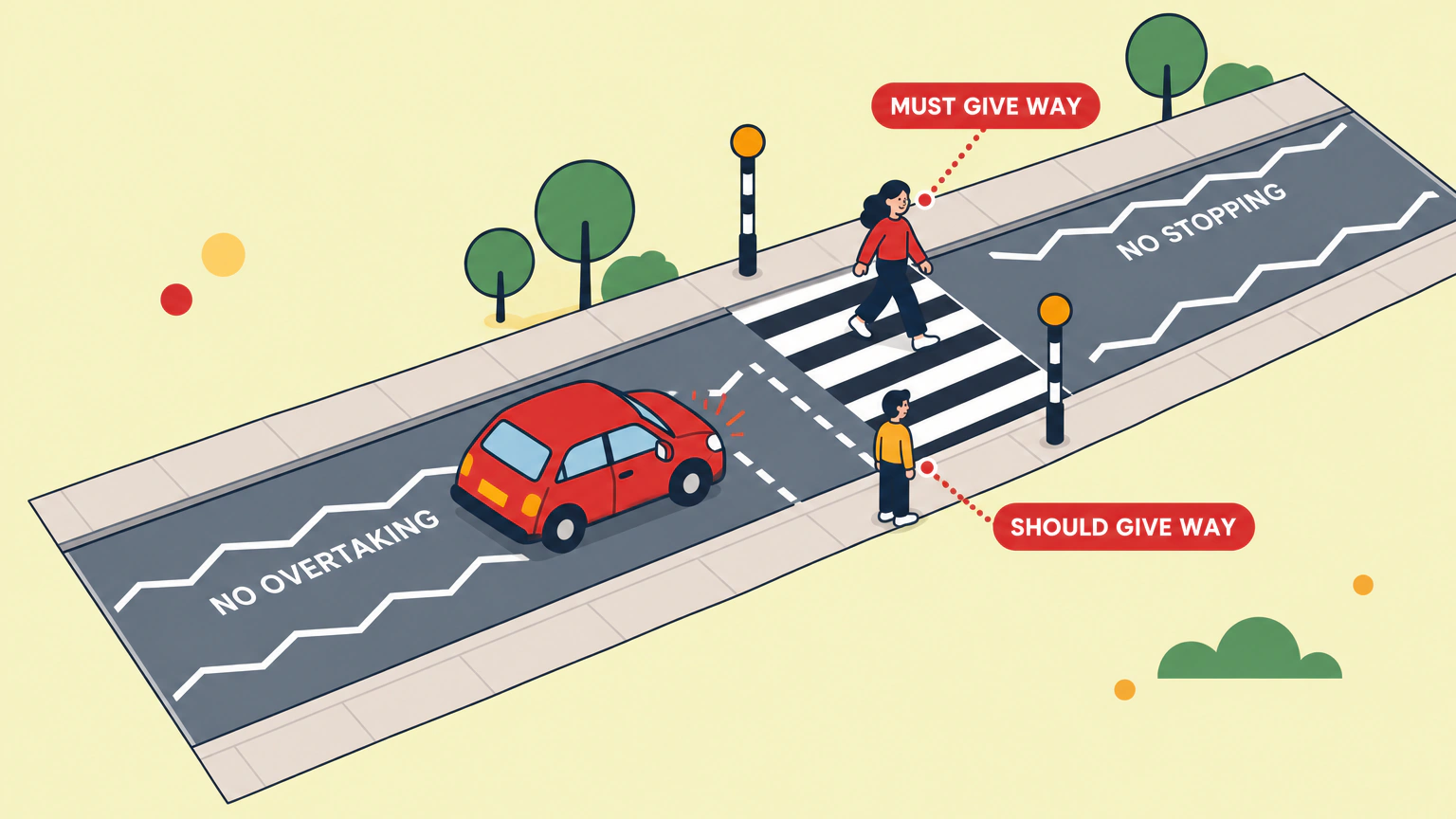
From the driver's seat, a pelican crossing's light sequence runs green, amber, red, flashing amber, then green again. Zig-zag lines mark the approach, and on them you can't park or overtake the vehicle nearest the crossing. A pelican that runs straight across the road is one crossing, even with an island in the middle. A staggered one, where the halves don't line up, is two. Cyclists are asked to wheel their bikes across.
The name is a squashed-up "pedestrian light controlled".
What the flashing amber asks of you
This is what makes a pelican a pelican. While the amber flashes, you must give way to anyone already on the crossing, including someone on the middle island of a straight-across pelican (a staggered one's island doesn't count). If it's empty, you may go on with caution. Don't edge forward or rev at someone still crossing. And if anyone's still on it when your light turns green, let them finish.
The trap runs the other way too. Waiting at an empty crossing on a flashing amber is what DVSA's examiner guidance calls undue hesitation: "being over-cautious by stopping or waiting when it is safe and normal to proceed". So make the rule a reflex. Flashing and empty, go. Flashing with anyone on it, wait.
Are pelican crossings being phased out?
Yes, slowly. New traffic sign rules for England, Scotland and Wales took effect on 22 April 2016, and the Department for Transport's guidance is blunt: "Pelican crossings are no longer prescribed." Sites already being built got six months' grace, and from 22 October 2016 no new pelicans could go in. Existing ones "can stay in place until the equipment becomes life-expired", and they still run under the old 1997 crossing rules. Road authorities have long been choosing more modern crossings, so the numbers keep falling.
One caution. Far-side figures alone don't prove it's a pelican, because the 2016 rules still allow a far-side crossing that runs like junction lights, with a steady amber instead. You'll meet pelicans for years yet, so learn the flashing amber.
Pelican, puffin, toucan or zebra: what each one asks of you
These are easiest to learn in look-alike pairs: pelican and puffin, zebra and parallel. Here are all six side by side: who crosses, how you'll spot each one and what you have to do.
| Crossing | Who crosses | How you'll recognise it | What you have to do |
|---|---|---|---|
| Pelican | People on foot. Cyclists walk their bikes across. | Push-button lights, with the red and green figures on the far side of the road | Stop on red. On flashing amber, give way to anyone still crossing, then go if it's clear |
| Puffin | People on foot. Cyclists walk their bikes across. | Push-button lights, with the red and green figures above the button on the near side | Treat it like ordinary traffic lights. There's no flashing amber, so wait for green |
| Toucan | People on foot, and cyclists, who can ride across | Push-button lights showing a green cycle symbol with the green figure | Treat it like ordinary traffic lights, and look out for bikes as well as people |
| Equestrian | Horse riders | A wider light crossing with horse-and-rider figures and a higher push button | Treat it like ordinary traffic lights, and don't go onto it unless you can clear it |
| Zebra | People on foot. Cyclists walk their bikes across. | Black and white stripes, flashing amber beacons and zig-zag lines | Give way to anyone on the stripes. You should also give way to people waiting |
| Parallel | People on foot, and cyclists on the cycle lane beside the stripes | Zebra stripes with a cycle lane alongside, plus beacons and zig-zags | Give way to anyone on it, walking or cycling. You should also give way to anyone waiting |
Puffin crossings, where the lights wait for slow walkers
A puffin has no flashing amber. It runs like ordinary traffic lights, red then red and amber together, so you don't move off until green. The person crossing sees red and green figures above the button on their own side of the road, with no flashing green figure.
The clever part is the sensors above the lights. Safe Driving for Life, DVSA's official publisher, explains that they can cancel the request if someone presses the button and walks off. They can also give a slow walker more time, up to a set maximum. So when a puffin's red seems to last forever, that's the crossing doing its job.
Toucan and equestrian crossings, built for bikes and horses
A toucan lets people on foot and on bikes cross together, and cyclists can ride straight over rather than walk. It's push-button, and its lights run the ordinary traffic-light sequence, with no flashing amber. If the theory test asks who may use a toucan crossing, the answer is pedestrians and cyclists.
An equestrian crossing is for horse riders. It has pavement barriers, a wider crossing space, horse-and-rider figures in the lights and a push button set higher up for someone in the saddle. Cyclists shouldn't ride across one. At puffin, toucan and equestrian crossings, if the signals aren't working, go on with extreme caution, and don't pull onto the crossing unless you can clear it.
Zebra and parallel crossings, where the stripes do the work
No lights here, so the rule has to do everything. You'll know a zebra by its flashing amber beacons, called Belisha beacons after Leslie Hore-Belisha, the politician who introduced them to crossings in 1934. Then there are the black and white stripes, the zig-zags, and a broken give-way line that you stop behind.
A zebra with an island in the middle is two separate crossings, so each half is judged on its own. A parallel crossing, a type added in 2016, is a zebra with a cycle lane marked alongside the stripes. It has its own zig-zags and beacons. Cyclists should walk their bikes across a zebra, but at a parallel crossing they ride over on the cycle lane.
At a zebra, everything hinges on one word.
Must or should: where the law starts at a zebra crossing
If someone is on the crossing before any part of your car has entered it, you must give way. The traffic sign regulations say "the driver must accord such precedence", and failing to is an offence.
Someone waiting on the kerb is a different case. Since 29 January 2022, the Highway Code has said "you should give way to pedestrians waiting to cross". Before that, it only asked you to be ready to slow down or stop. A should isn't an offence in itself, but the Code "may be used in evidence in any court proceedings under the Traffic Acts ... to establish liability".
Three of the best-known driving guides blur this both ways. Some say you must stop for people waiting, when that's only advice. Others call the duty to someone already on the stripes a should, when it's the law.
In practice, slow early and stop for anyone waiting. It costs you seconds, and we'd do it every time. Don't wave, flash or sound the horn to invite them over, because another driver may not be stopping. And never stop on the stripes in a queue.
Wales and Northern Ireland do a few things differently
Since 11 March 2026, a Welsh zebra across a side road can go without zig-zags or beacons, as long as both roads have a limit of 20 mph or less and the crossing sits within 5 metres of the junction markings. It's still a zebra, so the precedence rule holds, and a driver waiting to turn onto the main road may stop on it. If you're learning in Wales, driving instructors in Cardiff will know where these are on local routes.
Northern Ireland has its own Highway Code. Its zebra rule still reads "look out for people waiting to cross and be ready to slow down or stop to let them cross", with the same must once someone is on the crossing. It has no parallel-crossing paragraph, and GOV.UK notes that endorsement codes and processes differ there too. If you're learning there, driving instructors in Belfast will teach you the local version.
What a crossing mistake can cost you
In Great Britain, breaking crossing regulations or ignoring crossing signals is a criminal offence. That means 3 penalty points, a court fine of up to £1,000 and a possible ban. PC10, PC20 and PC30 cover crossing-regulation offences and stay on your record for 4 years from the offence. Stopping on the zig-zags can be settled without going to court. Police can offer a £100 fixed penalty with 3 points, and a council that enforces parking can send its own penalty charge instead. Not stopping for a school crossing patrol's sign is 3 points too, logged as TS60.
| The mistake | Where the rule sits | Points | If it goes to court |
|---|---|---|---|
| Not giving way to someone already on a zebra or parallel crossing | Highway Code rule 195. Zebra crossings: section 25(5) of the Road Traffic Regulation Act 1984. Parallel crossings: section 36 of the Road Traffic Act 1988 | 3 | A fine of up to £1,000, and a ban is possible |
| Moving off on a flashing amber while someone is still on a pelican | Highway Code rule 196, and reg 26 of the 1997 crossing regulations, which still cover pelicans | 3 | A fine of up to £1,000, and a ban is possible |
| Going through a red light at any light-controlled crossing | Highway Code rules 196 and 199 | 3 | A fine of up to £1,000, and a ban is possible |
| Overtaking the nearest moving motor vehicle, or the nearest vehicle stopped for the crossing, on the zig-zags | Highway Code rule 191, section 25(5) of the Road Traffic Regulation Act 1984, and section 36 of the Road Traffic Act 1988 | 3 | A fine of up to £1,000, and a ban is possible |
| Stopping or parking on the crossing or its zig-zags | Highway Code rules 191 and 240, section 25(5) of the Road Traffic Regulation Act 1984, and section 36 of the Road Traffic Act 1988 | 3 | A fine of up to £1,000. Police can offer a £100 fixed penalty instead, and a council may send its own penalty charge |
| Not stopping when a school crossing patrol shows its stop sign | Highway Code rule 210, and section 28 of the Road Traffic Regulation Act 1984 | 3 | A fine of up to £1,000. In England and Wales, police can offer a £100 fixed penalty instead |
In every row, a conviction or a police fixed penalty puts 3 points on your licence if you were driving a motor vehicle, and a court can ban you as well. A council penalty charge for stopping on the zig-zags carries no points.
We're explaining the rules, not advising on a charge. If you've had a notice, what it says and a solicitor's advice count for more than any guide.
Why it matters more when you've just passed
Points don't wipe clean when you pass. Any points on your provisional licence that haven't expired carry over to your full licence. Then, if you reach 6 or more within two years of passing, your licence is cancelled. Two crossing offences make 6. Getting back on the road means applying for a new provisional licence and passing the test again. The Highway Code is clear that this still applies if you paid for the offences by fixed penalty. Our provisional licence guide covers the six points that can take a new licence away and what starting again involves.
How examiners mark crossings on your driving test
DVSA's examiner guidance gives crossings their own fault heading, with two definitions: "failure to give precedence to pedestrians on a pedestrian crossing" and "non-compliance with lights at pedestrian controlled crossings". It also expects a candidate to be "fully aware of their responsibilities at pedestrian crossings". You pass with no more than 15 driving faults and no serious or dangerous ones, and our guide to how the practical test is marked covers the rest.
Now some reassurance with a number on it. In DVSA's yearly list of the ten most common test faults, crossings haven't appeared once from 2007/08 to 2025/26, while traffic lights came fourth in 2025/26.
Two habits help. Stop for someone waiting without waving them over. And at roadworks, if temporary lights run traffic one way at a time past a zebra, stopping for someone who's only waiting can strand you as the lights change. Where the crossing has been given temporary signals of its own, follow those.
Seven habits to practise at every crossing
- Spot the crossing early by its beacons, zig-zags or push-button lights.
- Check your mirrors well before you slow down.
- Stop at the give-way line or stop line, never on the stripes or between the studs.
- Don't wave, flash your lights or sound your horn to invite anyone across.
- On a flashing amber, look along the whole crossing, past the island if it runs straight across, before you move.
- If traffic ahead is queuing, wait short of the crossing until you can clear it.
- When your light turns green, let anyone still crossing finish.
These stick best with practice on real roads. We list driving instructors near you who know your local routes, and it's worth a minute to check your instructor is registered with DVSA before you book.
Common questions
Quick answers for revision nights and practice drives.
Do you have to stop at a zebra crossing if someone is waiting?
You should, but the legal must starts a step later. The Highway Code says to give way to people waiting, and that you must once they've moved onto the crossing. In law, the duty begins when they're on the road within the crossing before any part of your car is. Don't wave them across. Northern Ireland's Code asks you to be ready to slow down or stop instead.
Is it illegal not to stop at a zebra crossing?
It's illegal not to give way to someone already on the crossing. That's an offence carrying 3 penalty points, a fine of up to £1,000 and a possible ban. Driving past someone still waiting on the kerb isn't an offence in itself. But a court can use the Highway Code as evidence when deciding who was at fault.
What's the difference between a pelican and a puffin crossing?
A pelican has a flashing amber after the red, when you may go if the crossing is clear. A puffin runs like ordinary traffic lights, so you wait for green. A pelican's figures sit on the far side of the road, and the green one flashes before turning red. A puffin's sit above the button on the near side, and sensors can hold the red for slow walkers. No new pelicans have been allowed in Great Britain since 22 October 2016.
Who can use a toucan crossing?
Pedestrians and cyclists can use it together, and cyclists may ride across. That's what sets it apart from pelican, puffin and zebra crossings, where cyclists should get off and wheel their bikes over. Horse riders have equestrian crossings of their own, with higher push buttons and horse-and-rider figures, and cyclists shouldn't ride across those.
Can you park or stop on zig-zag lines?
No, outside a few set exceptions. On the stripes, these include being stuck, avoiding injury or damage, and turning onto the main road at a qualifying Welsh side-road zebra. On the zig-zags, they include giving way, obeying lights or authorised directions, and being forced to stop. At zebras, puffins and parallel crossings, turning is also allowed. A Blue Badge doesn't exempt you. Police can offer a £100 fixed penalty with 3 points, or the council may send a penalty charge. School keep clear markings are a separate rule.
Can you overtake on the zig-zags before a crossing?
Not the vehicle nearest the crossing. On the approach zig-zags, the offence covers passing the motor vehicle nearest the crossing, or the vehicle that's stopped to let someone cross. The Highway Code goes further and says not to overtake "on the approach to crossing facilities" at all. That includes passing a cyclist on the zig-zags, and we'd follow the Code.
Is a zebra crossing with an island one crossing or two?
Two. A zebra with a central island counts as two separate crossings, so each half has its own give-way duty. Pelicans work differently. A pelican that runs straight across is one crossing even with an island, so on a flashing amber you wait for people coming from the far side too. A staggered pelican or puffin, where the halves don't line up, is two.