

On this page
The check that takes ninety seconds
The car pulls up, you get in, and the lesson has started before you've had a chance to think. Underneath the small talk sits a question most learners never ask out loud, because asking it feels rude. Is this person actually allowed to charge me for this?
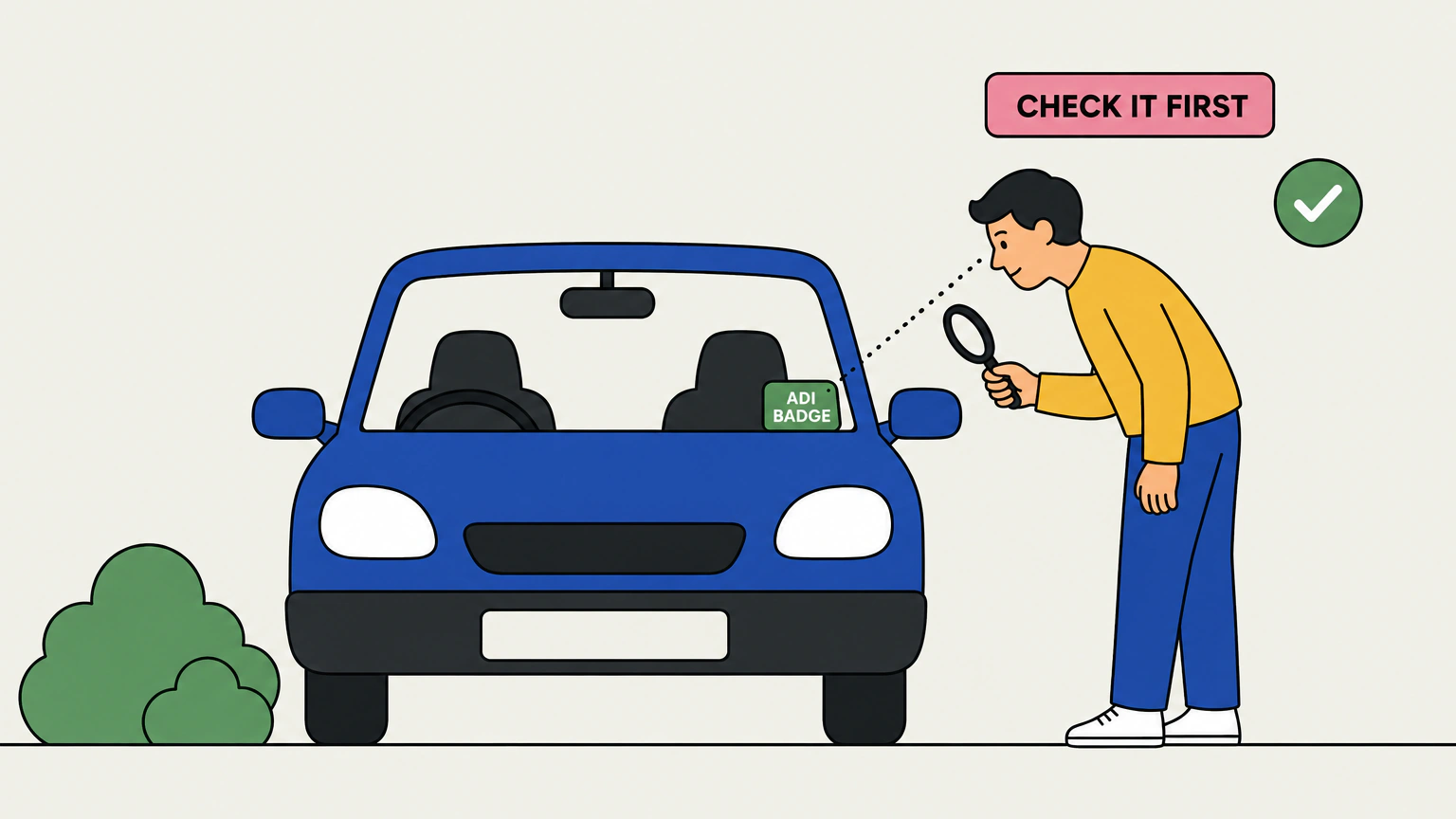
Before your first paid lesson, look at the edge of the windscreen nearest the kerb. A green badge means your instructor's name is on the DVSA register. A pink one means they hold a trainee licence that can last up to six months and are still qualifying. No badge at all means you should not pay until DVSA confirms who they are and the badge is displayed.
Three things, in that order. Is there a badge? What colour is it? Can you read its certificate or licence number? You can do all of it from the pavement, before you've handed over a penny, and almost nobody ever does.
Each colour means something specific. The government runs a service that will confirm a name, and there's a clear route if the badge isn't there at all.
Green badge, pink badge: what each one actually means
In England, Scotland and Wales, nobody may take money for teaching you to drive a car unless their name is in the DVSA register of approved driving instructors, or they hold a trainee licence. That's section 123 of the Road Traffic Act 1988, and it's blunt about what counts as paying. The words are "money or money's worth", so money for fuel counts too.
The badge is how that becomes visible from the kerb. Section 123 says the certificate or licence has to be fixed to the car and on display, and the 2005 Regulations pin down exactly where. It goes immediately behind the front windscreen, on the nearside edge, with the details on the front clearly visible in daylight from outside the car. The law puts that side where you can read it.
| What you can see | What it means | What they can be paid for |
|---|---|---|
| Green badge | Their name is in the DVSA register of approved driving instructors | Car driving lessons, on their own |
| Pink badge | They hold a trainee driving instructor licence, valid for up to six months | Car driving lessons, under the conditions attached to that licence |
| No badge, or a school sticker on its own | The required certificate or licence is not being displayed. A school logo is not proof of registration | Do not pay until DVSA confirms the instructor is registered or licensed and the badge is displayed |
Source: Road Traffic Act 1988, s.123; Motor Cars (Driving Instruction) Regulations 2005.
A green badge is the visible end of a longer process. DVSA runs an enhanced criminal record check when an instructor applies and again at every renewal, and the ADI Registrar decides whether they are a "fit and proper" person. Registration lasts four years. We've written separately about the criminal record check behind that badge, if you want to know what it turns up.
What a pink badge holder has already passed
A pink badge isn't a red flag. It's a stage.
There are three qualifying tests. Part 1 is the instructor theory test, with unlimited attempts. Part 2 is the driving ability test, and a trainee licence only becomes available once that's passed, so a pink badge holder has already proved they can drive to instructor standard. What's outstanding is part 3, the test of instructional ability, and they get three attempts at it.
The licence runs six months from the day it's granted, or ends the day after a third failure at part 3, whichever comes first. Don't read anything into the price, though. Instructors set their own prices, with no minimum or maximum.
The supervision rule most learners never hear about
Trainees teach under conditions, and there are two versions. The default, in regulation 15, is direct supervision: for one fifth of the total time they spend giving paid instruction, an approved instructor has to be in the car with them, and a signed record is kept for every working day.
They choose the alternative in writing when they apply. Instead of supervision they take at least 20 hours of supplementary training from an approved instructor, plus another 5 hours if they haven't passed part 3 at the first attempt or within three months.
So one route requires a second person in the car for one fifth of the trainee's total paid-instruction time, and the other does not require that supervision. Ask which one your instructor took. It's a fair question with a short answer.
Look them up on the DVSA service
GOV.UK runs a service for finding driving schools, lessons and instructors. It lists instructors approved by DVSA, and it shows a grade, in the government's own words, "if they declare it". You need a name and a couple of minutes.
We should be straight about our own part in this. Our listings and reviews tell you what other learners made of an instructor, and our checks cover business history, reputation and licensing. That's what our listings check, and what they don't. None of it is the DVSA register, which is a check you run yourself, and we'd rather teach it than let you assume we've done it for you. If you'd like to know who's telling you that, who we are is a short page.
Why a good instructor might not be on the list
The trap is one line on GOV.UK that most readers skim straight past: "Approved driving instructors (ADIs) choose whether or not to be on this service, so not all ADIs will be listed."
A blank result isn't evidence that they're unregistered. Not every ADI opts in. Absence isn't proof, and treating it as proof turns a fair check into an unfair accusation.
When someone isn't listed, ring DVSA instead, on 0300 200 1122, Monday to Friday, 8am to 5pm. Have their name ready, and their ADI number if you got it.
Before you hand over any money
- Look for the badge in the windscreen before the first lesson starts, on the edge nearest the kerb.
- Read the front of it from the pavement. The law says that side has to be legible from outside the car.
- Write down the certificate or licence number shown on the front.
- Search the name on the GOV.UK service for finding driving schools, lessons and instructors.
- If they're not listed, ring DVSA on 0300 200 1122 with the name and the ADI number.
- Ask what grade they got at their last standards check, and roughly when it was.
Work through those six and you're done. The next question, once the person checks out, is how many lessons you are likely to need, where the real cost of learning to drive sits.
The grade almost nobody asks for
Every approved instructor gets watched at work. A DVSA examiner sits in on a real lesson with a real pupil for about 45 minutes, scoring 17 areas of competence from 0 to 3 under three headings: lesson planning, risk management, and teaching and learning skills. It's called a standards check. It usually comes round every four years, and pupils' driving test results can bring one forward.
| Total score | Grade | What it means |
|---|---|---|
| 43 to 51 | Grade A | A high standard of instruction. They stay on the register |
| 31 to 42 | Grade B | A satisfactory standard of instruction. They stay on the register |
| 0 to 30 | Fail | Unsatisfactory. Three fails and they come off the register |
The grade isn't a secret, either. GOV.UK's guidance tells learners, "You can ask your instructor what their grade is." Some publish it on the finder service or their own website. If yours doesn't, ask.
What Grade A and Grade B mean, and what a fail costs
Both grades keep an instructor on the register, so a B isn't a warning. It means DVSA watched them teach and called the standard satisfactory. At March 2026, 7,625 instructors held a Grade A against 20,578 holding a B, so a little over a quarter of those carrying a current grade have the top one. Another 15,474 sit under "Unknown", which DVSA defines as cancellations, failures to attend and results still awaited.
A fail works differently. It's automatic if the risk management score is 7 or less, or if the examiner stops the lesson because someone was put in danger. Two more attempts follow. Fail three times and the instructor comes off the register and has to sit the qualifying tests again.
Pro tip: Text them one line before the first lesson: what is your ADI number? If they won't give it to you, don't pay until DVSA confirms who they are.
How many trainees are teaching near you
At March 2026 there were 44,429 approved driving instructors and 5,742 trainee licence holders in Great Britain. So roughly one in nine of the people who can legally charge you for a car lesson is still working towards the teaching test.
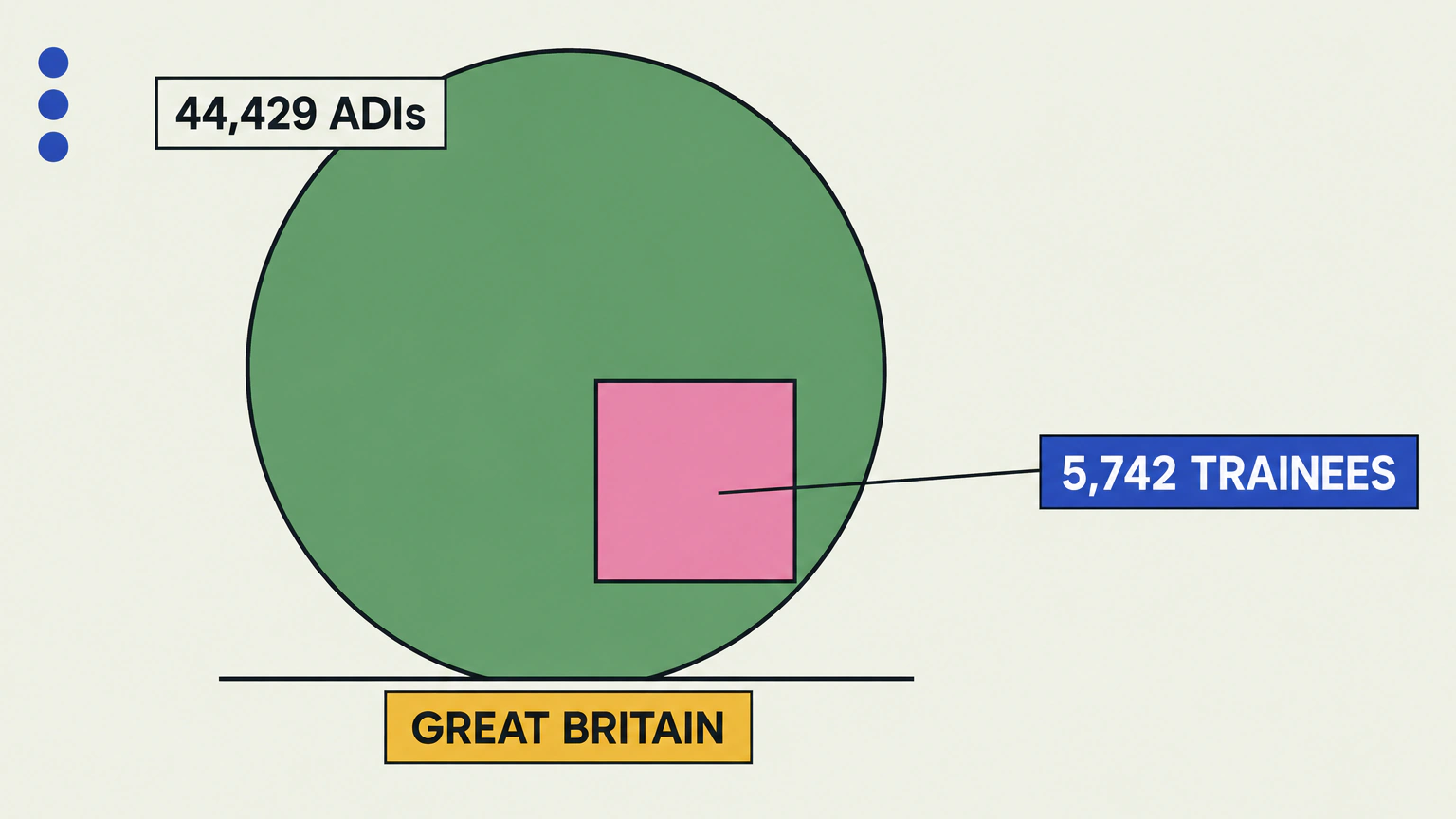
The share moves a lot by area. DVSA publishes the figures by postcode area, and these six are the three highest in the country alongside three from the bottom of the same list, among areas with at least 250 badge holders. They show the spread, not the typical case.
| Postcode area | Approved instructors | Trainee licences | Trainees as a share |
|---|---|---|---|
| BL | 345 | 108 | 23.8% |
| M | 796 | 226 | 22.1% |
| OL | 425 | 92 | 17.8% |
| HA | 473 | 33 | 6.5% |
| CO | 375 | 26 | 6.5% |
| IP | 418 | 24 | 5.4% |
| Great Britain | 44,429 | 5,742 | 11.4% |
Two things about those numbers. DVSA doesn't say whether a postcode area is where an instructor lives or where they teach, so take each row as instructors registered in that area. And the six come from 126 areas, whose own rows total 44,428 against the file's grand total of 44,429.
A base rate can't tell you anything about your own instructor. Bolton having a lot of trainees doesn't make yours one, and Ipswich having few doesn't make yours qualified. The number explains why the badge is worth a glance. It's no substitute for glancing.
If there is no badge at all
Sometimes there's nothing there. Sometimes there's a school logo on the door and nothing on the glass, which proves only that somebody owns a sticker. And sometimes there's a badge that has run out, which the law treats the same as no badge: a certificate or licence that has expired, or been cancelled, revoked or suspended, isn't a current one.
Two separate offences sit behind that empty windscreen. Teaching for money without being registered or licensed is one, and a driving school that employs the instructor can be guilty too. Failing to display the badge while teaching is an offence in its own right, even for someone genuinely on the register.
Red flag: Four things that should stop you booking. - The badge is face down, in the glovebox, or at home being renewed. - They tell you the register is private and DVSA won't confirm anything. - They want cash for ten lessons up front, before you've seen any badge. - The car carries a driving school livery and no badge at all.
If any of those turn up, don't get in the car, and don't feel awkward about it. Start again with driving schools and instructors near you and run the ninety-second check on the next one. This is general guidance rather than advice about your own case, so if real money is already at stake, take it to Citizens Advice or to your card provider.
Reporting an instructor who is not registered
DVSA has an intelligence unit for exactly this. Email [email protected] or ring 0800 030 4103, Monday to Friday, 8am to 5pm. Send what you have: the name they trade under, the car and its registration, where and when the lessons happened, and anything they advertised.
Your money is a separate question. If you paid for a block by card and the lessons were not provided, ask the card provider whether chargeback or Section 75 applies. If that does not recover the money, Citizens Advice can explain your other options, including a court claim. There's a second reason to bother. When the ADI Registrar weighs up whether someone is fit and proper, they take account of "successful applications to a court or bank to reclaim money that had been paid for driving lessons that were not provided or refunded". Where a registered instructor simply cancels on you, the question changes to what you can be charged when a lesson is cancelled.
Northern Ireland runs its own register
None of that works in Belfast, because Northern Ireland runs its own system. Instructors there register with the Driver and Vehicle Agency rather than DVSA. nidirect tells learners to ask to see the licence, which an instructor should carry at all times and may display on the windscreen.
The trainee arrangement is similar in spirit. A potential driving instructor gets a trainee licence to instruct under an approved instructor's supervision. To qualify at all, an instructor must have held a full driving licence for at least four years. DVA runs its own find service, and it's opt in there too. To report unregistered instruction, write to DVA's Business Support Unit with your evidence, such as a copy of a business card or an advert. DVA investigates every case and refers matters to the PSNI where it needs to.
Frequently asked questions
Do driving instructors have to be registered?
Yes, if they're charging you. In England, Scotland and Wales nobody may give paid instruction in driving a car unless their name is in the DVSA register or they hold a trainee licence. That's section 123 of the Road Traffic Act 1988. Northern Ireland works the same way under its own register, run by the Driver and Vehicle Agency.
Can a trainee driving instructor charge for lessons?
Yes. A trainee licence is a real licence to give paid instruction and can last up to six months. The pink badge is how you know they've got one. Conditions come with it. Either an approved instructor supervises the trainee in person for one fifth of their total paid-instruction time, or the trainee takes at least 20 hours of extra training instead.
What is an ADI number, and where do I find it?
It's the personal reference number DVSA uses for an instructor, and it appears on an ADI badge. The quickest way to get it is to ask, by text if that's easier than face to face. You'll want it if you contact DVSA, because its check service asks for the instructor's name and ADI number if you have it.
Can you pass your driving test with a trainee instructor?
Yes. Nothing about the test depends on your instructor's badge colour, and a trainee has already passed the instructor driving ability test. They're working towards the teaching one. What's worth asking is which condition their licence carries, because the supervised route requires an approved instructor to be present for one fifth of the trainee's total paid-instruction time.
Who do I complain to about a driving instructor?
It depends what went wrong. Someone teaching for money without being registered goes to DVSA's intelligence unit, on 0800 030 4103 or [email protected]. A complaint about a registered instructor's conduct also goes to DVSA, and feeds the Registrar's view of whether they're fit and proper. For money you've lost, ask your card provider whether it can recover a card payment, and ask Citizens Advice about your other options.
Can a friend give me driving lessons for money?
No. Paid instruction means registered instruction, and the law counts "money or money's worth", so money for fuel is still payment. A friend can supervise your practice for free if they're 21 or over, can drive the same category of vehicle, and have held a full licence for it for at least three years.