

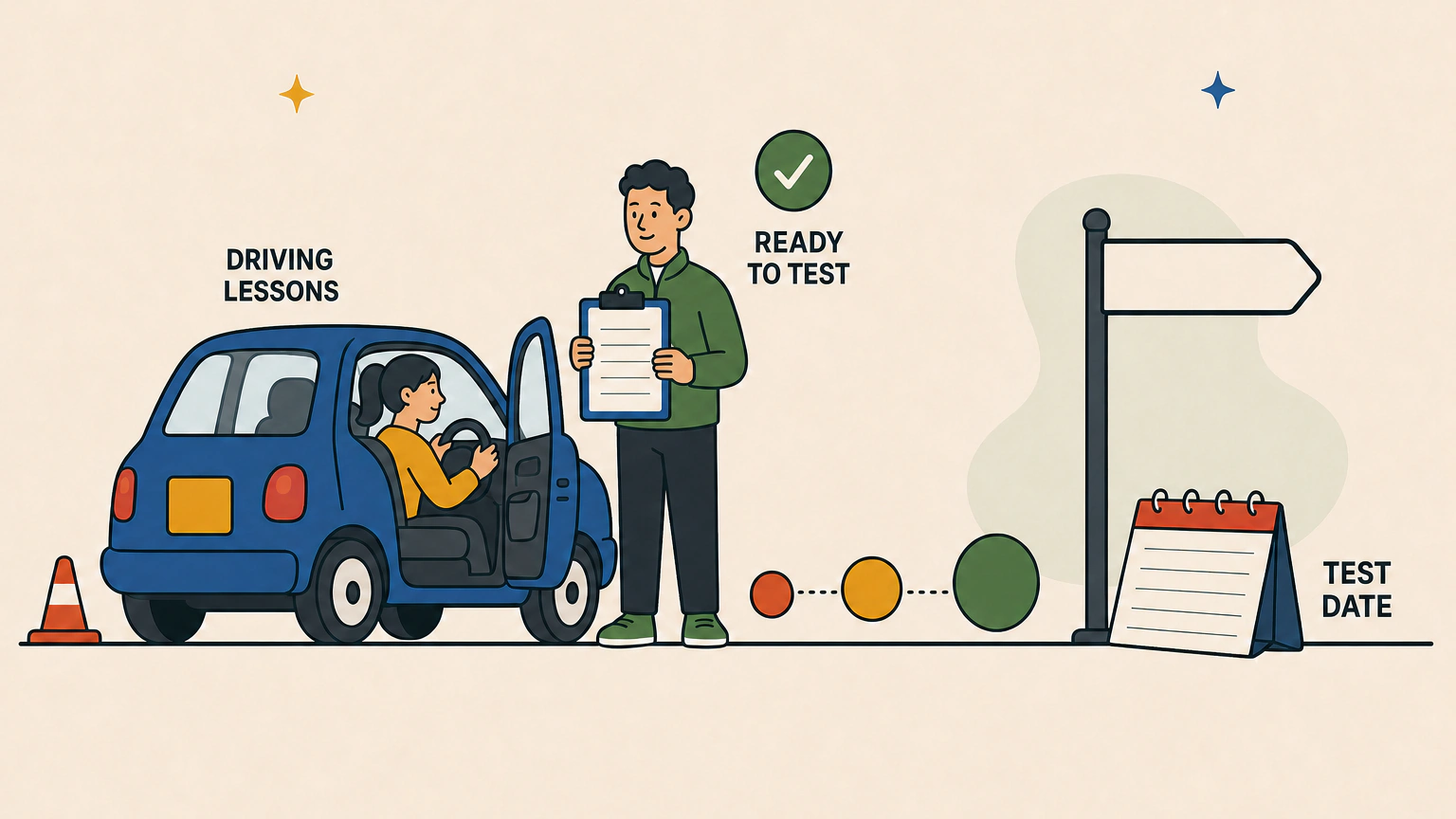
The government's data is worth more than a number anyway. Half of all car driving tests in Great Britain are failed, and the pass rate barely improves on a retake. So the expensive mistake isn't booking too few lessons. It's booking the test before you're ready.
On this page
- The short answer: nobody can tell you a number, and DVSA does not try
- What the test data actually says about "enough"
- The five checks that decide whether you are ready
- What driving lessons actually cost in 2026
- The 2026 booking rules changed how you have to plan
- How long you will really wait for a test where you live
- What published evidence can tell you about lesson planning
- Choosing an instructor who will not stretch it out
- Frequently asked questions
The short answer: nobody can tell you a number, and DVSA does not try
Readiness is a standard, not a duration. Two learners with the same instructor can reach it at very different times.
What GOV.UK actually says
GOV.UK says it twice. On learning to drive: "There's no minimum number of lessons you must have or hours you must practise driving." On the driving test: "There's no minimum number of lessons you must have done before you book and take your test."
You're measured against the national standard for driving cars instead, and it's blunt: "only take your test when you can do everything without instruction". DVSA breaks that standard into 27 driving skills and calls you ready at level 5 on all 27.
Where the "45 hours" figure comes from — and what it is not
Search this question and you'll be told, page after page, that it takes 45 hours of lessons plus 22 hours of private practice, with DVSA's name attached. That pairing doesn't appear in either GOV.UK guide, or anywhere on the Ready to Pass? site. We went looking.
Older official research provides a related benchmark. A January 2010 Driving Standards Agency report reaches back to the Cohort II study of 2008: learners averaged 47 hours of formal tuition and 20 hours of practice with family and friends before passing. Then it adds the part nobody repeats. The informal-practice hours, and the months spent learning, "were not found to be predictive of passing the practical test".
What the test data actually says about "enough"
Your number is unknowable. What happens to everyone else who turns up is not: DVSA publishes the outcome of every car practical test in Great Britain.
Half of all tests are failed, and that is now the best it has ever been
In the year to March 2026, Great Britain conducted 1,998,621 car practical tests and passed 1,000,043 people. That's a 50.0% pass rate, and it is the highest in a series running back to 2007-08, when it was 44.2%.
Turn up and your odds are a coin. Only 50,787 passes came with zero driving faults, 2.5% of tests taken.
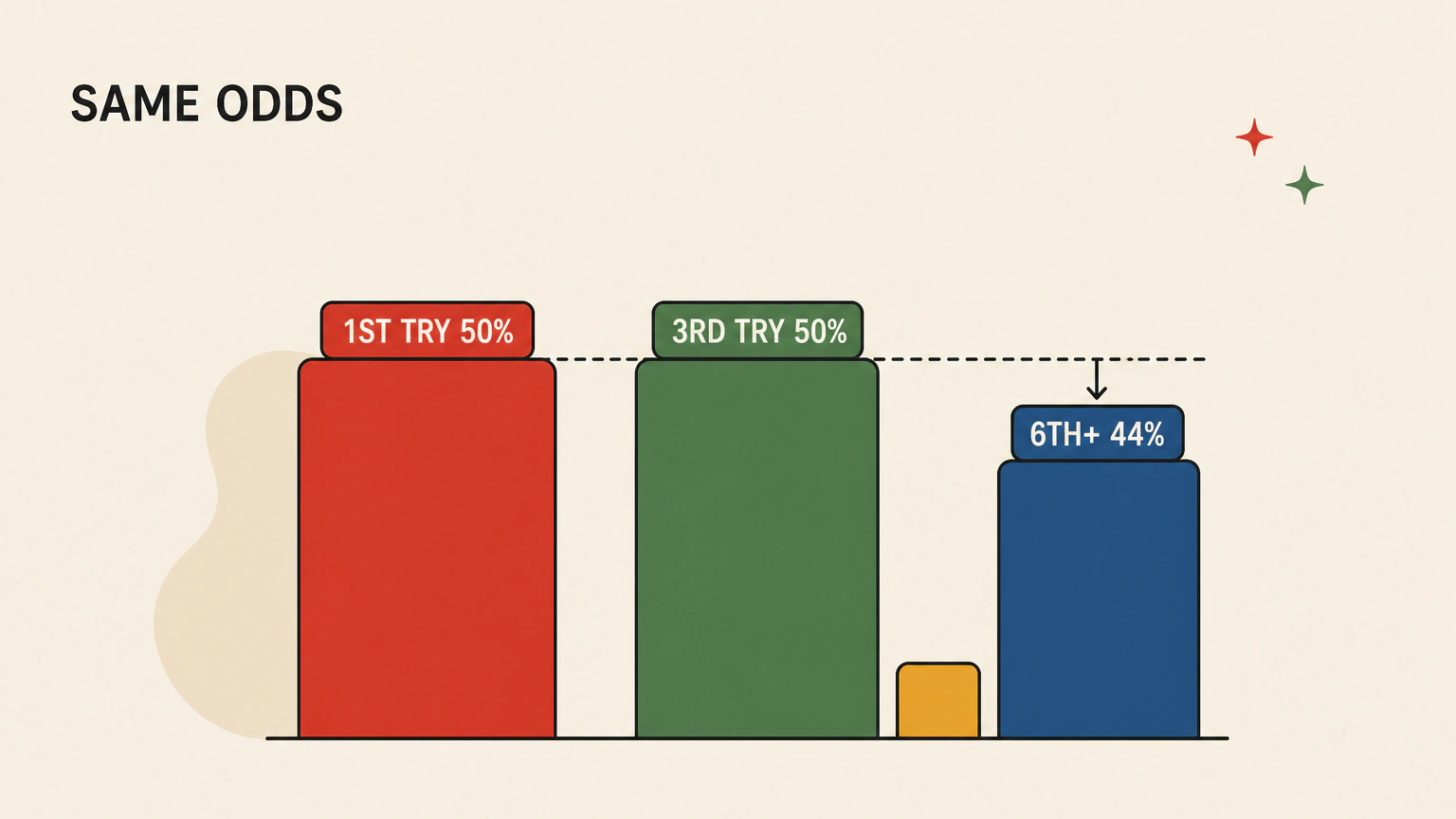
Retaking the test does not make it easier
| Attempt | Tests conducted | Tests passed | Pass rate |
|---|---|---|---|
| 1st attempt | 984,415 | 497,361 | 50.5% |
| 2nd attempt | 495,742 | 252,013 | 50.8% |
| 3rd attempt | 245,449 | 122,356 | 49.8% |
| 4th attempt | 124,606 | 60,782 | 48.8% |
| 5th attempt | 65,070 | 31,029 | 47.7% |
| 6th or more | 83,339 | 36,502 | 43.8% |
| All tests | 1,998,621 | 1,000,043 | 50.0% |
Source: DVSA table DRT121D, last updated 25 June 2026.
Experience of the test buys you nothing. The rate holds flat across the first three attempts, then slides to 43.8% by the sixth. Whatever was missing on the day is still missing next time, unless somebody works on it.
Only 984,415 of those tests were first attempts, so more than half of all car tests in Great Britain are retests. Failing doesn't make you unusual. It makes you typical.
Pro tip: Northern Ireland is a different system. If you're learning there, none of these DVSA figures describe your test. Northern Ireland is run by the DVA, with its own booking rules and costs, a 45 mph limit while you learn and R-plates for a year after you pass. nidirect is the page to read, and you can browse Northern Ireland listings for an instructor who works under those rules.
The ten faults that actually fail people
These are the faults DVSA recorded most often in the year to March 2026, in order:
- Junctions: observation
- Mirrors: change of direction
- Junctions: turning right
- Response to signs: traffic lights
- Control: steering
- Moving off: safely
- Response to signs: road markings
- Response to signs: traffic signs
- Positioning: normal driving
- Maintaining progress: speed
Observation at junctions has topped that list every year since 2007-08. It isn't an exotic skill. It's looking properly, at the junction, every time.
If any of these still goes wrong in lessons, you're not ready, whatever your hour count says.
The five checks that decide whether you are ready
DVSA does answer the readiness question. Its Ready to Pass? campaign answers it directly, and without a number.
DVSA's own readiness checklist
You are usually ready when all five are true.
- You need no prompts from your instructor, including in unfamiliar situations.
- You make no serious or dangerous mistakes. If you call them silly mistakes, they are not.
- You can pass mock tests, repeatedly, not once on a good day.
- You have practised managing your nerves, before test day.
- Your instructor agrees you are ready. If they say no, listen.
Not one of them is an hour count. DVSA also publishes an official driver's record on GOV.UK that scores you against all 27 skills, so ask your instructor to keep yours up to date.
The mock test is the cheapest thing you will buy
An hour with your instructor, run properly as a mock, typically costs £36 to £40. A test you weren't ready for costs £62, and you don't get that back. DVSA draws the comparison itself. We'd put it more bluntly: buy the mock first.
Of the learners who took one, 92% said it helped them prepare, 87% that it raised their confidence and 94% would recommend one. A real mock runs like the test: no prompting, you drive alone.
What driving lessons actually cost in 2026
You can't know your total until you know your readiness. You can know the price of an hour.
What instructors charge, from the government's own survey
| Price for a one-hour lesson | Share of instructors |
|---|---|
| £25 or less | 0.4% |
| £26 to £30 | 2.0% |
| £31 to £35 | 18.2% |
| £36 to £40 | 50.3% |
| £41 to £45 | 22.5% |
| £46 to £50 | 5.0% |
| £51 or more | 1.6% |
Source: DVSA, "Working as a driving instructor survey: 2025 results". 3,342 instructors answered this question, surveyed October 2025, published 25 February 2026; within ±2.2 points; England, Scotland and Wales.
Half the market sits in one band. The distribution has moved, too: 79.4% now charge £36 or more, against 25.7% in October 2022.
The South West has more instructors charging £41 or more than London
Everybody assumes London is where the dear lessons are. The share of instructors charging £41 or more per hour is South West 54.6%, South East 39.3%, Scotland 36.0%, London 25.2% and North East 8.1%.
At the top of the range, that inverts the assumption most people start from. So don't accept a steep quote outside the capital because you've heard prices went up everywhere. Ring two or three instructors and compare.
Building your own budget, and what the listings say
Start with the fees nobody can argue about. A provisional licence is £34 online or £43 by post, the theory test £23, the practical £62 on a weekday or £75 in the evening, at a weekend or on a bank holiday. Everything after that is your hourly rate times an hour count nobody can promise, so budget a range.
Our driving instructors and driver training schools near you page shows a £457 to £651 “fair price range”, based on 775 cost profiles. One warning: the page never says what that range covers. Don't read it as a market average, a course total or an hourly rate.
The 2026 booking rules changed how you have to plan
Ask anyone who passed a few years ago and you'll get the same plan: book early, move the test if you aren't ready. That old strategy is now tightly constrained.
What changed, and when
| Rule | Old rule | New rule | DVSA rollout date |
|---|---|---|---|
| Number of changes allowed | Up to 6 | Only 2 | 31 March 2026 |
| Who can book your test | You or your instructor | Only you | 12 May 2026 |
| Who can manage your test | You or your instructor | Only you | 12 May 2026 |
| Using unofficial services to search for tests | Allowed | Not allowed | 12 May 2026 |
| Where you can move your test | Any test centre | One of the 3 nearest centres, or the centre first booked on that booking | 9 June 2026 |
The statutory instrument about who may apply for a category B practical test came into force on 27 April 2026. DVSA dates its booking-service change to 12 May 2026, which is the date shown in the table. These booking rules apply to car driving tests in England, Scotland and Wales only. Northern Ireland has separate guidance.
Know what burns a change. Moving the date, the time or the test centre each counts as one, and so does swapping with another learner. Change two of those things at once and it still counts as one. Updating your address or your instructor's reference doesn't count at all, and if DVSA moves your test, your allowance resets. Spend both changes and your only route is to cancel and rebook, with the fee back only if you cancel at least 10 full working days ahead.
So when should you book?
Theory first. That certificate lasts 2 years, and if the practical hasn't happened inside that window you sit the theory test again and pay for it again.
Then get your instructor's honest view, check the wait where you live, and book. GOV.UK's instruction is now to "choose a date you realistically expect to be ready by", which is a polite way of saying stop treating the calendar as a strategy. After a fail, the earliest date you can pick is 10 working days away, and you pay the fee again.
Red flag: cancellation-finder apps and social media "slots"
Red flag: Since 12 May 2026, using any app or website that searches for cancellations or moves a test for you breaks the booking service's terms. That includes the ones that only send you a notification. DVSA monitors the service and can restrict your access or cancel your booking. Then there are the scam accounts, which post slots that look real at test centres that are real, move you to WhatsApp, and ask for a driving licence number, a theory certificate number or payment details. Anyone holding your licence number and booking reference can cancel your test.
What to do instead: keep those details off social media entirely. Book and manage the test yourself on GOV.UK. If you need an earlier date, use the official route inside the booking service.
How long you will really wait for a test where you live
Two numbers get quoted, both published by DVSA, both true, and they don't measure the same thing. Quoting the wrong one is how the frightening headlines get made.
Median waits and pass rates by country and region
| Country or region | Median wait, booking to test (weeks) | Weeks to 10%+ availability | Pass rate |
|---|---|---|---|
| Great Britain | 10.7 | 20.9 | 51.5% |
| England | 10.7 | 21.5 | 51.4% |
| Scotland | 14.4 | 21.6 | 51.0% |
| Wales | 7.7 | 13.0 | 54.7% |
| South West | 7.0 | 18.0 | 53.2% |
| Yorkshire and the Humber | 9.1 | 18.3 | 51.7% |
| South East | 9.6 | 21.8 | 54.4% |
| North East | 10.6 | 18.9 | 50.5% |
| East Midlands | 11.0 | 23.0 | 51.5% |
| West Midlands | 11.0 | 23.1 | 46.8% |
| East of England | 11.4 | 23.4 | 54.3% |
| North West | 11.6 | 21.5 | 50.5% |
| London | 15.4 | 23.8 | 49.9% |
Source: DVSA table DRT121G, published 8 July 2026 with data to June 2026. Great Britain only, and the two wait columns measure different things. Figures from April 2025 onward are provisional.
Driving instructors in Wales work in the country with the shortest median wait and the highest pass rate. Anyone learning with driving instructors in Scotland should plan around 14.4 weeks instead, so start the test-date conversation earlier than feels natural.
Why "21 weeks" and "11 weeks" are both true
One of them is "Weeks to 10%+ weekly appointment availability", which asks how far ahead you have to look before a tenth of the weekly slots are still free. For Great Britain in June 2026 that was 20.9 weeks. The other is the wait learners actually had, from booking to sitting: a median of 10.7 weeks.
DVSA notes that many learners book sooner than that, because cancellations open earlier slots. The 20.9 weeks is the availability measure, not the wait most learners get.
What published evidence can tell you about lesson planning
Strip out the folklore and a little real evidence is left. None of it gives you an hour count.
Long gaps between lessons are common
DVSA asked instructors what their pupils were doing. 60.7% reported pupils taking breaks of three weeks or more, up from 51.7% a year earlier, and 56.2% reported pupils wanting lessons less often.
Then it asked why. 94.1% of those answering named high test waiting times, up from 89.2%. The survey links high waits with longer breaks. It does not measure how those breaks affect skill retention or total lesson hours, and neither can we.
Private practice, and the rules that govern it
This is the cheap hour, and it has rules worth reading before a parent takes you out on a Sunday. Whoever supervises your unpaid practice must be over 21 and have held a full licence for that vehicle category for 3 years. Get it wrong and you face up to a £1,000 fine and 6 penalty points.
You also need insurance covering you as a learner in that car. Motorways are out unless you're with an approved driving instructor in a dual-control car, and then only in England, Scotland or Wales. DVSA's position is that learners who combine lessons with private practice "tend to do better in their test and become safer drivers".
Manual, automatic and intensive courses
The test is identical for manual and automatic cars. The licence is not. Pass in an automatic and DVLA adds code 78, which keeps you in automatics until you go back and pass a manual test.
On lessons, DVSA publishes nothing. On outcomes it publishes plenty: automatic tests ran at a 44.6% pass rate in the year to March 2026, from 589,483 tests, against 50.0% for all car tests. That is not proof automatics are harder to drive. Take it as a reason not to expect a shortcut.
Intensive courses are the other shortcut, and nobody outside the company can check the claim. DVSA does not break its statistics down by how you trained, so it cannot verify an intensive course's advertised pass rate. An intensive course also hangs on a fixed date you can now move only twice.
Choosing an instructor who will not stretch it out
This is the decision that controls your total spend, and it's the one most learners make fastest.
Green badge, pink badge, no badge
Look at the windscreen. Anyone you pay to teach you must be a qualified approved driving instructor or a registered trainee, and the badge tells you which. Green means a fully qualified ADI, pink a trainee. No badge means you should not be paying them, and you can report them to DVSA.
Not being on GOV.UK's finder isn't a warning sign, because instructors choose whether to appear on it. If yours isn't listed, give DVSA their name and ADI number and DVSA will confirm they're qualified. Prices are their own affair: no minimum, no maximum. Qualifying does require a criminal-record check, and our guide to how criminal-record checks work for people who teach your child explains what those cover.
Four questions to ask before you buy a block
Your bargaining power is highest before you pay, and it's higher now than it was: 45.4% of instructors had capacity for new pupils in October 2025, against 32.0% three years earlier. The share with a waiting list fell from 81.9% in June 2021 to 47.3%. You can afford to ask, and to walk away.
- Are you a fully qualified ADI, and can I see your green badge? Ask at the first lesson.
- How many hours do you think I need, and what would change that estimate? A flat number quoted before they have seen you drive is a sales figure.
- Will you give me a full mock test before you agree I should book, and what does it cost? In writing.
- If I buy a block and stop, what happens to the unused hours? Settle refunds and expiry dates first.
Frequently asked questions
How many driving lessons does the average person need?
There is no current official average in DVSA's guidance. The widely quoted "45 hours" is close to a 47-hour professional-tuition average reported from 2008 research among people who passed, and that same report says informal-practice hours and months spent learning were not predictive of passing. Ask your instructor to estimate from your driving instead.
Can you pass with 20 driving lessons?
Yes, in principle. No law and no DVSA guidance sets a minimum, so anyone meeting the driving standard after 20 hours may book and take the test. What decides it isn't the count. It's whether you can drive unprompted, on an ordinary day, in traffic you haven't met before.
How many driving lessons should I take a week?
There's no official answer, because DVSA publishes no recommended frequency. What its instructor survey shows is that long gaps are normal rather than rare: 60.7% reported pupils taking breaks of three weeks or more. Settle on a frequency your budget and your instructor's diary can both sustain.
Do automatic learners need fewer lessons?
DVSA publishes no figure for a specific hour difference, so nobody can tell you. It does publish outcomes: automatic tests ran at a 44.6% pass rate in the year to March 2026, against 50.0% for all car tests. Weigh what an automatic pass costs you afterwards, too: it restricts your licence to automatics.
Can I book my driving test without an instructor?
Yes, and since 12 May 2026 you have to book it yourself, because your instructor is no longer allowed to. There is no minimum lesson requirement either, so nothing legally stops you booking with no lessons. We'd still wait for an instructor to confirm you're ready before spending the fee.
How do I know when I am ready to book my test?
Run DVSA's five checks. You need no prompts from your instructor, you make no serious or dangerous mistakes, you can pass mock tests, you have practised managing your nerves, and your instructor agrees you are ready. All five, on ordinary days as well as good ones.
How soon can I retake my driving test if I fail?
The earliest date you can take is 10 working days after the failed test, and you pay the full fee again: £62 on a weekday, £75 evenings, weekends and bank holidays. Use the gap properly. Since the pass rate barely moves between attempts, the faults on your test report are the only thing worth working on.