

On this page
- The short answer, wherever you live in the UK
- Why the law treats a private tutor differently from a schoolteacher
- What changed on 21 January 2026
- Which check applies to your situation
- What each level of check actually shows
- How to check a tutor's DBS certificate yourself
- Scotland and Northern Ireland: what you will actually be shown
- Driving instructors are the exception that proves the rule
- What a check costs, and who pays
- Swimming, dance, gymnastics, martial arts and music: how the same rules land
- What a listing, badge or "verified" label does and does not tell you
- Questions to ask before the first lesson
- Frequently asked questions
The short answer, wherever you live in the UK
Three schemes, three legal positions. Read your own nation first.
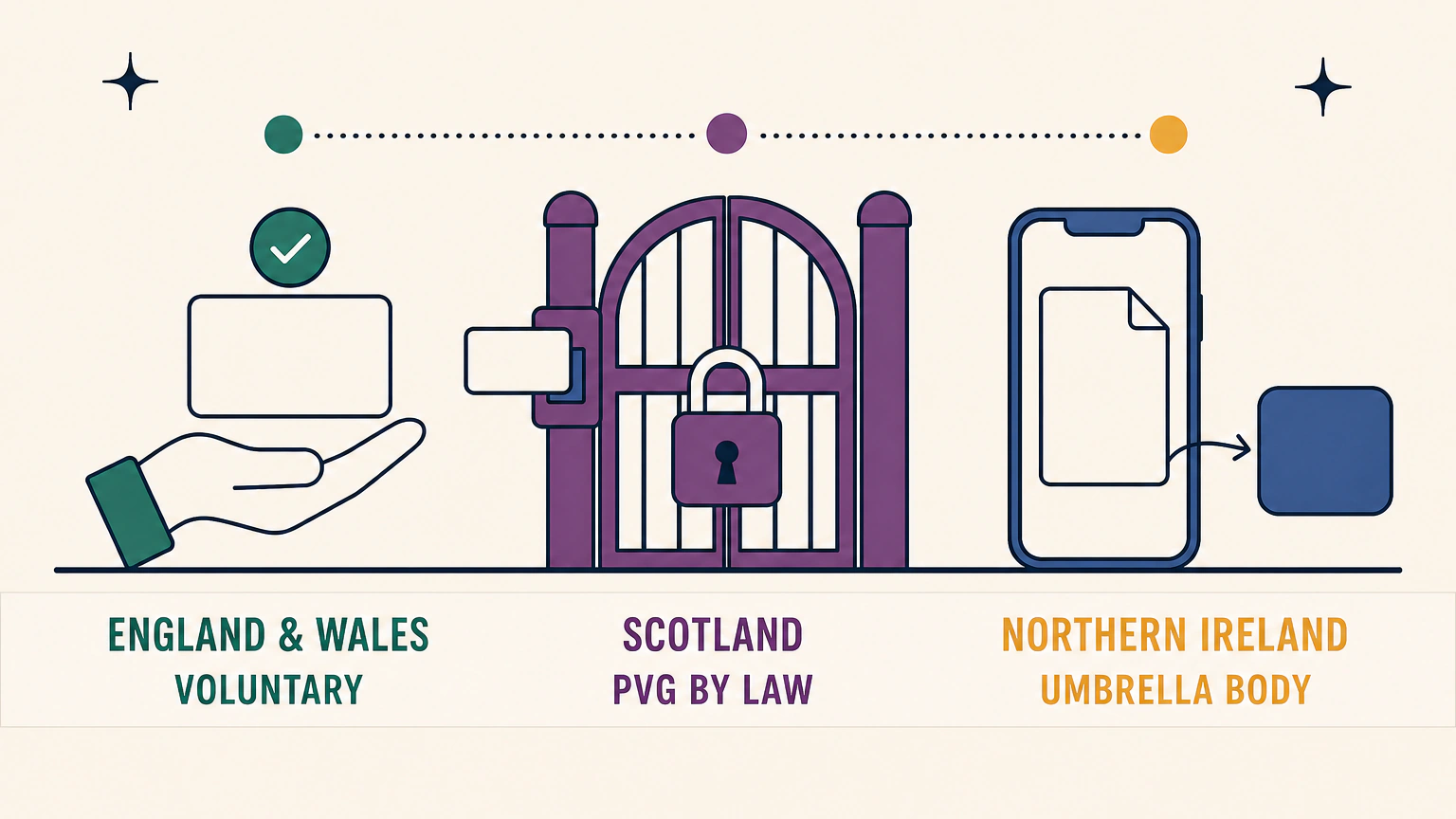
England and Wales: not required, but the strongest check is now available
You break no rule by hiring a tutor who has never been checked. Since 21 January 2026 a self-employed tutor can apply through a DBS umbrella body for an Enhanced check, or an Enhanced check with Barred List(s) where the work qualifies. Before that they were largely limited to a Basic check, which is why so much older advice is wrong.
Scotland: PVG membership is a legal requirement
Disclosure Scotland lists "employed by a parent as a tutor for their child" as an example of a regulated role. PVG membership became a legal requirement on 1 April 2025. After a three-month grace period, two things became criminal offences on 1 July 2025: carrying out a regulated role without membership, and an organisation offering one to a non-member. Ask before the first lesson, whichever of the providers across Scotland you are hiring from.
Northern Ireland: an enhanced AccessNI check through an umbrella body
The route mirrors England and Wales. A self-employed tutor applies through an umbrella body for a standard or enhanced AccessNI check, and the certificate arrives digitally in their nidirect account. Available, not compulsory.
| Where you live | Scheme | Is a check legally required for a tutor hired directly by a parent? | Highest check available to a self-employed tutor | Who applies |
|---|---|---|---|---|
| England | DBS | No | Enhanced with Barred List(s), for regulated activity | The tutor, through a DBS umbrella body |
| Wales | DBS | No | Enhanced with Barred List(s), for regulated activity | The tutor, through a DBS umbrella body |
| Scotland | PVG, run by Disclosure Scotland | Yes, for a regulated role with children | PVG membership and its disclosure | The tutor, through Disclosure Scotland |
| Northern Ireland | AccessNI | No | Enhanced check with the children's barred list | The tutor, through an AccessNI umbrella body |
The block further down does the same job for your own situation.
Why the law treats a private tutor differently from a schoolteacher
It comes down to who counts as the employer. Schools and agencies arranging regulated activity can have statutory safeguarding duties. A parent hiring a tutor directly cannot apply for the tutor's check; the tutor must use the self-employed route through an umbrella body.
What "regulated activity" means, and the 3-days-in-30 rule
This test decides whether a barred-list check is available to your tutor at all, and every condition has to hold at once. Under the DBS child workforce guide, teaching, training or instructing children is regulated activity when it happens on more than 3 days in a 30-day period, or overnight between 2am and 6am, with the opportunity for face-to-face contact, and none of three exceptions applies. Frequency counts days taught in a rolling 30-day window, not hours. The three exceptions are where setting and supervision come in. One covers activities designed for adults, where a child's presence is unexpected. Another covers 16 and 17-year-olds in work. The third belongs to a recruiting organisation, which can decide someone is sufficiently supervised under Department for Education statutory guidance, provided they are not paid staff in a specified establishment such as a school. Hire a tutor yourself and nobody is making that judgement or supervising the room.
Above the line, an Enhanced check with Barred List(s) is available. Below the frequency line, where the work is infrequent but happens more than once and the separate overnight limb does not apply, only an Enhanced check without barred-list information is available. On ordinary daytime schedules, a weekly tutor and a fortnightly tutor cannot hold the same document; the government's own example is a maths tutor working two evenings a week.
The gap this leaves, and what is being done about it
A BBC News investigation published on 6 September 2024 found that more than 90 private tutors in the UK had been convicted of sexual offences involving children over the previous 20 years. The BBC compiled that figure from newspaper reports and court filings, and said it was likely an underestimate. The Children's Commissioner for England, Dame Rachel de Souza, told the BBC that anybody working one-to-one with a child as a tutor should have a DBS criminal record check, and that "it's an absolute basic minimum". The January 2026 change made higher-level checks obtainable at all, which is the part you can act on.
What changed on 21 January 2026
One guidance change reset this question, and it's why so much of the advice still online is out of date.
What a self-employed tutor can apply for now
Four steps. The tutor confirms the role is eligible under the DBS eligibility guidance, applies through an umbrella body that handles self-employed applicants, proves their identity, and receives the certificate by post. The umbrella body adds its own administration fee, which is not published centrally. Joining the Update Service at application is what makes the free status check possible later.
What you as a parent can and cannot do
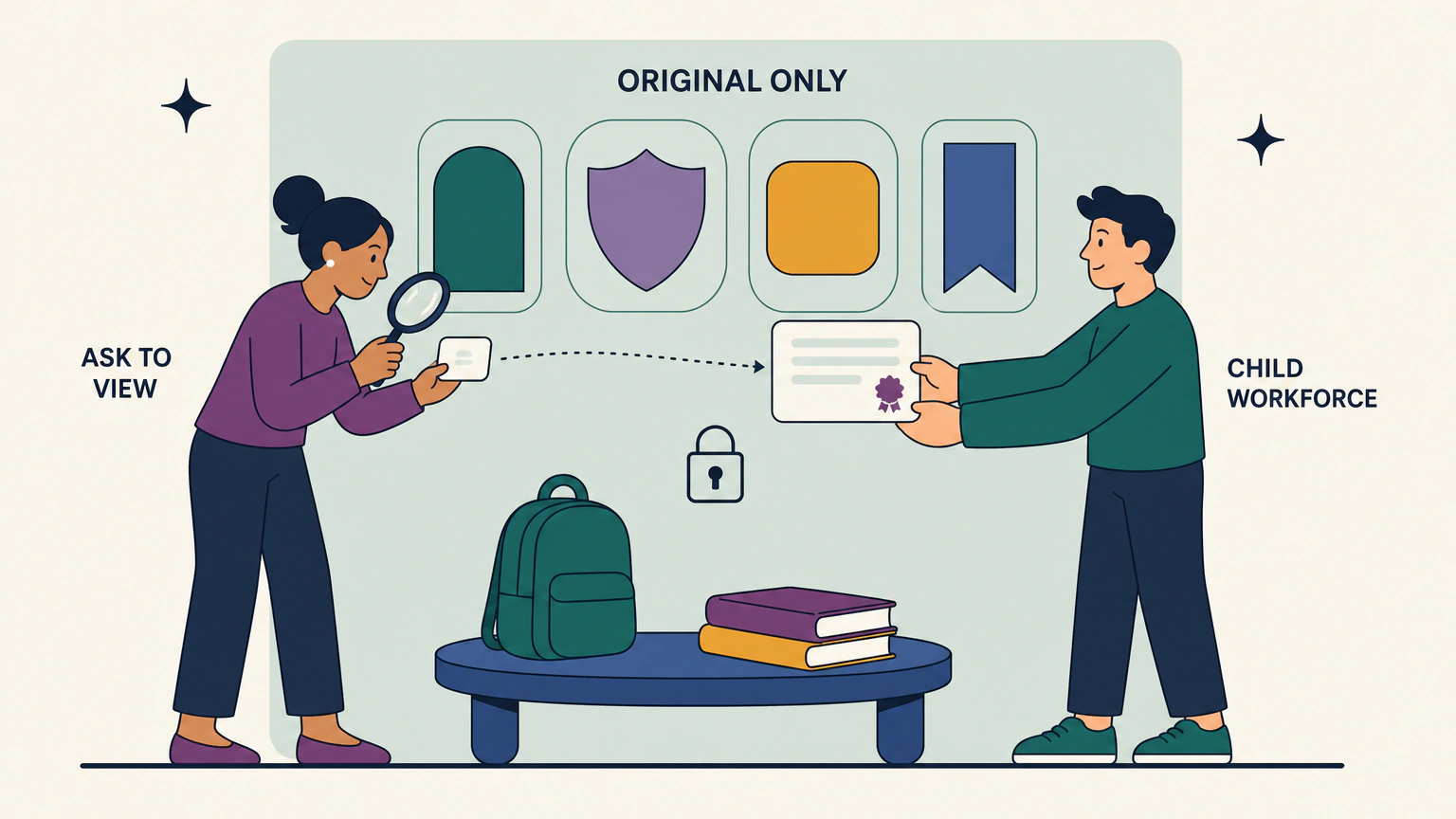
You can't apply on your tutor's behalf, and an umbrella body will not take an application from you. You can ask to view their certificate as part of your decision, with their consent. What you must not do is keep it: no photocopy, no photograph, no note of the contents.
Which check applies to your situation
Choose your nation, how you hired the person and how often they teach your child. The block returns the check, its legal status, who applies and what to ask to see.
Which check should they have?
The four UK nations don't share one scheme. So the answer depends on where you live, how you hired this person, and how often they teach your child.
The short answer by nation
- England and Wales — DBS — A directly hired self-employed tutor is not required by law to hold one; organisations can have different duties.
- Scotland — PVG — Required by law for a regulated role with children.
- Northern Ireland — AccessNI — A directly hired self-employed tutor is not required by law to hold one; organisations can have different duties.
Driving instructors use a registration check in all four nations; in Scotland the registration check sits alongside PVG.
Showing the answer for:
- Where you live England
- How you hired them Directly, and they are self-employed
- How often they teach your child On more than 3 days in any 30-day period
Your answer
- The check
- Enhanced DBS check with Barred List(s), child workforce.
- Is it required by law?
- Not required by law
- Who applies for it
- They apply for themselves, through a DBS umbrella body. You cannot apply on their behalf.
- Fee
- £49.50, plus the umbrella body's own administration fee.
- What to ask to see
- Ask to see the original certificate, not a photo or photocopy. Check the position applied for mentions the child workforce, and check the issue date.
- Source
- GOV.UK, DBS checks for self-employed people and personal employees.
A criminal-record check tells you about the past on the day it was issued. It is not a guarantee of safety, and it is one part of your decision, not the whole of it.
Not sure whether a role needs a check? Disclosure Scotland: 0300 020 0040. AccessNI: 0300 200 7888. For England and Wales, DBS customer services are listed on GOV.UK.
Fees do go up. It's worth checking the current amount with the scheme before you pay.
What each level of check actually shows
The trap is the word "enhanced". An enhanced check and an enhanced check with barred-list information are two documents, and only the second shows whether someone is barred from working with children.
| Level | What it shows | Available to a self-employed tutor? | Can it be status-checked on the Update Service? |
|---|---|---|---|
| Basic | Convictions and cautions unspent under the Rehabilitation of Offenders Act 1974 | Yes, anyone can apply | No |
| Standard | Spent and unspent convictions and adult cautions that are not filtered | Not by this route, which covers enhanced checks | Yes |
| Enhanced | Standard-check information plus anything a police force holds and considers relevant | Yes, where the role is eligible | Yes |
| Enhanced with Barred List(s) | Enhanced information plus whether the person is on the children's or adults' barred list | Yes, but only for regulated activity | Yes |
How to check a tutor's DBS certificate yourself
Five minutes at a kitchen table, and more useful than knowing the law.
- Ask to see the original certificate, not a photo, scan or photocopy.
- Ask for a government-issued photo identity document at the same time.
- Check the name and personal details match the identity document.
- Check the position-applied-for field mentions the child workforce.
- Check whether barred-list information was included, not just "enhanced".
- Check the issue date, and remember the certificate is accurate only for that day.
- Ask whether they subscribe to the Update Service, and if so run a free status check with their consent.
- Hand the certificate back. Do not photograph it, copy it or write down what it said.
Step 1: ask to see the original
The DBS guidance for private individuals is blunt: copies and digital photographs are not acceptable and must be rejected. An original is printed on both sides, carries the DBS logo and is larger than A4, at 209mm by 404mm. DBS takes queries about altered certificates at [email protected].
Step 2: match the identity
Best practice is a government-issued photo identity document, a passport or a driving licence, checked against the certificate in your hand. Someone else's certificate is the easiest fraud to miss if you never ask.
Step 3: check the workforce and the level
Expect wording along the lines of "child workforce" in the position-applied-for field, then look for the barred-list line. If it's absent, the tutor holds an enhanced check without barred-list information, which may simply mean they teach your child on three days or fewer in a month.
Step 4: check the issue date, then run a free status check
A DBS certificate has no expiry date, so the issue date is the number to look at. If the tutor subscribes to the Update Service you can run a free status check with their consent, using the certificate number.
Pro tip: the organisation-name box. The status check form asks for an organisation name, and that field stops many parents at the last step. The DBS guidance for private individuals says to enter the phrase "private employer". You also confirm you have their consent and that the role is eligible for that level of check.
What to do if the certificate shows a bar
Do not employ them. A barred person who seeks, offers or engages in regulated activity with that group is committing a criminal offence, and you should report it to the police. A disclosed conviction is different and not automatically disqualifying: DBS asks employers to weigh it fairly and discuss it openly.
Scotland and Northern Ireland: what you will actually be shown
Neither nation hands you the paper certificate the English guidance describes.
Scotland: a shared digital disclosure, not a certificate
Disclosure Scotland emails the member a secure link once the application is processed. They sign in, view the disclosure online and choose whether to share it with you. Membership lasts five years, and Disclosure Scotland keeps checking a member's suitability while they stay in the scheme.
Northern Ireland: a digital certificate in a nidirect account
The certificate is issued to the tutor's nidirect account and shared from there, and you receive an email with a link. Read that email carefully: AccessNI's guidance says the link stays live for five calendar days and can be opened once only. Agree a time to look at it together.
Driving instructors are the exception that proves the rule
Paid car-driving instruction has its own compulsory registration check. In England, Wales and Scotland, an approved driving instructor has a criminal-record check when they first apply and again at every renewal, and registration lasts four years. The duty continues in between in Great Britain: an ADI must tell the ADI Registrar within 7 days of any caution or conviction, including being bound over, having their name entered on the sex offenders register, or being banned or barred from working with children. You can check this yourself. An instructor must display the ADI registration certificate, the badge in the windscreen, while giving paid lessons, and DVSA runs a public finder for driving schools and instructors. Listing there is voluntary, so phone DVSA with a name and ADI number if yours is missing. In Scotland they need PVG membership too, because Disclosure Scotland names a driving instructor employed by an individual as a regulated role. Ask any of the driving instructors near you what they hold, and in Scotland ask about both.
What a check costs, and who pays
This is the tutor's business expense, like their insurance. Offering to pay speeds nothing up, since you can't apply anyway.
| Scheme | Check | Fee |
|---|---|---|
| DBS | Basic | £21.50 |
| DBS | Standard | £21.50 |
| DBS | Enhanced | £49.50 |
| DBS | Enhanced with Barred List(s) | £49.50 |
| DBS | Update Service | £16 per year, free for volunteers |
| PVG | Confirmation of membership (Join) | £59 |
| PVG | Confirmation of membership (Existing) | £18 |
| AccessNI | Basic | £16 |
| AccessNI | Standard | £16 |
| AccessNI | Enhanced | £32 |
Umbrella bodies charge their own administration fee on top, and that fee is not published centrally.
Swimming, dance, gymnastics, martial arts and music: how the same rules land
These rules follow the arrangement, not the subject. Where your child attends a club, school, leisure centre or studio, ask the organisation whether it ran a check, at what level and when; the legal duty and eligible level depend on the setting and role. An organisation that knowingly employs a barred person in regulated activity with children is breaking the law. Where an instructor teaches your child one-to-one and you pay them directly, the rules for a directly hired tutor apply unchanged. If a national governing body sets a standard, ask which one the club follows. Club-based swim schools and instructors sit on the organisation side of that line. A private poolside lesson you arrange does not.
What a listing, badge or "verified" label does and does not tell you
Directory inspections are business-level checks. Our published methodology says a business must pass an inspection covering business history, reputation checks, licensing and a physical location check, and you can read what our inspection actually checks before you rely on it. None of that is a criminal-record check on an individual. For a directly hired self-employed tutor, the tutor—not the directory or parent—must apply through an umbrella body. Review integrity is separate: since 6 April 2025 the Digital Markets, Competition and Consumers Act 2024 has banned fake and misleading reviews, enforced by the Competition and Markets Authority.
Questions to ask before the first lesson
Ask these at the enquiry stage, before money changes hands. A good tutor answers without flinching.
- What criminal-record check do you hold, at what level, and when was it issued?
- Are you on the DBS Update Service, or can you share your PVG or AccessNI disclosure with me?
- Will lessons be one-to-one, and where will they take place?
- Are you insured, and can I see the policy?
- Who do I contact if I have a concern about a lesson?
- Are you a member of a professional body or governing body, and what does that require of you?
Red flag: three answers that should make you pause. "I can't show you the original, but I'll send you a photo." The guidance says copies and photographs must be rejected, so ask to see the original in person before the first lesson. "I've got a DBS, it's fine," with no level named. Ask which level, and whether barred-list information was included, because those are not the same document. "You can't ask me that." You can. Viewing a certificate with the holder's consent is what the DBS guidance for private individuals describes.
It's a fair conversation to have with any of the maths tutors in your area before you book.
Frequently asked questions
These are the questions people actually type into Google in the UK, plus the ones the highest-ranking pages answer in their own headings.
Is a DBS check a legal requirement for a private tutor?
No, not in England and Wales. A self-employed tutor you hire directly is not required by law to hold any criminal-record check, and no law obliges you to ask for one. In Scotland the answer is yes: PVG membership is a legal requirement for a regulated role with children, and working without it is a criminal offence. Northern Ireland follows the England and Wales position.
How long does a DBS check last?
A DBS certificate has no expiry date. It's accurate on the day it was issued and tells you nothing about what happened afterwards, so the issue date is the figure that matters. If the tutor subscribes to the Update Service, you can run a free status check with their consent to see whether anything has changed.
Is a basic DBS check enough for someone teaching my child?
A basic check shows only convictions and cautions that are unspent under the Rehabilitation of Offenders Act 1974. It cannot show barred-list status, it does not include information held by police forces, and it cannot be status-checked on the Update Service. For one-to-one teaching, ask for an Enhanced check; barred-list information is available only where the work meets the regulated-activity test described above.
Can I ask to see my tutor's DBS certificate?
Yes. The DBS guidance for private individuals says you can view the certificate as part of your decision, with the applicant's consent, and that you must see an original rather than a copy. You must not keep a photocopy, an image or a written record of its contents, or pass on what you saw.
Is there a DBS share code, like the one for right-to-work checks?
No. Share codes belong to the Home Office right-to-work service, not to DBS. The equivalent here is an Update Service status check, run against the certificate number with the tutor's consent, which returns a status rather than the contents. In Scotland and Northern Ireland the person shares their disclosure from their own account.
What does an enhanced check with a barred list actually show?
It shows spent and unspent convictions and cautions from the Police National Computer that have not been filtered, plus any information a police force holds and considers relevant to the role, plus whether the person appears on the children's or adults' barred list. It is only available for regulated activity.
Does my tutor need insurance as well as a check?
A self-employed tutor without employees will not normally need employers' liability insurance. Whether that cover is legally required depends on the real working relationship with anyone who works for the business, not merely on labels or tax status. Public liability and professional indemnity cover are still worth asking about, and an established tutor should be able to show you the policy.
We're explaining published rules here, not giving legal advice. If you're unsure whether a particular role needs a check, the regulator will tell you: Disclosure Scotland on 0300 020 0040, AccessNI on 0300 200 7888, and DBS customer services, whose contact details are on GOV.UK, for England and Wales.
A criminal-record check is evidence about a person's past on the day it was issued. It's never a guarantee of safety, and it's one part of your decision. If you're worried about a child's immediate safety, contact the police. The NSPCC publishes guidance on reporting a concern about a child.