

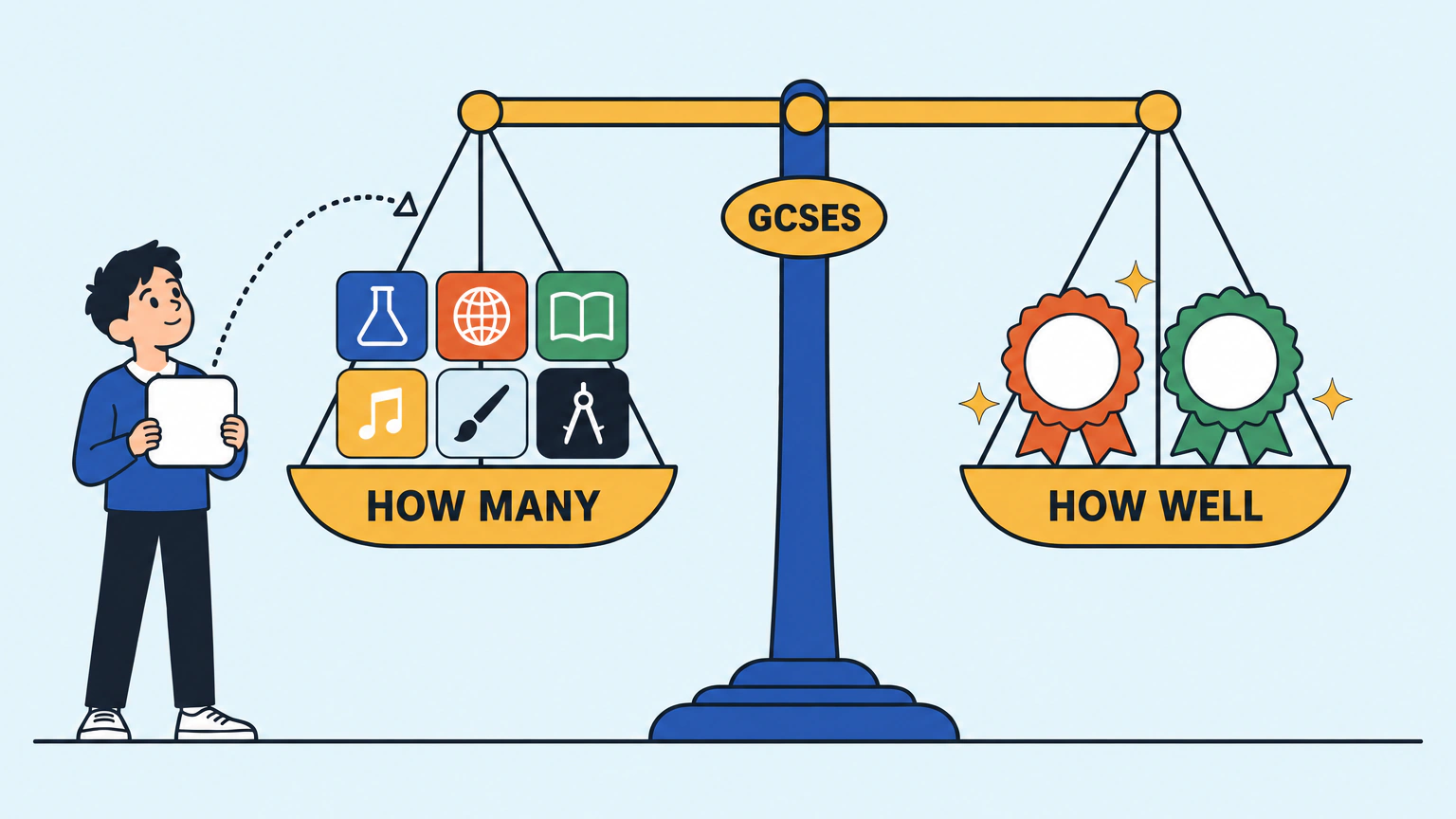
Most students in England take eight or nine GCSEs. In 2026, nine was the most common number among 16-year-olds and eight came a close second. Combined science counts as two of those GCSEs. For sixth form, the number that matters is usually five, at grade 4 or above with English and maths among them, and past that the grades in the subjects your child wants to keep studying carry more weight than the total.
On this page
- Most students take eight or nine GCSEs
- Why nine is so common
- How many GCSEs you need for sixth form
- How many GCSEs you need for university
- How many exams nine GCSEs add up to
- Can you take more GCSEs, or fewer?
- Wales, Northern Ireland and Scotland count differently
- Questions parents ask about the number of GCSEs
Most students take eight or nine GCSEs
Ofqual's results for summer 2026 settle how many GCSEs students take in England. Nine was the most common number of GCSEs among England's 16-year-olds, taken by about 28 in every 100, and eight came next at about 26. Together that's just over half the year group. Widen the range to seven, eight, nine or ten and you've covered about four students in five.
How many GCSEs 16-year-olds took in England
| Number of GCSEs | 16-year-olds, summer 2026 | 16-year-olds, summer 2025 |
|---|---|---|
| 6 or fewer | 17.6% | 17.3% |
| 7 | 16.1% | 15.6% |
| 8 | 25.8% | 25.3% |
| 9 | 28.4% | 28.5% |
| 10 | 10.9% | 11.7% |
| 11 | 1.3% | 1.6% |
| 12 or more | Under 0.1% | Under 0.1% |
Ofqual's results data for England, all exam boards. Combined science counts as two GCSEs. The "6 or fewer" row adds Ofqual's rows for one to six GCSEs.
The averages you'll see quoted look low for a simple reason. Ofqual puts the 2025 average for 16-year-olds at 7.78 (its 2026 release rounds the figure to eight). About one in six took six or fewer, and they drag it down. Across all ages, the 2025 average was 5.56. That figure counts everyone who got a GCSE result, and a quarter of them took just one. So the number worth holding your child's plans against is the one for 16-year-olds, the age at which most people sit GCSEs.
These are England's figures, drawn from every exam board, and Ofqual counts combined science as two GCSEs. That detail matters more than it sounds.
Why nine is so common
Most of a timetable is settled before anyone fills in an options form. In maintained schools in England, the national curriculum makes English, maths and science compulsory at key stage 4, which is Years 10 and 11. Computing, PE and citizenship are compulsory too. Academies do not have to follow the national curriculum, but they must teach a broad and balanced curriculum including English, maths and science. These are subjects to study, not exams to sit, so core PE is a timetabled lesson rather than a GCSE. Schools must also provide religious education, and the GCSE in it is optional.
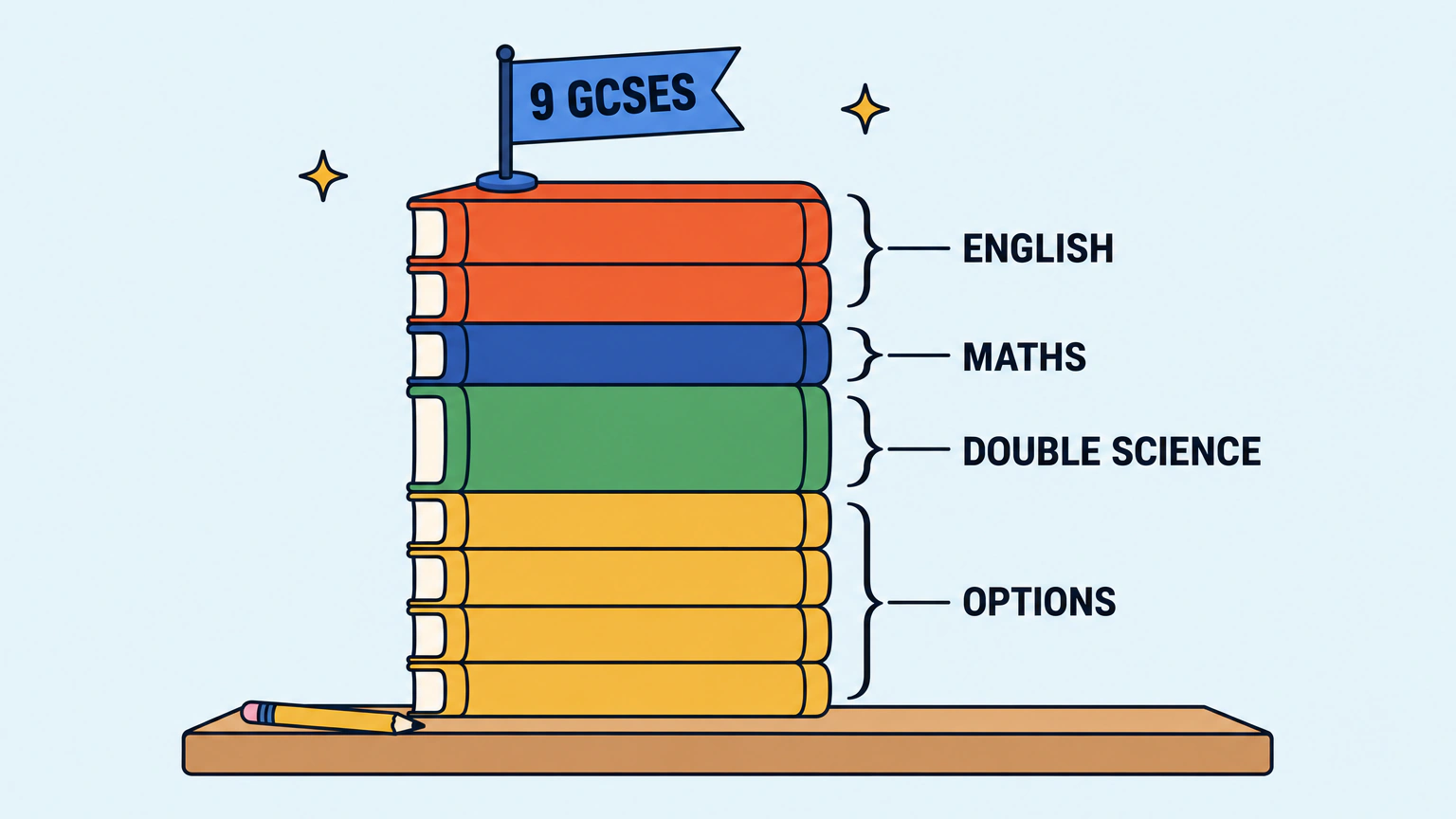
English is usually two GCSEs, not one. The Department for Education says about 96% of pupils in state-funded mainstream schools sat both English language and English literature in 2024 to 2025. Then there's science. Combined science is one course worth two GCSEs, graded with two numbers such as 6-5, while triple science is three separate GCSEs. Add it up and a student taking both English GCSEs, maths and combined science has five before the options are counted. Four options make nine.
The eight slots your school is judged on
There's a second reason schools plan for eight or more, and it's about how the schools themselves are measured. Attainment 8 scores pupils' results across eight slots and feeds into state secondary school performance data in England. Progress 8 uses the same slots, but it cannot be calculated for 2024 to 2025 or 2025 to 2026 because those cohorts have no key stage 2 baseline. Maths counts twice. English counts twice when a pupil takes both English GCSEs. Three slots go to EBacc subjects (the sciences including computer science, history, geography and languages), and three are open. Combined science can fill two slots on its own.
That's changing. In its response to the Curriculum and Assessment Review, the government said it would drop the EBacc headline measures, starting with the 2025 to 2026 school tables published this autumn. It then consulted on a new model, still with eight slots. English and maths would stay as they are. Two slots would go to sciences, and two "breadth" slots would have to come from two of three groups: humanities, creative subjects and languages. The last two would be free choice.
The Department for Education said the new model would first apply to pupils starting GCSEs in September 2027, which is this year's Year 9. It promised its decision in the summer term of 2026 so schools could plan options around it. The consultation has closed, but the decision hasn't been published, so schools are planning this year's options without it.
For a parent, the point is simpler than the scoring. The slots shape which options a school steers students towards. They don't cap what your child may take.
How many GCSEs you need for sixth form
Usually five. The bar that moves from one sixth form to the next is the grade, not the number. We read the published entry requirements of eight sixth forms in six regions of England, and this is what they ask for.
What eight sixth forms ask for
| Sixth form | Where | For three A levels | Higher bars they publish |
|---|---|---|---|
| The Sixth Form Bolton | Bolton | Two GCSEs at grade 5 and three at grade 4, including English language and maths | Four A levels: six GCSEs at grade 7 or above, with English language and maths at 6 |
| Leeds Sixth Form College | Leeds | Five GCSEs at grade 4 or above, including English and maths | Some subjects ask for grade 5 in English or maths |
| Greenhead College | Huddersfield | Grade 6 in three GCSE subjects, plus grade 4 in English language and maths | Each subject adds its own grade |
| Trinity Sixth | Halifax | Five GCSEs at grade 4 or above, including English language and maths | Sciences: 6-6 in combined science, or 6 in the single science |
| Shrewsbury College | Shrewsbury | Five GCSEs at grade 4 or above, including English language | Below 4 in maths means taking GCSE maths alongside A levels |
| The Green School Sixth Form | Isleworth, west London | Five GCSEs at grade 5 or above, including English and maths at 5 | Four A levels: seven GCSEs at grade 7 or above, with English and maths at 8 |
| William Farr School | Welton, Lincolnshire | Five GCSE passes at grade 4 or above | Biology: 6 in biology, or 6-5 in combined science |
| Peter Symonds College | Winchester | Five GCSEs at grade 4 or above, including English | Chemistry: grades 7, 6 and 6 across the sciences and maths |
From each sixth form's own published entry requirements. Bolton's are for September 2027. Requirements change every year, so the page for the year your child would start is the one that counts.
Seven of the eight ask for five GCSEs. Greenhead is the odd one out, asking for grade 6 in three GCSE subjects plus grade 4 in English language and maths. Two of them want some grade 5s even for three A levels, and the two that publish a four-A-level route want six or seven GCSEs at grade 7. A maths grade below 4 isn't always the end of the road, either. Shrewsbury College has students take GCSE maths alongside their A levels, and our guide to what happens if English or maths comes in below a 4 covers the resit rules.
Check the science tier. Ask the school which tier your child is sitting in combined science. The foundation tier tops out at 5-5, and several sixth forms want 6-6 before a student can start A level biology, chemistry or physics.
Maths works the same way, with foundation tier capped at grade 5, so read how the maths tiers work before the school confirms entries. Some schools don't send home the full list of exam entries until spring, so it's worth asking for it well before then.
Four things to write down before options evening or a sixth-form application:
- Every exam subject your child takes, with its exam board and specification code.
- The tier your child is sitting in maths and in science.
- The published entry requirements of each sixth form or college, for the year your child would start.
- The GCSE grade each likely A level subject asks for.
How many GCSEs you need for university
University offers are made on A levels or their equivalents, and the GCSE rules sit underneath them. There's often no set number of GCSEs you need for university at all. Cambridge is blunt about it: "There are no GCSE (or equivalent) requirements for entry to Cambridge." It does look at GCSE results, but "within the context of the performance of the school/college where you achieved your GCSEs."
UCL sets a floor instead. Its admissions rules for 2026-27 ask every applicant for English language and maths at grade 4 or C, and say some programmes want more. Individual courses can set their own GCSE bar, so the course page is the only place to check. Offers are usually based on A levels or another Level 3 qualification. Our guide to what A level grades are worth in UCAS points translates A level grades.
How many exams nine GCSEs add up to
The number of exams is far bigger than the number of GCSEs. Most GCSEs are sat as two or three written papers, and combined science is sat as six. AQA's specifications give the papers and timings for some of the most common subjects.
Exam papers and written exam time, AQA GCSEs
| Subject (AQA code) | Counts as | Written papers | Written exam time |
|---|---|---|---|
| English language (8700) | 1 GCSE | 2 | 3 hours 30 minutes |
| English literature (8702) | 1 GCSE | 2 | 4 hours |
| Maths (8300) | 1 GCSE | 3 | 4 hours 30 minutes |
| Combined science: Trilogy (8464) | 2 GCSEs | 6 | 7 hours 30 minutes |
| Biology, chemistry and physics (8461, 8462, 8463) | 3 GCSEs | 6 | 10 hours 30 minutes |
| History (8145) | 1 GCSE | 2 | 4 hours |
| Geography (8035) | 1 GCSE | 3 | 4 hours 30 minutes |
| Religious studies A (8062) | 1 GCSE | 2 | 3 hours 30 minutes |
| Spanish (8692), higher tier | 1 GCSE | 3, plus a speaking test | 3 hours |
| Music (8271) | 1 GCSE | 1, plus performing and composing in school | 1 hour 30 minutes |
From AQA's current specifications. Times are standard exam lengths, before any extra time. Spanish foundation tier papers total 2 hours 30 minutes. Other boards' papers differ.
AQA gives every paper a date and a morning or afternoon session in the summer timetable, although two papers can share one session. Our guide to when each GCSE paper falls lays the dates out.
Now take one common set: English language, English literature, maths, combined science, history, geography, religious studies and higher-tier Spanish. That's nine GCSEs, because combined science counts twice. The papers run 2, 2, 3, 6, 2, 3, 2 and 3, which makes 23 written papers and 34 hours 30 minutes in the exam hall, before any extra time and with a Spanish speaking test on top. It's a lot of sharpened pencils.
Change one subject and the totals move. Swap combined science for triple and it becomes ten GCSEs, still 23 papers, and 37 hours 30 minutes. Swap Spanish for music instead and it's 21 papers and 33 hours, because music's performing and composing happen in school. Those performances have to be completed in the exam year, at least four minutes of them, so a Year 10 student with a rusty instrument may want to look at piano teachers near you sooner rather than later.
England's load stands out. The Curriculum and Assessment Review put the typical figure at 24 to 31 hours for students taking eight to ten subjects (OCR's estimate is 31.5), against 16 hours in Ireland, 18 in New Zealand and 10 in Alberta. The review built its range on the most popular combinations of eight GCSEs, which is why one set of nine lands above it.
With twenty-plus papers, one or two will go badly. That's normal. It's worth saying out loud to a Year 11 before the exams start, because the season tests stamina as much as knowledge.
What the curriculum review means for exam time
Relief is coming, just not quickly. The review recommended cutting GCSE exam time by at least 10%, after Ofqual told it that a 10% cut was feasible with the current content. The government's response commits to reducing exam time by 2.5 to 3 hours on average for a student taking eight or nine GCSEs, as the qualifications are reformed.
Reformed GCSEs are planned for first teaching in 2029 for some subjects and 2030 for the rest, with first exams at the end of the two-year course. So the cut won't touch anyone sitting GCSEs before 2031. The first year group who could meet a reformed GCSE is today's Year 7, if their school starts GCSE courses in Year 10.
The response also plans a statutory entitlement to triple science, once the government has worked with schools on what stops them offering it. For now, today's papers and hours are the ones to plan for.
Can you take more GCSEs, or fewer?
No rule sets a number. In maintained schools in England, the national curriculum lists compulsory subjects, while academies must teach a broad and balanced curriculum that includes English, maths and science. Schools decide which subjects become GCSEs and how many options sit beside them. Taking eleven is rare (1.3% of 16-year-olds in 2026), and twelve or more is rarer still, at under 0.1%.
More GCSEs don't automatically buy a better offer. None of the eight sixth forms we checked asks for more than seven, and every one of them names subjects and grades. Fewer is fine for many routes. The curriculum review defines a level 2 pass as "five GCSEs at grade 4 or above or the equivalent". A tenth GCSE also costs revision time across every other subject, and that's a trade worth weighing.
Wales, Northern Ireland and Scotland count differently
Ofqual's figures cover England only. Wales and Northern Ireland count GCSEs differently, and Scotland's national qualifications system uses National 5s.
How the four nations count
| Nation | What students sit at 16 | How grades are written | Worth knowing |
|---|---|---|---|
| England | GCSEs | 9 to 1 | Combined science counts as two, graded like 6-5 |
| Wales | Made-for-Wales GCSEs | A* to G, with double awards as two matching letters, like CC | English, maths and the sciences are double awards |
| Northern Ireland | CCEA GCSEs, or GCSEs from English boards | CCEA: A* to G with a C* equal to a 5. English boards: 9 to 1 | One results slip can mix letters and numbers |
| Scotland | National 5s, not GCSEs | A to D, or No Award | Each school sets how many |
Wales: for students who began GCSEs from September 2025, with the new sciences double award from September 2026. Northern Ireland: CCEA's A covers 7 and 8.
In Wales, students who began GCSEs from September 2025 take Made-for-Wales GCSEs. English language and literature (which also comes as a single award) and maths and numeracy are double awards, and from September 2026 so are the sciences. Each one is a bigger qualification, graded with two matching letters such as CC. Count a double award as two, the way England counts combined science, and English, maths and science add up to six GCSEs in Wales, one more than the same subjects make in England. Our exam dates guide covers the first Made-for-Wales exams, and our Wales pages list tutors and teachers in Wales.
Northern Ireland's exam board, CCEA, grades its GCSEs A* to G, with a C* that lines up with a grade 5 and an A that spans 7 and 8. GCSEs from the English boards taken there use 9 to 1, so one results slip can carry both. If that's your family, you'll find tutors across Northern Ireland on our Northern Ireland pages.
Scotland's national qualifications system does not use GCSEs. Pupils sit National 5s, graded A to D or No Award, and each school sets how many. Lenzie Academy's S4 pupils study six subjects, while every pupil at the High School of Glasgow sits eight. Our Scotland pages list tutors in Scotland.
Questions parents ask about the number of GCSEs
Is combined science two GCSEs?
Yes. Combined science is one course worth two GCSEs, graded with two numbers such as 6-5 (AQA's scale runs from 1-1 to 9-9), and Ofqual counts it as two in its results. Triple science is three separate GCSEs: biology, chemistry and physics. In Wales, the new science double award is graded as two as well, with matching letters such as CC.
Is five GCSEs enough?
For many next steps, yes, as long as they're at grade 4 or above and include English and maths. The curriculum review counts five GCSEs at grade 4 or above as a level 2 pass, and seven of the eight sixth forms we checked ask for five as well, two of them with some grade 5s. Subjects your child wants to carry on often need a 5 or 6.
What's the most GCSEs you can take?
No national rule caps the number. In 2026, 1.3% of England's 16-year-olds took eleven GCSEs, and fewer than 0.1% took twelve or more. Schools set the menu of subjects and options. The schools and universities checked here focus on named subjects and grades rather than rewarding a bigger total.
How many GCSEs do you need to do A levels?
Usually five at grade 4 or above, including English and maths, plus whatever grade each A level subject asks for, often a 5 or 6 and sometimes a 7. The Green School in Isleworth wants all five at grade 5 or above, and taking four A levels can mean six or seven GCSEs at grade 7.
How many GCSE exams will my child sit?
Far more than nine. One common set of nine AQA GCSEs comes to 23 written papers and 34 hours 30 minutes in the exam hall, before any extra time, plus a speaking test for the language. Subjects with performing or coursework, like music, have fewer hours in the hall. Other boards' papers differ, so check your child's entries.
Do universities care how many GCSEs you have?
The grades in named subjects matter far more than the count. Cambridge says it has no GCSE requirements and reads your results in the context of your school. UCL's admissions rules for 2026-27 ask every applicant for English language and maths at grade 4 or C. Individual courses can set their own GCSE grades, so check the course page.
Before you fill in anything, open each sixth form's published requirements for the year your child would start. And if maths is the grade standing in the way, we'd rather see help arrive now than GCSE maths squeezed in beside A levels later, so this term is a good time to look at maths tutors near you.