

On this page
- The short answer, by the grade on the slip
- Who the resit rule is actually on
- Which subjects you can resit, and when
- The November window, and the deadline that comes first
- If you've already left school or college
- What a grade 4 opens that Functional Skills level 2 doesn't
- Questions people ask after a GCSE result goes wrong
The short answer, by the grade on the slip
The slip says 3, somebody in a corridor has already said the word resit, and nobody has told you who decides or by when. What happens if you fail your GCSEs comes down to two things, and neither of them is how you feel about it: the grade you got, and the course you've just started.
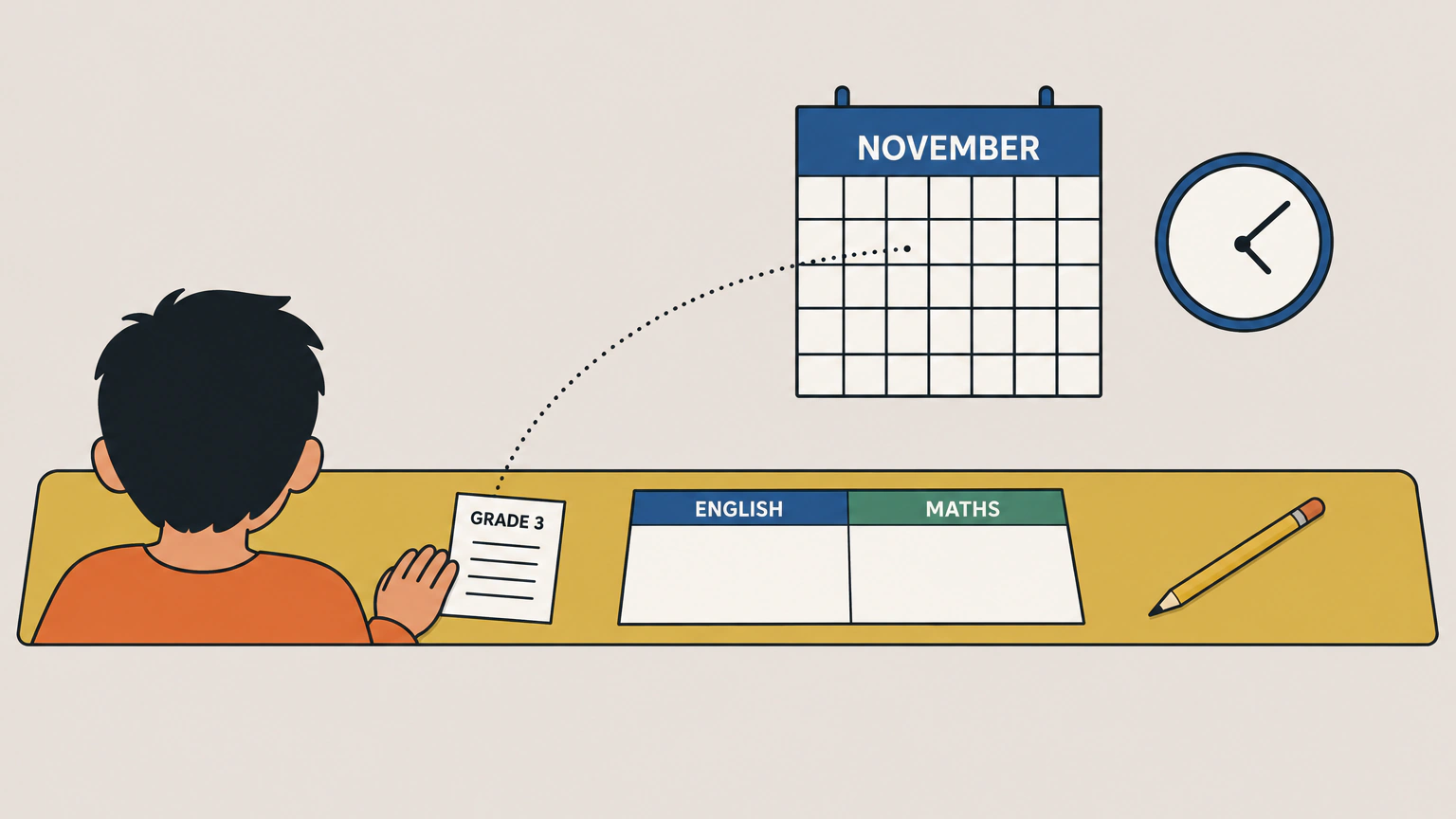
Nothing stops if you miss a grade 4. If you're 16 to 18 and in full-time study in England, a grade 3 in English or maths means you carry on with that GCSE itself. A grade 2 or below means your college can put you on Functional Skills level 2 instead. Every other subject waits for next summer, and the only sitting before then is the November window for English language and maths, which closes to entries weeks before the first paper.
These are England's rules. Wales, Scotland and Northern Ireland use different grading scales and fund post-16 study differently, so check locally if you're studying there.
English and maths don't behave like your other subjects. For those two, the grade on the slip decides which route is open to you, and the choice gets made at enrolment rather than in an exam hall. Grade by grade, this is what a school or college in England has to teach you.
| Your grade | Your programme | What your school or college must teach you | Can you take Functional Skills instead? |
|---|---|---|---|
| Grade 3 | Full time | GCSE English language or GCSE maths itself | No |
| Grade 3 | Part time, 150 hours or more | Any qualification approved for the condition | Yes |
| Grade 2 or below, or no grade | Full time or part time | Any qualification approved for the condition | Yes, and a Functional Skills level 2 pass ends it |
| Any grade | A programme under 150 hours | Nothing. The condition does not apply | Not applicable |
| Overseas qualification at grade 4 or above | Full time or part time | Nothing, once ENIC confirms the equivalence | Not applicable |
| EHC plan, with an assessment that you cannot study either route | Full time or part time | Nothing. The exemption applies | Not applicable |
The condition is measured on the programme you enrol on, not on the subject you failed. It applies to students aged 16 to 18. It also covers students aged 19 or over who are continuing a 16 to 19 study programme or T Level begun by age 18. Students up to 25 with an education, health and care plan are covered too.
A grade 3 keeps you on the GCSE itself
A 3 is a real grade. It goes on your certificate, and it sits one step below the grade 4 the Department for Education treats as a standard pass. It's also the one grade that takes the choice away.
Full-time students holding a grade 3 study towards the GCSE itself, not an alternative, and the guidance gives the reason: they are "those closest to achieving a grade 4 and above at GCSE". So GCSE maths or GCSE English language goes on your timetable, and Functional Skills isn't on the menu.
There's a floor on the hours, too. For a full-time student that's 100 planned hours of maths and 100 of English across the year, and it has to be stand-alone, whole-class, face to face teaching. A drop-in session or an online module bolted onto your main course doesn't count. If your timetable has no real English or maths lesson on it, something has gone wrong, and your tutor is the person to ask.
A grade 2 or below opens a second door
At grade 2 or below the choice comes back. You can work towards Functional Skills level 2, or you can work towards a GCSE grade 9 to 4, and the college decides with you which one is realistic.
A Functional Skills level 2 pass ends the requirement outright. That matters, because plenty of people treat it as the consolation prize. It isn't. It's a level 2 qualification in its own right. For somebody sitting two or three grades short of a 4, it's usually the honest route to a pass this year instead of another near miss next summer.
If even that's a stretch, a college can start you on a level 1 or entry level qualification and build up from there. That's a judgement about the distance to be covered, not a verdict on you.
A grade 4 in English literature can settle the English side
Here's the one that appears on none of the pages ranking today. The rules read English as two subjects rather than one. Hold a grade 4 or above in either English language or English literature and the English side is settled. The guidance puts it in one sentence: "If a student has achieved a grade 4 or above in either of these subjects at key stage 4, CoF is met."
So a 3 in language beside a 4 in literature meets the condition, and your college does not need to put GCSE English language back on your timetable for this funding rule.
| Your English language grade | Your English literature grade | What you have to study |
|---|---|---|
| 9 to 4 | Any grade, or none | Nothing. English is settled |
| 3 or below, or no grade | 9 to 4 | Nothing. English is settled |
| 3 | 3 or below, or no grade | GCSE English language, for the minimum hours |
| 2 or below, or no grade | 3 or below, or no grade | Any approved qualification. A Functional Skills level 2 pass settles it |
A grade 4 in either English language or English literature settles the English side. There is no second subject that does the same for maths.
Maths has no equivalent, so a 3 in maths is simply a 3.
Worth doing before you accept a timetable: dig out the certificate and read what's actually on it. Colleges work from the data they're sent, and a literature grade that settles your English is easy to miss.
Who the resit rule is actually on
Almost every page on this subject tells you that you have to resit. That isn't quite what the rule says, and the difference changes what you're able to ask for.
The requirement isn't a law about students at all. It's a condition attached to the money a school or college receives for teaching you.
It's a condition on your college's funding, not a law about you
The Department for Education calls it the condition of funding, and it binds the college. If you didn't reach a grade 4 in English or maths by the end of Year 11, your school or college has to put approved teaching in those subjects on your programme. If it doesn't, its funding is at risk. Yours isn't, because you don't have any.
The same logic covers attendance. A student who stops turning up to English isn't breaking this funding rule and won't be fined under it. The funding test records the lessons the college planned, not whether you attended each one. The rules also let a college exclude a small share of its students from the requirement, 2.5% measured by funding value, where the support genuinely isn't going to land.
None of this is the same as the duty to stay in education or training until you're 18, which people mix up with the resit rule constantly. That duty is about doing something: full-time education, an apprenticeship, or 20 hours or more a week of work or volunteering alongside part-time study. It says nothing at all about which subjects.
Under 150 hours, and it doesn't reach you at all
There's a threshold underneath all of this, and almost nobody prints it. The condition covers students on a programme of 150 planned hours or more. Below that, it doesn't apply, whatever your grades were.
Above it, your hours decide how much has to be timetabled. Full time means 580 hours or more if you're 16 or 17, or 485 hours or more if you're 18 or over. Part time means anything from 150 hours up to those ceilings. A part-time student holding a grade 3 gets the choice a full-time student doesn't: any qualification approved for the condition, rather than the GCSE itself. The teaching hours scale with the programme too, so a student on 485 hours gets 84 hours of maths and 84 of English rather than 100 of each.
Two exemptions sit outside the whole thing. The first is an education, health and care plan, plus a documented assessment. The assessment has to conclude that you can't study towards a GCSE, Functional Skills level 2 or an approved qualification at level 1 or entry level. A plan on its own doesn't do it, and somebody senior inside the college has to sign the assessment off. The second is an overseas qualification that UK ENIC, the national agency that rates foreign qualifications, confirms is equivalent to a GCSE grade 9 to 4.
Which subjects you can resit, and when
November is a two-subject window. GCSE English language and GCSE maths, and nothing else.
You can see that in the boards' own timetables rather than take anyone's word for it. AQA's November 2026 GCSE timetable lists five papers: English Language Paper 1 and Paper 2, and Mathematics Papers 1, 2 and 3. Pearson Edexcel's runs the same five days with the same two subjects. History, the sciences, art, a language: none of them has a November sitting, and the next chance is the following summer.
Now the part that tends to land better than people expect. The condition of funding doesn't require you to resit anything outside English and maths. If you got a 3 in geography and you're starting A-levels, you can leave it there unless your course sets its own requirement. Picking up a subject you actually want is nearly always a better use of a year than repeating one you didn't.
If you're going back for maths, ask two questions before the entry is made. Which board was the last entry with, and which tier. AQA's Foundation tier covers grades 1 to 5 and its Higher tier covers grades 4 to 9. All three papers have to be at the same tier, and the entry records which tier you will sit.
The November window, and the deadline that comes first
The exam isn't the deadline. The entry is, and it closes weeks earlier.
If you're at a school or college, you almost certainly aren't the one making it. Your exams officer does that, from a list, by a date the board sets. Which means the only way to be sure you're on the list is to ask.
The five mornings
Entries for the November 2026 series close on 4 October 2026. From 5 October the board charges a late entry fee, and anything submitted on or after 26 October counts as very late and costs more again. Schools and colleges run their own internal cut-offs ahead of the board's, so your real deadline is whatever your exams officer tells you it is.
Then the papers. Five mornings, spread across two weeks.
| Date | Subject and paper | How long |
|---|---|---|
| Tuesday 3 November 2026 | English language, Paper 1 | 1 hour 45 minutes with AQA and Edexcel 1EN0, 1 hour 55 minutes with Edexcel 1EN2 |
| Wednesday 4 November 2026 | Maths, Paper 1, no calculator | 1 hour 30 minutes |
| Thursday 5 November 2026 | English language, Paper 2 | 1 hour 45 minutes with AQA, 2 hours 5 minutes with Edexcel 1EN0, 1 hour 55 minutes with Edexcel 1EN2 |
| Friday 6 November 2026 | Maths, Paper 2, calculator | 1 hour 30 minutes |
| Monday 9 November 2026 | Maths, Paper 3, calculator | 1 hour 30 minutes |
Every paper is a morning paper, and both boards sit them on the same days because the slots are set jointly across the exam boards. AQA sends November results to schools and colleges on Tuesday 12 January 2027, and students see them on Wednesday 13 January.
Five things worth asking before the window shuts:
- Ask your exams officer whether you have been entered already, because in a school or college the entry is made for you and the internal cut-off is earlier than the board's.
- If it is maths, ask which tier you sat last time, because Foundation and Higher cover different grade ranges and your entry records which tier you will sit.
- Say whether you want English, maths or both, since the two are entered separately and nobody will assume you want the pair.
- As a private candidate, get the centre's acceptance in writing and ask what its own administration fee is on top of the entry fee.
- Ask what happens if you are not entered this time, because for these two subjects the next sitting is the following summer.
Sit it in November, or wait for the summer?
We'd sit it in November if the lessons have been going in, and wait for the summer if they haven't.
In November's favour: the content is still fresh, you can get the result about seven months earlier, and a pass ends the requirement on the spot. Against it: a GCSE resit is the entire qualification again. Every paper, in one series, on about six weeks of teaching.
The guidance colleges work to hands them a test, and it's a good one for you as well. They "must carefully consider whether to enter these students into the November resit series, by considering if they have demonstrated suitable readiness, including attendance, engagement and progress". Students starting from a low grade 3 or below are expected to need more teaching time. If you've been in the lessons and something has clicked, November is worth the paper. If you're coming off a 2 with half a term of catching up behind you, the summer is the sane target.
The other half of the question is how far off you were. A grade 4 can be a handful of marks away or a different planet, and how many marks a grade 4 actually takes is the thing to look at before you commit either way.
If you've decided to sit it and you want help, that's the point where a tutor earns their money, and you can find a maths tutor near you. We'll say this plainly, because everyone else writing about resits is selling tuition: we sell nothing here, and your first call is to your exams officer, not to us. That's how we work.
Make the call this week.
If you've already left school or college
If you've left, there's no exams officer to ring and no timetable to be added to. You aren't stuck. You do have to do the arranging yourself, though, and which route fits depends mostly on your age and on whether an employer is in the picture.
Entering as a private candidate
AQA defines a private candidate as somebody who enters "through an AQA-approved school or college but is not enrolled as a student there". You're responsible for making the entry and paying the fees.
Start early, because the hard part isn't the exam. It's finding a centre that will take you. Not every school or college accepts private candidates, and AQA warns that the search "can take some time".
Once you've found one, the exams officer needs a short list of things. Your full name and date of birth, backed by a birth certificate, passport or photo driving licence. Proof of your identity, the entry codes for your subjects, and your UCI and ULN if you've been issued with them before. Those two numbers are often printed on an old certificate.
Then the money. You pay the board's entry fee, and some centres charge an administration fee of their own on top, set by them and paid to them. We went looking for a national figure for that second fee and there isn't one, because centres set their own fees.
At 19 and over, the course can be fully funded
This is the route missing from every page we measured, and it's the best news here.
English and maths up to and including level 2 is one of four legal entitlements to full funding for adults in England. It applies if you're 19 or over, meet the residency rules and haven't previously achieved a GCSE at grade A* to C or grade 4 or higher. It comes from the Apprenticeships, Skills, Children and Learning Act 2009 rather than from a college's goodwill. It doesn't depend on what you earn, and it doesn't depend on being out of work. Where a learner is fully funded, a college can't charge them for the direct costs of the course.
One catch is worth knowing before you ring anybody. The entitlement pays for teaching, not for an exam entry on its own. The rules are blunt about it: they "will not fund the learner to only resit the exam". Enrol on the course and the exam comes with it. Ask for the exam alone and you're a private candidate paying private candidate fees.
If English rather than maths is the real barrier, and English isn't your first language, English classes near you are the better place to start.
On an apprenticeship, the rules changed in 2025
The apprenticeship rule changed in 2025
One rule changed under everybody's feet. Since 11 February 2025, an apprentice who is 19 or over when their training starts no longer has to pass level 2 English and maths to finish the apprenticeship. Most pages still say the opposite. If you are 16 to 18 on a level 3 apprenticeship, nothing has changed: you still need both subjects at level 2 before you can go through gateway.
Gateway is the checkpoint an apprentice passes through before the final assessment, and it's where English and maths used to stop people.
For adults, the current funding rules make English and maths optional rather than taking them away. A 19-plus apprentice can still opt in, and if they do, the government funds the study towards level 2, but they "do not need to achieve to pass gateway". If an employer won't agree to English and maths as part of the training, the apprentice can fall back on the adult entitlement and study in their own time.
For 16 to 18 year olds nothing moved. On a level 3 or higher apprenticeship it's "a requirement that they hold or achieve an approved level 2 in both subjects before they can successfully complete the apprenticeship". On a level 2 apprenticeship, someone holding neither level 1 nor level 2 must reach level 1 first, then work towards level 2 where time allows meaningful progress.
What a grade 4 opens that Functional Skills level 2 doesn't
Functional Skills level 2 and a GCSE grade 4 aren't the same currency, and you pick between them at enrolment, usually before anybody explains the difference.
Where the level 2 pass genuinely does the job: it ends the condition of funding, so the timetabled lesson comes off. It can satisfy an apprenticeship's English and maths requirement. An employer asking for level 2 English and maths may accept it, but check the wording before you rely on that.
Where Functional Skills may not do the job: an entry requirement that names a GCSE grade. Teacher training, for example, requires the standard of a grade 4 in English and maths. Providers decide what evidence is equivalent, and the Department for Education says Functional Skills level 2 doesn't match GCSE breadth. If that's the next question in your house, what your grades are worth in UCAS points is the arithmetic to run.
So find out which of the two you need before you choose a route. Ring the course, the employer or the university and ask which one they'll accept. They'll tell you, and their answer fills in your enrolment form.
Questions people ask after a GCSE result goes wrong
Is a grade 3 a fail?
No. A 3 is a real grade and it appears on your certificate. It sits below the grade 4 the Department for Education treats as a standard pass, which is why people call it a fail. For a full-time 16 to 18 student in England it's also the grade that forces the GCSE route rather than the Functional Skills one.
Do you have to resit GCSE maths if you got a 3?
On a full-time 16 to 19 study programme in England, yes. Your college has to teach GCSE maths rather than an alternative. Part-time study can use another approved qualification, while the condition does not apply below 150 planned hours. Outside a 16 to 19 study programme, that funding rule doesn't apply.
How many times can you resit a GCSE?
As many times as you like. There's no cap on attempts. The constraint is the calendar. English language and maths run in November and again in the summer, and every other subject runs in the summer only. Each attempt means sitting the whole qualification again rather than the single paper that went wrong.
What happens if you fail your GCSEs twice?
The same rules apply again, and you're in ordinary company. Of the 161,480 GCSE entries in the November 2025 series, 72,070 came from Year 13 and above, against 89,405 from Year 12. Close to half the entries were therefore from Year 13 or above. The funding and exam-entry rules add no penalty for a second attempt.
Can you resit a GCSE as an adult, and what does it cost?
Yes, at any age. At 19 and over in England, the course is fully funded if you meet the residency rules and don't already hold a grade 4 or C. That entitlement pays for the teaching, not for an exam entry on its own. As a private candidate, you'll pay the board's entry fee plus any administration fee your centre charges on top.
Do universities look at a resat GCSE grade?
Yes, if the course names a GCSE grade in English or maths as an entry requirement. Ofqual maintains standards across exam series, so a grade 4 from November is the same regulated standard as a grade 4 from summer. A university can still set its own resit policy, so check the course terms.