

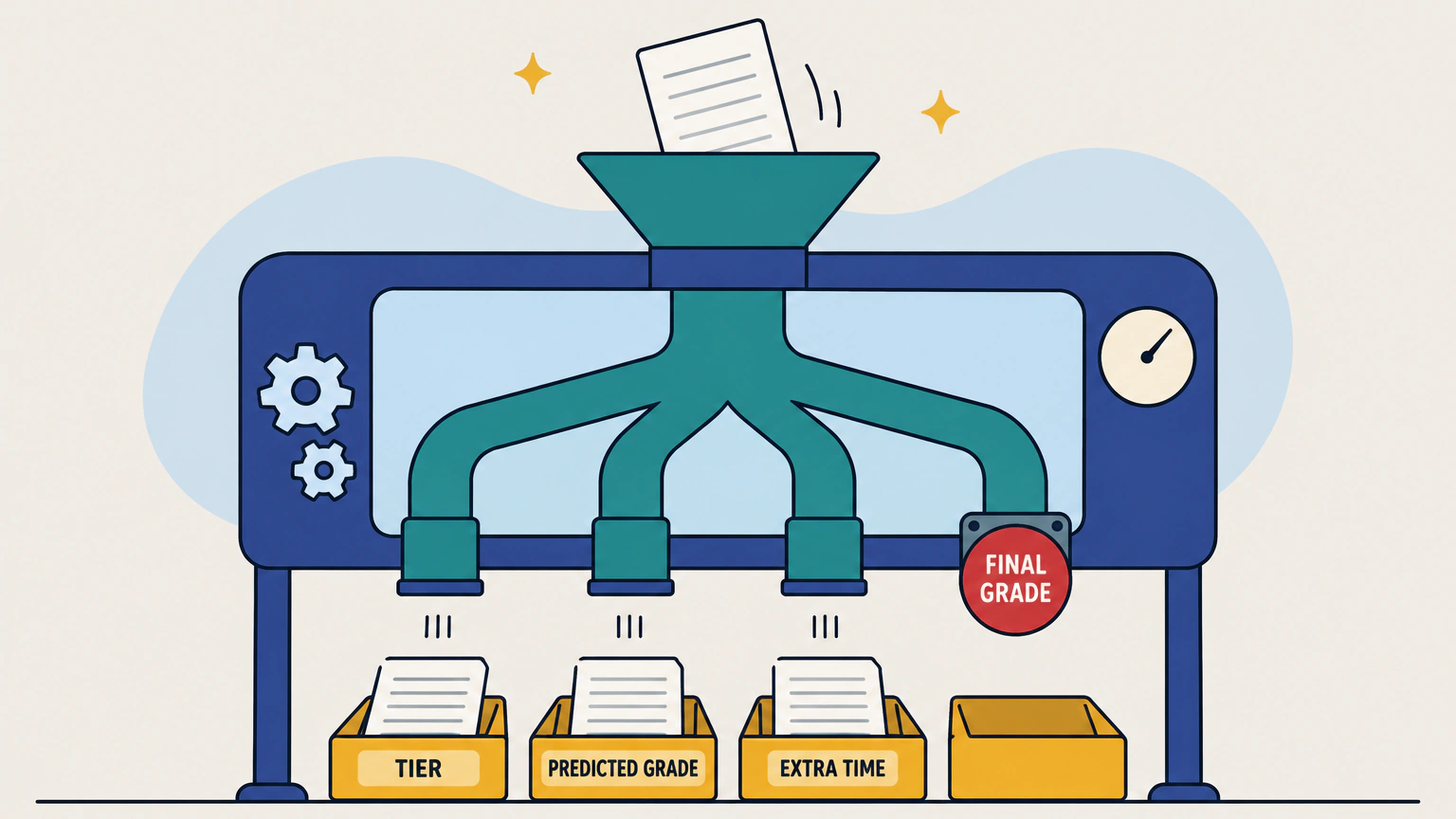
Mock exams don't count towards a GCSE grade. Your child's school sets them, marks them and keeps them, and the grade on the certificate comes only from the real exams in May and June and any coursework. What a Year 11 mock does feed is quieter and arrives sooner: the tier your child is entered for before entries close on 21 February 2027, the predicted grades a sixth form or college sees, the evidence behind any extra time, and the one set of papers Ofqual asks schools to keep in case summer exams can't go ahead.
Each of those four has its own owner and its own date. Know them, and a bad mock stops being a verdict. It becomes a few conversations you can still have in time.
On this page
What a mock exam is, and where the result goes
A mock exam is a practice run of the real thing, set and marked by your child's own school. Ofqual, the exams regulator in England, asks for exam-like conditions. Students shouldn't know the questions beforehand. They work alone, with no books or notes, under supervision, on timed papers that match the real ones. That needn't mean a sports hall, because Ofqual says "these controls could be provided within a classroom rather than exam hall setting".
The papers "should be based on exam board materials as far as possible" and marked "in line with published exam board mark schemes". A teacher may tell your child which grade the mark points to, but Ofqual is blunt that this "is not an indication of what their final grade would be". The result stays in school.
We've written this for England. Families in Wales and Northern Ireland should check their own school's exam board and dates, and Scotland's prelims are a different system.
Why the paper usually stays in school
If you've asked to see the mock paper and been told no, there's usually a real reason. AQA keeps "the most recent series of past papers" confidential "for one year for the purposes of mock examinations", so your child's mock may well be last summer's actual paper. AQA tells schools they "must not allow secure papers to physically leave the centre", and it puts the summer 2026 question papers on its public website on 9 July 2027.
That rule covers AQA's confidential recent papers only. Ofqual says students "may be given copies, or the original work, where this would support their study", so older, public papers can come home. Either way, ask to go through the marked paper in school, question by question.
Are mocks harder, or just earlier?
Often a mock is a recent year's real GCSE paper, and then the questions are exactly as hard as the exam itself. What changes is the timing. A November mock comes months before the course ends, with weeks of revision behind it rather than months. It's a long training run, not race day. The student who crams for a week, gets a poor grade and decides June is hopeless has read it the wrong way round.
Ofqual says students "should normally only be assessed on content they have been taught so far", so ask whether a paper included topics the class hadn't reached. The grade is an estimate twice over, too. The mark is real, but the boundary that turns it into a grade is borrowed from another year. Ofqual tells schools to use papers from 2019 and earlier or from 2023 onwards, skipping the more lenient years in between.
When schools hold mocks
There's no national mock date. Each school sets its own. Ofqual noted in 2023 that "many schools and colleges already conduct their mock assessments late in the first term, or in the first half of the second term". Its guidance encourages schools to finish the evidence-gathering assessments "in the first half of the academic year where possible". To see what that looks like, we read eight English schools' own calendars for GCSE mock exams this year.
When eight schools in England hold Year 11 mocks, 2026 to 2027
| School | Where | First Year 11 mocks | What else the calendar shows |
|---|---|---|---|
| Queen Elizabeth High School | Hexham, Northumberland | Wednesday 14 to Thursday 22 October 2026 | Spring round Wednesday 3 to Friday 12 February 2027 |
| Dame Elizabeth Cadbury School | Birmingham | Thursday 15 October to Thursday 5 November 2026, either side of half term | None listed |
| Alcester Grammar School | Alcester, Warwickshire | 2 to 10 November 2026 | A spring round in February |
| Thorns Collegiate Academy | Brierley Hill, West Midlands | From Friday 13 November 2026 | Results day Friday 8 January 2027. Second round from Monday 22 February 2027 |
| Priory School | Shrewsbury, Shropshire | Monday 16 to Friday 27 November 2026 | None listed |
| Brookvale Groby Learning Campus | Groby, Leicestershire | Weeks of 16 and 23 November 2026, then language speaking mocks | Results day in the week of 4 January 2027. Core-subject mocks the week of 8 March 2027 |
| St Martins School | St Martins, near Oswestry | 16 to 26 November 2026, with Year 10 | Second round 1 to 5 February 2027 |
| Northstowe Learning Community | Northstowe, Cambridgeshire | Monday 11 to Friday 29 January 2027 | Listed as spring mocks. No autumn round shown |
Read from each school's own 2026 to 2027 calendar, key-dates page or mock timetable. Eight schools show the spread, not a national pattern, and "none listed" means we didn't find a later round on the page we read.
Two of the eight start in October and five in November. One holds its first round in January. Five list a second, spring round in February or March, and two publish a January results day. Four list Year 10 mocks too: three in the summer term (from April, from late April into May, and from late June into July) and one alongside Year 11, in November and February.
For your own child's dates, the school calendar or the head of year is the only reliable source.
Four things a Year 11 mock feeds into
The mock grade goes nowhere official. The evidence it produces does, though. So are mocks important? For four decisions, yes. Four different people use that evidence, and each decision has a date after which a mock can't change much.
What a Year 11 mock feeds, and the date that matters
| What the mock feeds | Who acts on it | The date that matters for summer 2027 |
|---|---|---|
| The tier in maths, the sciences, statistics and modern languages | The school, ranking students on classroom assessment evidence | Entries close 21 February 2027. AQA and Pearson Edexcel change a tier free until 21 April 2027 |
| Predicted grades for a sixth form or college | Your school writes the reference. The college makes a conditional offer | Each college sets its own deadline. Results day, 19 August 2027, confirms the place |
| 25% extra time | The SENCo, with an assessor where needed | Processed by 21 March 2027 |
| Backup evidence if exams are cancelled | The school keeps the papers. They're used only if exams can't go ahead | Only if the summer series, due to start on 10 May 2027, is cancelled |
| The GCSE grade itself | The mock result does not count while exams go ahead | Results day, 19 August 2027, reports the real exams and any coursework |
Entry and access deadlines are JCQ's common dates for the June 2027 series. The free tier-change window is AQA's and Pearson Edexcel's. Schools using WJEC or CCEA papers should check those boards' own dates.
Which tier your child sits
Some GCSEs come in two tiers. Ofqual lists them: maths, combined science, physics, chemistry, biology, statistics and modern foreign languages. Foundation tier awards grades 5 to 1 (5-5 to 1-1 in combined science). Higher tier awards 9 to 4, or 9-9 to 4-4 in combined science. There's a narrow safety net: grade 3, or 4-3 in combined science, for students who just miss the bottom grade. Below that, the result is U. A grade 4 or 5 is worth the same on either tier, and the certificate doesn't show which tier was sat.
The school decides the tier. Ofqual tells schools to use "evidence from classroom assessments ... for ranking students", and a Year 11 mock is exactly that kind of evidence. Entries close on 21 February 2027. AQA tells schools to enter the most likely tier, and adds that "Tiers can be changed for free before the amendment deadline date". For AQA that's 21 April 2027, and Pearson Edexcel's amendment fees start on 22 April. After that, AQA charges the school an amendment fee equal to the whole entry fee, which is £52.85 for GCSE maths.
So after the November mock, ask which tier your child is entered for in each tiered subject, and what would move it. A spring mock can still change the answer for free. If your real question is about marks, we've worked out how many marks a grade 4 actually takes on each maths tier.
The predicted grades a sixth form sees
Sixth forms and colleges make offers on GCSE grades your child hasn't sat yet, so they lean on what the current school says. Lancaster Royal Grammar School's conditions are "your GCSE results and a satisfactory report from your current school". Solihull Sixth Form College asks the school for a reference itself. It also says it "might ask you to provide your mock exam grades" when it advises on what to study. Either way the offer stays conditional, and Solihull is clear that the place depends on getting the grades its courses need.
Ofqual's guidance notes that mocks also inform "decisions on predicted grades, be that for use internally or for external use". Each college sets its own deadlines. It's worth knowing how many GCSEs a sixth form asks for as well.
Whether extra time has the evidence behind it
If your child has 25% extra time, or might need it, this is the part of the mock that matters most. JCQ, which sets the shared exam rules for the boards, says access arrangements (extra time, rest breaks and similar help) must reflect a student's "normal way of working". The SENCo, the teacher who coordinates special educational needs, must work with staff so that approved arrangements are "put in place for internal school tests, mock examinations and examinations".
The evidence bar has gone up. For 25% extra time applications processed from 1 September 2025 (GCSE resits apart), the file must hold "a sample of internal school tests/mock exam papers across relevant subjects showing the application of 25% extra time", plus teachers' comments on how your child uses it. It works in reverse too: "If a candidate has never made use of the arrangement granted to them, e.g. 25% extra time or supervised rest breaks, then it is not their normal way of working", and the SENCo may consider withdrawing it only if that won't put your child at a substantial disadvantage.
Applications for summer 2027 must be processed by 21 March 2027. A new diagnosis, a newly apparent impairment from an existing disability, or a temporary injury or impairment can justify a late application. The change must arise after the deadline.
Families whose first language isn't English should ask the SENCo which route applies. The learning-difficulty route doesn't cover literacy difficulties mainly caused by English, Irish or Welsh not being their first language. JCQ has a separate bilingual-dictionary route with 25% extra time for some recent arrivals who meet strict language and schooling conditions. Ask the SENCo about that route before ruling extra time out. For help learning English, you can find English classes near you.
Before you pay for a private assessment: If you're thinking of paying for a private dyslexia or processing assessment to get extra time, speak to the school's SENCo first. Under JCQ's rules, an outside assessor's report only counts as evidence if the assessor has liaised with the school and received the access arrangements paperwork before the assessment takes place. A diagnosis on its own doesn't entitle anyone to extra time, and the decision is the school's.
The backup paper Ofqual asks schools to keep
There's one more job a mock does, and families hear least about it. Ofqual's guidance for England "asks that schools and colleges ensure students sit mock exams in exam conditions before their formal exams, and that their papers are retained. One set of mocks for this purpose should be sufficient."
Those papers would be used for teacher assessed grades only "in the unlikely event that government determines that exams are not able to go ahead". They're not meant for "localised disruption to teaching and learning". Ofqual's September 2026 guide for schools repeats that one set of mocks is likely to be enough, and that schools should avoid over-assessment. Schools should also tell students, where possible beforehand, whether a mock will be used as evidence.
So ask which round is the evidence set, and keep it in proportion. Ofqual says the government doesn't expect exams to be cancelled.
If your child is ill or misses a mock
What happens after a missed mock is up to the school, so ask what its policy is.
For the evidence set, Ofqual does ask for a few things. "Centres should make sure students know they need to tell their teachers before, or immediately after, the assessment of any events outside of their control." If illness or a bereavement affected the paper, the teacher "should mark the assessment as normal but record the issues". After a serious illness that kept a student away, Ofqual accepts that other work may have to stand in. If a need for a reasonable adjustment only comes to light after the mock, the teacher records why and, where possible, offers "a different, but equivalent, assessment". A catch-up sitting has to be fair to everyone else, so Ofqual asks for the same material at the same time, or different material at different times.
Missing a real GCSE paper in May or June is a different matter. That goes through JCQ special consideration, a separate process with its own deadlines, which we cover alongside the summer 2027 exam timetable. For a mock, tell the school the same day, in writing.
Mocks in Year 12 and Year 13, and UCAS predictions
For a sixth-former, the UCAS deadline changes which mocks can shape a prediction. UCAS defines a predicted grade as the grade the school "believes they're likely to achieve in positive circumstances", based on "demonstrable evidence of performance" such as "past performance, internal assessments, or current student work". Predictions are "Finalised by the point of submitting an application", and universities "may only consider the predicted grades received as part of the UCAS application".
For 2027 entry, the deadline is 15 October 2026 at 18:00 for Oxford, Cambridge and most medicine, dentistry and veterinary courses. For most other courses it's 13 January 2027 at 18:00. UCAS tells applicants to check their school's own deadline, which comes first so the reference can be written. A January Year 13 mock can arrive after the prediction is fixed. What counts is the evidence the school held by then.
Predictions also run high. UCAS says "around half of UK 18-year-olds" were "predicted AAA and above in 2025", while "26% of accepted applicants secured AAA and above last summer". The Year 13 mock still matters, though. It's the final-year evidence set Ofqual asks schools to keep, and practice for the papers that decide whether an offer is met. For the next step, see what your A level grades are worth in UCAS points.
What to do with the result
Start by reading the grade properly. Ask which board's paper it was, which boundaries turned the mark into a grade, and which tier it was sat at. A mark means something only against its own paper, and for maths we've shown how many marks a grade 4 actually takes tier by tier.
Then do the useful part. Sort the marks lost, question by question, into three piles: topics not yet taught, topics taught but not learned, and exam technique. Check every past paper and revision guide at home against your child's exam board, specification and tier, because a guide for the wrong paper teaches the wrong paper. From mid-January to the first exam on 10 May 2027 is about four months.
Five questions for the parents' evening after mocks
- Which board's paper was this, and whose grade boundaries turned the mark into a grade?
- Which tier is my child entered for in each tiered subject, and when is the last date the school can change it?
- Is this the set of mocks the school is keeping as backup evidence, and did you record anything that affected it?
- If my child has extra time or rest breaks, did they use them in this mock?
- Which topics cost the most marks, and when will they be taught or revisited before May?
We sell nothing on this page, so we can say this plainly (here's how we work). A tutor earns their place when there's a named gap in one subject and months to close it, not a grade to rescue. If maths is the gap, you can find a maths tutor near you. Either way, take those five questions to the next parents' evening.
Questions families ask about mock exams
Do mock exams count towards your GCSE grade?
No. The school sets the mock, marks it and keeps it, and nothing from it goes towards the grade on the certificate. That grade comes from the real exams and any coursework. The one exception would be a national cancellation. Ofqual asks schools to keep one set of mock papers sat in exam conditions, to be used only if the government decides summer exams can't go ahead.
Are mocks harder than the real GCSEs?
Usually the questions are just as hard, because a mock is often a recent real paper. AQA keeps its most recent papers off its public website for a year so schools can use them as mocks. What makes a mock feel harder is timing. It's sat months before the course ends, with less revision behind it, and Ofqual says students should normally only be tested on what they've been taught so far.
What happens if you fail your mocks?
Nothing official. A mock grade doesn't appear on any certificate and doesn't count towards the GCSE. It can still move decisions inside school: the tier your child is entered for in a tiered subject, the predicted grades a college sees, and whether extra time has the evidence behind it. Ask which of those is on the table, and by when. Then work on the topics that cost the most marks.
Do sixth forms look at mock results?
Indirectly, yes, and sometimes directly. Solihull Sixth Form College asks your current school for a reference, and Lancaster Royal Grammar School makes its offers conditional on a satisfactory report from that school. Solihull also says it may ask for mock grades to help advise on what to study. Offers stay conditional either way, and it's the August results that confirm the place.
Do you do mocks in Year 10?
Often, yes. Four of the eight school calendars we read list Year 10 mocks: three in the summer term, between April and early July, and one alongside Year 11 in November and February. Treat them as practice. The set Ofqual asks schools to keep as backup evidence should normally come from the final year of the course.
When do mock results come out?
There's no national day, so each school picks its own. Two of the eight schools we checked publish one: Thorns Collegiate Academy on Friday 8 January 2027, and Brookvale Groby Learning Campus in the week of 4 January, both after November mocks. If your school's calendar doesn't show a date, ask the head of year when papers come back.