

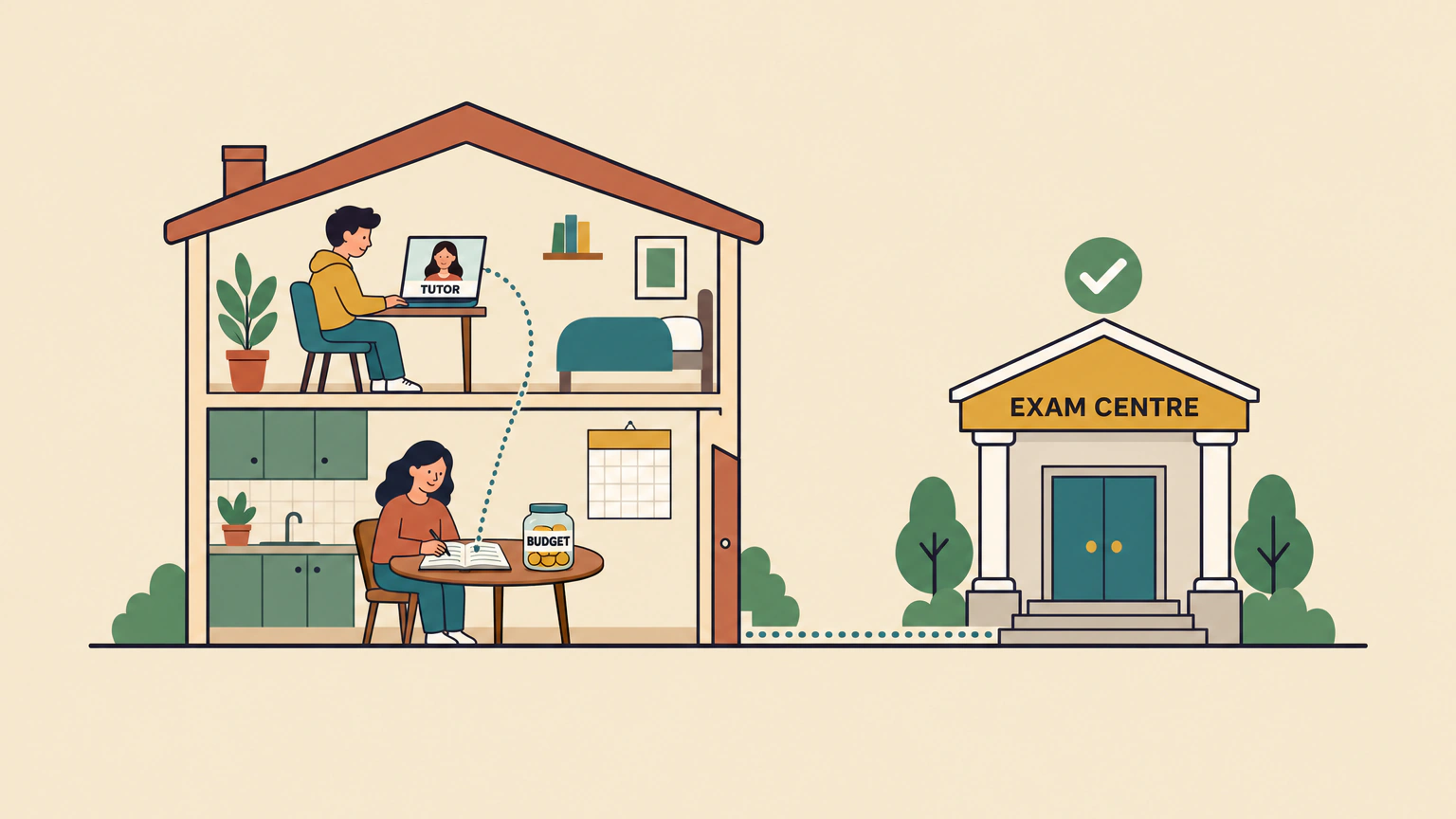
Home schooling in the UK comes with no council or government funding for the family, so it costs whatever you choose to buy. One large tutoring platform's GCSE tutors average about £36 an hour. A single GCSE sat as a private candidate costs between £197.95 and £390 at the six exam centres whose price lists we read, and combined science can reach £780. Some help is free or funded, though: part-time college places for home-educated 14 to 16 year olds in England, Child Benefit after 16, and council-arranged provision for a child with an education, health and care (EHC) plan.
On this page
- What home education costs, and why nobody sends you a bill
- What a tutor adds each month
- What a GCSE costs when you sit it privately
- The help that's free or paid for by someone else
- What the new law will change, and what it won't pay for
- Scotland, Wales and Northern Ireland
- Questions parents ask about the cost of home schooling
What home education costs, and why nobody sends you a bill
The Department for Education (DfE) is blunt about who pays. Parents who home educate "must be prepared to assume full financial responsibility for the child's education, including bearing the cost of any public examinations". Councils "do not receive funding to support home-educating families", apart from high-needs funding for some children with special educational needs. So any help your council gives with exam fees is its own choice.
That leaves a bill with three lines. Teaching help comes first: tutors, group programmes and online courses. Then exams. Then everything else DfE lists: books, paper, IT and other equipment, educational visits and sport. Sport is where swimming lessons for your child come in, because PE was one of the things school quietly covered.
DfE names one more cost that most budgets leave out: "loss of income if a parent is at home educating a child". If one of you cuts working hours to teach, put that figure at the top of the list.
You're in a lot of company doing these sums. Councils in England counted 126,000 children in elective home education (the official name for it) on census day in autumn 2025, up from 111,700 a year earlier, according to DfE. The line that arrives every month is the tutor, so start there.
What a tutor adds each month
Tutorful, one of the large tutoring platforms, publishes what its own tutors charge on average. Primary tutors average £33.01 an hour, Key Stage 3 £34.47, GCSE £35.86 and A level £41.88. By subject, it's £36.12 for maths, £37.51 for English and £43.04 for physics. Online lessons come in at £37.45 an hour, against £40.54 in person. Every tutor sets their own price, so treat these as a starting point.
| What you buy | Published price | Four weeks of it |
|---|---|---|
| One-to-one maths tutor, one hour a week | £36.12 an hour, one platform's maths average | £144.48 |
| Maths and English tutors, one hour a week each | £36.12 and £37.51 an hour | £294.52 |
| Small-group Year 10 and 11 core programme, 12 hours a week | £600 a month for 48 taught hours | £600 |
| Free online lessons from Oak National Academy | Free | £0 |
Tutor rates are the averages one large tutoring platform publishes for its own tutors, and every tutor sets their own price. The group programme is one Birmingham provider's published fee, and exam entries are charged on top.
Some families choose a cheaper shape: a small-group programme built for home-educated teenagers. A-Team Academy, based in Birmingham, charges £600 a month for its Year 10 and 11 core programme. That buys 48 taught hours of English, maths, biology, chemistry and physics, which works out at £12.50 an hour before any exam entries.
Be honest with yourself about what you can teach. Helping with a history essay is one thing. GCSE physics at the kitchen table, after a full day, is quite another. We'd buy help only for the subjects you can't cover, and if maths is the one you'd rather hand over, you can compare maths tutors near you on our own listings. Before the first lesson, check whether a private tutor needs a DBS check and ask what your tutor can show you.
What a GCSE costs when you sit it privately
A home-educated teenager sits GCSEs as a private candidate. AQA, one of the exam boards, defines that as someone who enters "through an AQA-approved school or college but is not enrolled as a student there". Then comes the catch: "It's up to the school or college whether to accept private candidates." The Joint Council for Qualifications (JCQ) keeps a list of centres that do, and AQA's page for private candidates points you to it.
Now the money. The exam board charges the centre a fairly modest entry fee. AQA's summer 2027 fee is £52.85 for GCSE maths and £96.25 for combined science. The centre charges you that, plus invigilation (paying staff to supervise the exam room), the room itself and its own admin. Here's what six centres charge, from a Suffolk secondary school to a Nottingham college.
| Centre | How it charges | GCSE maths | Combined science (two GCSEs) | If you miss its standard deadline |
|---|---|---|---|---|
| Thomas Gainsborough School, Great Cornard, Suffolk (secondary school) | The exam board's fee, plus £45 registration and an invigilation fee set by the number of papers | £197.95 (Pearson Edexcel, the school's own example) | Not on its list | A £25 late registration fee, on top of the board's late fee |
| Excel Exam Centres, six London sites | One price per subject | £225 | £375 | £60 more per subject, rising to £120 and then £180 |
| A-Team Academy, Birmingham | One price per subject, exam board fee included | £250 | £500 | The board's surcharge, passed on at cost |
| Exam Centre London | One price per subject, rising after each deadline | £250 | £390 | Maths rises to £320 and then £395 |
| David Game College, London | One price per subject | £290 | £430 | £425 for maths and £565 for combined science, if space allows |
| Nottingham College | £130 for each exam paper | £390 (three papers) | £780 (six papers) | No late rate on its page, and its fees aren't refundable |
Each centre's published price for private candidates, for summer 2027 where the centre labels its series and from Thomas Gainsborough School's November 2026 list. Every price has to cover the exam board's own entry fee, which AQA sets at £52.85 for GCSE maths and £96.25 for combined science in summer 2027. Nottingham College's figures are £130 times the number of papers in each AQA subject.
Hold those prices against what you may have read. One home-schooling budget guide suggests allowing £80 to £150 a subject. The cheapest maths entry on any of these six lists is £197.95. If you're budgeting a full set, multiply by how many GCSEs most students sit before you settle on a number.
Why one GCSE can cost twice as much at another centre
Four things drive the gap.
The first is per-paper pricing. Nottingham College charges £130 for each exam paper. GCSE maths has three papers, so it costs £390 there. Combined science has six, which makes £780. The flat-fee centres charge £375 to £500 for the same two GCSEs.
The second is place. A-Team Academy prices the same GCSE maths entry at £250 in Birmingham, £275 in Manchester, £300 in London and £325 in Liverpool.
The third is extra support. If your child needs extra time or a reader (known as access arrangements), that costs money too. David Game College charges a £100 application fee for access arrangements, plus 25% of the exam fee for extra time. At Nottingham College, the assessment for access arrangements costs up to £250.
The fourth is any part of a subject done outside the written papers, which the boards call non-exam assessment. The English language spoken endorsement is the familiar one. AQA says centres "must only accept entries from a private candidate if they are willing to do this", so not every centre will take your child for every subject. Some charge for it on top: Thomas Gainsborough School adds £75 for the English spoken assessment. The steepest example we found was science. Exam Centre London lists AQA combined science at £390, or £1,120 with the practical work included, so ask which one your child needs.
On top of all that sits the booking agent. An agent books your child a seat at a partner centre and adds its own fee to that centre's price, £30 a subject at the one we looked at.
The deadlines that push the price up
The exam board's deadline is the last one, not the first. AQA's summer 2027 entry deadline is 21 February 2027. From 22 February a late entry adds 100% of the board's fee, and after 21 April 2027 a very late entry adds 150%.
Centres set their own dates earlier. A-Team Academy and David Game College both close on 1 February 2027, and after that David Game's maths price rises from £290 to £425, if it still has space. Excel Exam Centres adds £60 a subject from 6 February, then £120 and £180 as later dates pass. Exam Centre London's deadline is 15 February.
Read the refund terms before you pay. Excel refunds before its deadline, minus £40 a unit or paper, and nothing after. Nottingham College's fees aren't refundable at all.
If your teenager only needs English or maths again, the November series may suit better, and we've covered resitting English or maths in November separately. For everyone else, check when the summer 2027 papers fall and count back from there.
Before you pay an exam centre:
- Ask whether the price is per subject or per exam paper, and get the total for every paper in writing.
- Ask whether the exam board's own fee is included or added on top.
- Write down the centre's own deadline, which can fall about three weeks before the exam board's.
- Ask what you get back if you withdraw, and by which date.
- If your child needs extra time or a reader, ask what the centre charges to assess and arrange it.
- For English language or any subject with coursework, check the centre will supervise that part before you pay.
The help that's free or paid for by someone else
Four routes cost a home-educating family little or nothing, and most of the guides we read miss three of them. DfE's guidance to councils adds two smaller points. A child who attends a state-funded school or college for part of the week does so at "no cost to the parents". A school or college attended part-time may also meet exam costs. Oak National Academy's curriculum-aligned online lessons are free.
| Route | Who it's for | What it covers | Where it applies |
|---|---|---|---|
| Part-time college place | Home-educated 14 to 16 year olds a college agrees to take | The course itself, paid for by the government | England |
| Child Benefit after 16 | A 16 to 19 year old in full-time non-advanced education | The weekly payment carries on, until 20 at the latest | Across the UK |
| EOTAS through an EHC plan | A child whose council agrees school is the wrong place for their provision | Provision the council arranges and pays for | England |
| Council help with exam fees | Any home-educated child, if your council has a policy | Only what your council chooses to offer | England |
| Oak National Academy | Anyone | Free online lessons that follow the national curriculum | Free to use anywhere |
Red flag: two things that stop when your child leaves school. Free school meals don't follow your child home. Leeds City Council's guidance says a child who qualified for them gets no support in their place once the family home educates, pupil premium included. Tax-Free Childcare can't pay for teaching at home either, because it only pays approved childcare such as registered childminders, nurseries and clubs. At least one widely read guide says otherwise on both counts, so build your budget without them.
A part-time college place from 14
Paragraph 52 of DfE's funding rules for 2026 to 2027 is the sentence to know: "DfE funds children 14 to 16 years old who are currently electively home educated who enrol at funded institutions to study part-time programmes only." The money goes to the college and covers the course. Home-educated children who attend schools and academies aren't eligible for that funding.
Colleges choose whether to offer places, and each one sets its own terms. Plumpton College, near Lewes, shows what a real offer looks like. Its home-educated Year 10 and 11 students attend two or three days a week, studying a vocational subject alongside English and maths, with PSHE and applied science as options. Applicants must have been out of education for at least six months before the course starts in September. The course fees are funded, but parents pay for materials, equipment, safety wear, handbooks and travel, plus a facility fee for three-day students. The application form for 2027/28 opens on 26 October 2026 and stays open for five weeks. The college says its places are regularly oversubscribed.
That six-month rule is the trap. Ask your nearest further education colleges now, and check each one's out-of-school rule before you set a deregistration date.
Child Benefit after 16
Child Benefit carries on as normal while your child is under 16. After that, it stops on 31 August on or after their 16th birthday unless you tell HMRC they're staying in education. It can then continue until they turn 20, as long as the education is full time and below degree level.
The regulations set the bar. Full time means more than 12 hours a week on average, in term time, of tuition, practical work, supervised study or exams. Unsupervised study and meal breaks don't count. A young person with an illness or disability can qualify on fewer hours, if that suits their circumstances.
The big change came on 1 September 2025. Before then, education outside a school or college had to have started before your child turned 16. A change to the Child Benefit regulations removed that condition across the UK.
One more condition applies at the far end. Your child must have started the course, or been accepted onto it, before turning 19. Only the person who claims Child Benefit can tell HMRC about it.
If your child has an EHC plan, ask about EOTAS first
This is where a hurried deregistration letter can cost a family support it already has. While a council maintains an EHC plan, it "must secure the specified special educational provision". That duty falls away "if the child's parent or the young person has made suitable alternative arrangements". DfE's guidance spells out the result. If your home education is suitable, the council has no duty to arrange any of the special educational provision in the plan.
EOTAS (education otherwise than at school) works differently. A council in England may arrange the provision outside school if it's satisfied that school would be inappropriate, and it must consult you first. The council arranges that provision and pays for it. DfE's statistics count it separately from home education, because it isn't elective.
If your child attends a special school, you'll also need the council's permission to educate them at home, according to GOV.UK. From a mainstream school you usually won't, even with an EHC plan. A school attendance order is the exception: you must get the council's permission first.
A decision this size is worth taking to your council's SEND team, or to an independent SEND adviser, before the deregistration letter goes in. Put the EOTAS question to them first.
What the new law will change, and what it won't pay for
The Children's Wellbeing and Schools Act 2026 received Royal Assent on 29 April 2026. It adds new sections to the Education Act 1996 for England and Wales, and several of them touch home-educating families.
Councils must keep a register of children not in school. Parents must tell the council their child is eligible to be on it and pass on the information they have. Once your child is registered, the council must support you if you ask, "by securing the provision of advice and information". That support may include "information about access to examinations for the General Certificate of Secondary Education". English councils must also offer parents a forum twice a year.
Some children will need council consent before they're withdrawn from school. That covers children the council placed at a special school or at certain independent schools providing for special educational or additional learning needs. It also covers current section 47 enquiries or action, and section 47 action taken in the previous five years.
None of this has started. On legislation.gov.uk these sections are in force only so that regulations can be made. Wales will bring them in through its own regulations, after a public consultation. And even once the duties begin, they pay no fees. The support duty is advice and information, not money.
Scotland, Wales and Northern Ireland
Most of the money rules above are England's. The other three nations differ mainly on who has to give permission, and two of them say outright that the costs are yours.
In Scotland, you need the council's consent to take your child out of a council-run school. Once you're home educating, mygov.scot says you're responsible for "any costs or qualifications your child wants to take".
In Wales, you tell the school in writing. The Welsh Government says you need the council's permission only if your child attends a special school. Registers will follow under Welsh regulations.
In Northern Ireland, you don't need permission from the school or the Education Authority, though you do tell the school principal. If your child is leaving a special school, you let the Education Authority know. Nidirect is plain about money: "there are no funds directly available for parents who decide to educate their children at home".
Two money points travel differently. The funded college place is England's funding rule. The Child Benefit change applies UK-wide. For local help, we list tutors and lessons in Scotland, in Wales and in Northern Ireland.
Questions parents ask about the cost of home schooling
Short answers to the money questions that come up before the letter goes in.
Is home schooling free in the UK?
No. Home education is legal, but no council or government money comes with it. The Department for Education tells parents to expect "full financial responsibility" for their child's education, exams included. Some help is free around the edges: Oak National Academy's online lessons, part-time college places for some 14 to 16 year olds in England, and Child Benefit, which carries on as normal for a child under 16.
Do you get paid to home school your child?
No. There's no payment or allowance for home educating, and in England any council help with exam fees is at the council's discretion. Child Benefit carries on as normal for a child under 16. After 16 it continues only while your child meets HMRC's full-time, non-advanced education rules, and you must tell HMRC.
Do home-educated children still get free school meals?
Usually not. Leeds City Council's guidance says there's no funding when a family chooses home education, and a child who qualified for free school meals gets no support in their place, pupil premium included. Plan your food budget as if school lunches stop on the day your child comes off the roll.
Can you use Tax-Free Childcare to pay for home schooling?
Not for the teaching. Tax-Free Childcare only pays approved childcare: registered childminders, nannies, nurseries, clubs and playschemes, and a few others on GOV.UK's list. A private tutor or your own teaching at home isn't on it. The scheme also ends in the September after your child turns 11, or 16 if they're disabled. Our guide explains what Tax-Free Childcare does cover.
How much does it cost to sit GCSEs privately?
At the six centres whose price lists we read, GCSE maths costs £197.95 to £390 and combined science, which counts as two GCSEs, £375 to £780. The exam board's own fee is a small part of that, £52.85 for AQA maths in summer 2027. Miss a centre's deadline and the price goes up.
Can a home-educated child go to college at 14?
Sometimes. In England the government funds colleges that take electively home-educated 14 to 16 year olds on part-time courses, but each college decides whether to offer places. Plumpton College, for one, takes Year 10 and 11 students two or three days a week if they've been out of education for at least six months, and parents pay for materials and travel.
Does Child Benefit stop when a home-educated child turns 16?
Not if they stay in full-time education. That usually means more than 12 hours a week on average of supervised study, tuition, practical work or exams. Fewer hours can count if illness or disability makes that appropriate. Since 1 September 2025 the home education no longer has to have started before 16. Tell HMRC, or the payments stop on 31 August on or after the 16th birthday.
We'd price the exam years first, because that's where the bill is lumpy and the deadlines bite. Then ask two questions before the deregistration letter goes in. Ask your council whether it helps with exam fees, and about EOTAS if your child has an EHC plan. Ask your nearest college whether it takes home-educated 14 to 16 year olds, and what its out-of-school rule is.