

On this page
- The short answer, and the line it turns on
- The two things your provider needs
- Which of your child's clubs and lessons qualify
- Why the rule lands where it does, nation by nation
- How to check your own club in ten minutes
- What to say if your club is not signed up
- The money, and where families lose some of it
- Questions parents ask about Tax-Free Childcare
The short answer, and the line it turns on
Three bills arrive in the same fortnight. The after school club, the Saturday swimming lesson, and the Easter camp you booked before you thought about it. You can use Tax-Free Childcare for a breakfast club, an after school club or a holiday camp. You usually can't use it for a one-hour weekly swimming or dance lesson. What decides it isn't the activity. It's whether the provider holds a place on a childcare register, and whether it has signed up with HMRC as well. In England, a club that looks after each child for under two hours a day can't join Ofsted's voluntary register, unless it runs before or after school.
The line runs between care that wraps around the school day and lessons that stand on their own. Wraparound care counts as childcare. An hour of coaching on a Saturday morning counts as a lesson. Lessons sit outside the scheme, unless the provider has gone out of its way to join a register. That's why one family pays four fifths of the price of an Easter camp while the family next door pays full price for Tuesday gymnastics. Same scheme, different session. You can settle your own case in ten minutes, with one question and one search.
The two things your provider needs
Most parents know about the first test and get caught by the second. A provider has to hold a place on a childcare register. That's a matter for the regulator in your nation. Then, separately, it has to sign up with HMRC before it can take a penny from a childcare account. Being registered doesn't do that second job. Plenty of good clubs pass the first test and never get round to the other one.
First, a place on a childcare register
GOV.UK calls it "approved childcare", and the list is short. It covers a registered childminder, nanny, playscheme, nursery or club, a registered school, or a childminder or nanny working through a registered agency. A home care worker from a registered agency counts too. Who keeps the register depends on where you live. It's Ofsted in England, Care Inspectorate Wales, the Care Inspectorate in Scotland, and your local Health and Social Care Trust in Northern Ireland. Notice what's absent from all of that: any mention of what the children do. The register is the gate. Trampolining, maths and karate never appear on the form.
Second, a separate sign up with HMRC
Registration gets a provider to the door. Signing up with HMRC opens it. A registered club sets up its own childcare provider account, and it needs three things to do that: the 11-digit user ID from its HMRC letter, its bank details, and the postcode it registered with its regulator. That's an afternoon job at most, and it's why a genuinely registered club can still tell you it can't take your payment. If the letter never arrived, the provider can contact the Childcare Service helpline for its user ID. So when a club says no, ask which of the two things it's missing.
Which of your child's clubs and lessons qualify
The sessions families actually buy sort out like this. Treat it as a starting point rather than a verdict: two of these six cases go either way.
| What it is | Can the account pay for it | What decides it |
|---|---|---|
| Breakfast club and after school club | Usually yes | On GOV.UK's own list of what the account covers, and the under-two-hours bar carves out care immediately before or after school |
| Holiday club or activity camp | Usually yes | On the same GOV.UK list. Check the venue, because registration attaches to premises |
| Weekly one-hour class outside school hours | Usually no | In England, Ofsted will not register a provider that looks after each child for under two hours a day, unless it offers before or after school care |
| All-day or half-day workshop in the holidays | It depends | Check whether the workshop is approved childcare and whether the provider is signed up with HMRC |
| Private tuition during school hours | No | GOV.UK excludes private lessons during school time by name |
| A club run by a registered nursery or school | Sometimes yes | The setting's registration may cover it. Ask which provider and registration the payment sits under |
Breakfast clubs and after school clubs
Wraparound care is the clearest yes in the scheme. GOV.UK says it plainly: the account can help with care outside school hours, "for example after school clubs or breakfast clubs". A 3.15 to 5 o'clock session lasts under two hours, which would normally stop a provider registering. Ofsted's rule carves out exactly this case, for care immediately before or after the school day.
That matters most where one provider sells you two different things. Plenty of gymnastics classes run a school pick-up session on a Wednesday and a standalone hour on a Saturday. Same hall, same coaches. The first can be paid from your account, and the second usually can't.
Holiday clubs and activity camps
Half-term and summer camps sit on GOV.UK's list beside after school clubs and play schemes. The operator still has to be approved and signed up for Tax-Free Childcare. Two checks are still worth five minutes.
First, check the venue and not the brand. Registration attaches to premises, so a chain's Bristol site being on the register tells you nothing about its Leeds site. Second, check before you pay. The government's share is added to money you put into the account, so a deposit you pay by card never picks it up.
The weekly hour, and why it usually cannot qualify
This is the part that catches families out. It feels arbitrary, and it isn't a matter of goodwill. Ofsted's guidance is blunt about it: "You cannot register if you look after each child for under 2 hours a day unless you are providing before and/ or after school care." A 45-minute swimming lesson or an hour of ballet falls under that line. The teacher can be brilliant, insured, DBS-checked and keen to help. The door is still shut, because the bar sits on registering rather than on signing up with HMRC.
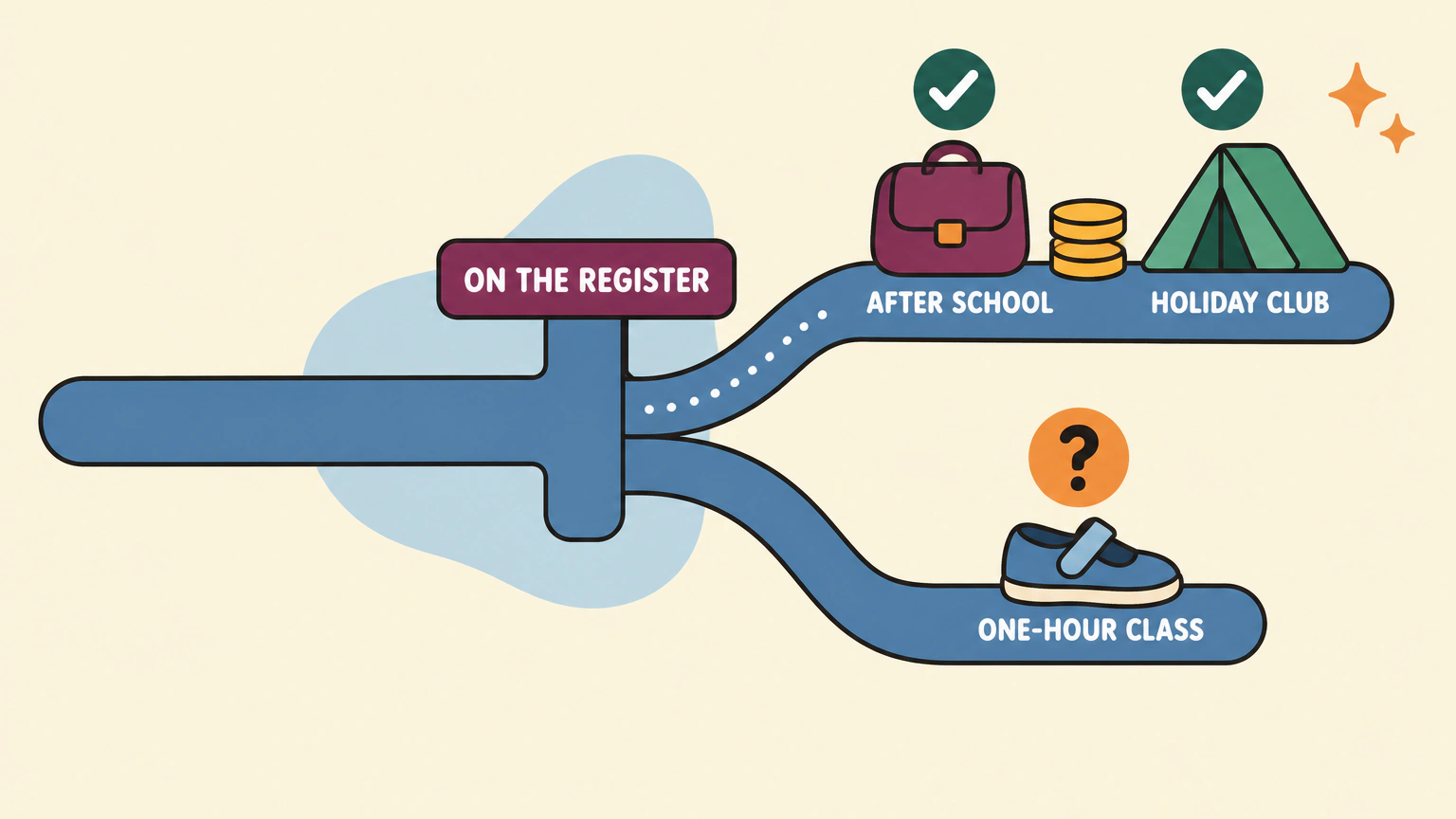
Two situations flip the answer, and both are worth a question. The class might be run by a nursery or school that's registered in its own right, and then the setting's registration may cover the session. Or your provider might already be registered for something longer, such as a holiday intensive. Ask which registration the weekly class sits under.
None of this makes the lesson less worth having. It just means you pay for it the way you pay for shoes. Our own listings for swimming lessons near you sit on both sides of that line. At the same pool, a weekly half hour may sit outside the scheme while an approved Easter intensive qualifies.
Private lessons in school hours, ruled out by name
One category is excluded outright rather than by the two-hour rule. GOV.UK says you can't get help paying for your child's compulsory education, or for "private lessons during school time (for example, private music lessons during school hours)". That's the piano teacher who comes into school on a Thursday morning. It's the maths tutor who sees your child in a free period. Move the same lesson to 4.30pm and the exclusion drops away, though the two-hour bar is then waiting for it.
Why the rule lands where it does, nation by nation
Tax-Free Childcare is one UK-wide scheme run by HMRC, and the test that decides whether your club can take part is devolved. Four nations, four regulators, four sets of words. It's why a parent in Cardiff and a parent in Carlisle can get different answers about the same franchise. And it's why a Welsh toddler class that's exempt today has a date in its diary.
| Nation | Who holds the register | When a clubs or lessons provider has to be on it | Where you check |
|---|---|---|---|
| England | Ofsted, which keeps the Early Years Register and the Childcare Register (compulsory and voluntary parts) | Care for under-8s on non-domestic premises for more than 2 hours a day, unless an exemption applies. Coaching or tuition for children aged 3 and over is exempt under the Childcare (Exemptions from Registration) Order 2008 (SI 2008/979), art. 6: no more than two of five activity types, and no under-5 attending for more than 4 hours a day | Ofsted's report and register search on GOV.UK |
| Wales | Care Inspectorate Wales | Coaching or tuition is excepted today under the Child Minding and Day Care Exceptions (Wales) Order 2010 (WSI 2010/2839), art. 15: up to two of five activity types, and no under-5 attending for more than 4 hours a day. From 1 April 2027, arts. 17 and 21 of WSI 2026/100 replace it: no exception for a child under 3, and none for a 3 or 4 year old coached for more than 2 hours a day | Care Inspectorate Wales service directory |
| Scotland | The Care Inspectorate | Day care of children on non-domestic premises, but only where the service runs for more than 2 hours in any day (Public Services Reform (Scotland) Act 2010, sch. 12, paras. 13 and 14(b)). Provision on fewer than 6 days a year sits outside it if the regulator was told in writing beforehand (para. 15) | The Care Inspectorate's register of care services |
| Northern Ireland | Your local Health and Social Care Trust | Day care for children under 12 on non-domestic premises for more than 2 hours in any day (Children (Northern Ireland) Order 1995, arts. 118(1)(b) and 120(1)), registered separately for each premises (art. 120(2)). Fewer than 6 days a year is excluded after written notice (art. 121(4)) | The Trust's early years team, listed on nidirect |
England, and the register an exempt club can choose to join
The English exemption is the reason your child's club may not be registered, and it's written for exactly the sort of place we list. A provider is exempt if it coaches or tutors children aged 3 and over in one or two activity types. The list of five is sport, performing arts, arts and crafts, school study or homework support, and religious, cultural or language study. Under-fives can't attend for more than four hours a day. Ofsted adds that the activity has to be the main event, so a bouncy castle and a box of paints won't do.
Exempt isn't the same as barred. Ofsted's guidance calls the voluntary part of the Childcare Register "the only way you can register if you are exempt", and says that being on it "enables the parents and carers of children attending your childcare to claim tax-free childcare entitlements". A club that joins accepts real conditions: an enhanced DBS check with barred lists for everyone providing childcare, a first aid qualification, and a written complaints policy with three years of records and a reply within 28 days. So if your club is on that register, you've learned something about its vetting as well as its billing, and it's worth knowing what a DBS check actually proves.
Wales, Scotland and Northern Ireland
Wales runs a near-copy of the English exception today: the same four-hour limit for under-fives, the same cap of two activity types. That changes on 1 April 2027. A new Welsh order, made in March 2026, revokes the 2010 rules and tightens the exception. It won't apply to a child under 3 at all, and for a 3 or 4 year old it stops at two hours of coaching a day. Providers pulled into registration by the change have until 31 March 2028 to apply without being treated as in breach. For a Welsh parent, a toddler class whose provider is exempt today may be registered or approved from April 2027.
Scotland has no coaching carve-out. Instead, the Act doesn't count a service as day care of children unless it runs for more than two hours in any day. The weekly hour sits outside the system rather than inside it as an exception. Northern Ireland works the same way for children under 12, and registers each set of premises separately.
One honest limit. Today, we could confirm a single opt-in route for an exempt provider: England's voluntary part of the Childcare Register. We couldn't find an equivalent in Scotland or Northern Ireland. Wales has announced a Voluntary Approval Scheme from April 2027. It will let eligible families use Tax-Free Childcare with more exempt childcare, playwork and activity providers. If you're unsure which route covers your provider today, ask your nation's regulator.
How to check your own club in ten minutes
Start with the question that ends most cases in a sentence: ask the club for its registration number. A club that has one will give it to you in a reply. A club that starts explaining why it doesn't need one has just told you the answer. Everything after that is detail.
- Ask the club for its registration number with the regulator for your nation, and for the address that number is registered to.
- Search that number, or the provider's name, on the regulator's own directory, and check the registered address matches the building your child walks into.
- Ask whether they've also signed up separately for an HMRC childcare provider account, because the register on its own doesn't let them take your payment.
- If they're registered but not signed up, ask them to sign up with the 11-digit user ID from their HMRC letter. They can contact the Childcare Service helpline if they do not have it.
- Check your own account is in date, because eligibility has to be reconfirmed every three months and a lapsed account pays nobody.
- Pay from the account rather than by card, and keep the confirmation. Money that goes straight from your bank to the club never gets the government's share.
What to say if your club is not signed up
Keep the message to a registered club short and specific, because specific is what gets it done. "You're registered with Ofsted, so you can sign up for a childcare provider account with HMRC. You'll need the 11-digit user ID from your sign-up letter, and the postcode you registered. Parents here would save a fifth on eligible bills until they hit the quarterly cap." Clubs move quickly when three families ask in the same week, because it's their own income at stake too.
A club that's exempt is a different conversation, and pushing it is unkind and pointless. Joining the voluntary register means DBS checks, first aid and a complaints policy, for a coach who runs six hours of classes a week. In England, the under-two-hours bar may stop them anyway. Ask instead whether they run anything longer in the holidays, because that session may qualify.
So is it worth switching providers for a fifth off? For a holiday camp, yes, without hesitation. The sums are large, the weeks are interchangeable, and your child will be fine. For the Tuesday class your child loves, with the coach who knows her, no. We'd take the term of good teaching over the discount, and go looking for the saving in the holidays instead.
The money, and where families lose some of it
The scheme is generous and simple. Almost everything families lose, they lose to admin rather than to the rules.
The top up, the cap and the quarter
For every £8 you pay into the account, the government adds £2. That's a fifth of the bill. GOV.UK's own worked example is a £250 childcare bill: you pay in £200, and the government adds £50. The cap sits on the top-up rather than on what you pay in, and it's £500 for each child every three months, up to £2,000 a year. If your child is disabled it doubles, to £1,000 a quarter and £4,000 a year. GOV.UK says that extra can pay for more hours, or for specialist equipment your provider buys. Where a child qualifies for it, that's often what pays for the extra hours behind lessons for an autistic child.
Set against a real bill, it's meaningful money. Across our own 734 UK cost profiles for dance classes, the average spend comes to £532. On a provider that qualifies, you'd pay in £426 and the government would add about £106.
The reconfirmation that ends it quietly
Every three months you have to sign in and confirm you're still eligible. Miss it and, in GOV.UK's words, "your Tax-Free Childcare will stop". It bites mid-term, when a camp is booked and the money is meant to be sitting there. Put the date in your phone the day you open the account, alongside the invoice reminders. One minute of admin protects three months of top-up.
The swap you cannot undo
You can't claim Tax-Free Childcare at the same time as Universal Credit or keep getting new childcare vouchers. If you switch from vouchers, you can still spend any you already have, including in a joint payment with Tax-Free Childcare. Once you tell your employer you're getting Tax-Free Childcare, you can't rejoin their scheme. You have 90 days from applying to tell them. With Universal Credit, GOV.UK says to wait for the decision on your Tax-Free Childcare application before you cancel the claim.
Run the numbers before you move. Universal Credit can refund up to 85% of childcare costs, which beats a fifth for a good many families. GOV.UK's childcare calculator compares them in a few minutes. We're not HMRC, and your own figures decide it, so use the calculator and ring the Childcare Service helpline before you cancel a thing.
Questions parents ask about Tax-Free Childcare
Can you use Tax-Free Childcare for swimming lessons?
Usually not for a weekly half hour in the pool. A short weekly lesson normally sits outside registered childcare. A holiday crash course is different. It may run as approved childcare, so check whether the pool is approved and signed up with HMRC.
Does Tax-Free Childcare cover holiday clubs?
Yes. Holiday clubs and play schemes sit on GOV.UK's list of what the account pays for, beside after school clubs and childminders. The camp still has to be registered with your nation's regulator and signed up with HMRC. Registration attaches to the venue, so check the site your child is booked into rather than the company name.
How much can you put into a Tax-Free Childcare account?
The cap sits on the government's share rather than on your own payments. You get £2 for every £8 you pay in, up to £500 for each child every three months, which is £2,000 a year. For a disabled child it's £1,000 every three months, up to £4,000 a year. Pay in more than that and the extra simply doesn't attract a top-up.
Can you get Tax-Free Childcare and Universal Credit at the same time?
No, you can't claim both. GOV.UK says to wait for the decision on your Tax-Free Childcare application before cancelling a Universal Credit claim. Universal Credit can refund up to 85% of childcare costs, against a flat fifth here. Run the childcare calculator before you switch either way.
Can you use Tax-Free Childcare alongside the free childcare hours?
Yes, and the two are designed to sit together. In England, HMRC checks whether you also qualify for Tax-Free Childcare when you apply for Free Childcare for Working Parents, and both schemes then run from the same childcare account. The account pays for what the free hours don't cover, such as an after school club or extra sessions.
Can both parents have a Tax-Free Childcare account for the same child?
No. One child, one account: you and your partner can't both hold accounts for the same child. If you've separated and you're jointly responsible, the two of you decide who applies. If you can't agree, you both apply separately and HMRC decides who gets the account.
What age does Tax-Free Childcare stop?
Your child stays eligible until the September after their eleventh birthday. If they're disabled, that runs to the September after they turn 16. They need to be certified as blind or severely sight-impaired, or getting a qualifying benefit such as Disability Living Allowance or Personal Independence Payment.