

On this page
- What an autism friendly swimming lesson actually looks like
- What a pool has to change, and where that duty stops
- Mainstream, one to one, or a SEND only session
- Paying for it, and the funded route parents get ruled out of by mistake
- Why this is a water safety question, not a hobby
- The swimming England's national curriculum requires
- If the pool says no
- Questions parents ask
What an autism friendly swimming lesson actually looks like
You probably know exactly how the last one went wrong. The hall was loud, a whistle went, a different teacher took the group, and it was over before anyone got wet. Worth naming: almost none of that was about swimming. An autism friendly swimming lesson isn't a product a pool either stocks or doesn't. It's a short list of small changes, and pools around the country already make them. A few publish the list. Ask for them by name and you'll get a straighter answer than asking for help gets you.
The changes pools have actually made
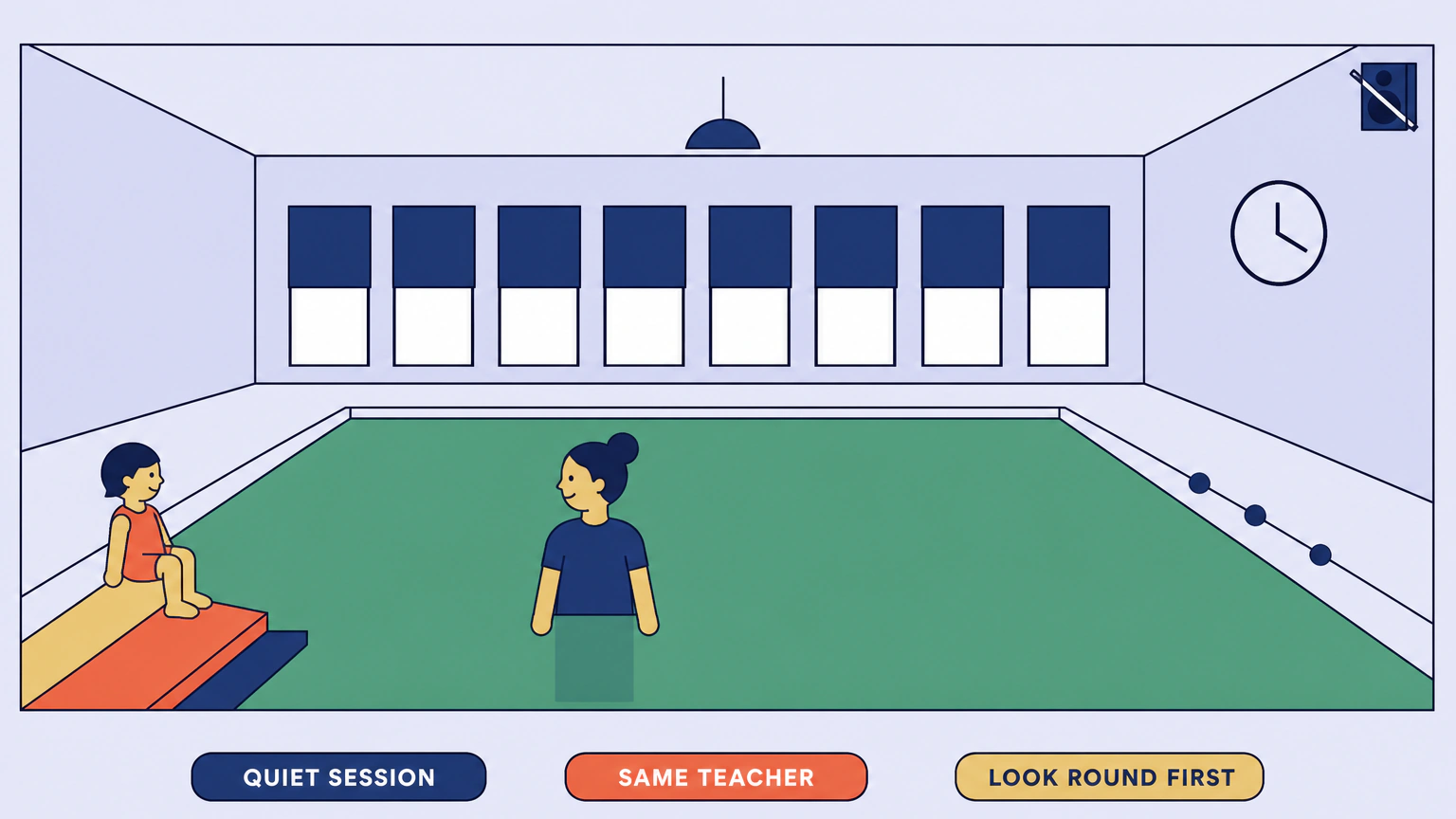
Halo Leisure, a charitable operator in England and Wales, publishes what it changes for its autism friendly sessions. The tannoy stays off unless there's an emergency, the music goes off, the pool takes fewer swimmers, nobody jumps or dives, and there are no whistles and no shouting. Swimmers come in down a sloped entry rather than a ladder. Chesterfield Borough Council's sessions at Staveley, written up in Swim England's own magazine, go further on the room itself. Music off, overhead lights dimmed, blinds down, and the underwater lighting on instead. The teachers use the same words and the same running order every week, count down ten seconds before free time ends, show each new skill rather than describing it, and put two instructors on every group.
Ten changes worth asking for by name:
- A quieter session, or the first lesson slot of the day before the hall fills up.
- The music off, and the tannoy silent except in an emergency.
- Overhead lights dimmed and blinds down, with the underwater lighting on instead.
- No whistles and no shouted instruction, with something visual in their place.
- The same teacher every week, taking the lesson in the same order every week.
- A smaller group, or a second teacher in the water alongside the class.
- Sloped or step entry rather than a ladder, and no jumping or diving in that session.
- Each new skill shown rather than described.
- A signposted ending, such as a countdown before free time finishes.
- A quiet changing option, and somewhere to wait that isn't the spectator gallery.
Go and look at the building before you book anything
The lesson is half an hour. The building is the other hour. Car park to poolside, a corridor that echoes, cubicle doors that bang, a hand dryer that fires without warning: any one of those can end the morning before the teaching starts. So ask to look round, at the same time of day as the lesson you're offered. The ones that hesitate have told you something. If you're starting from scratch, pull up swimming lessons near you, shortlist two or three within a sensible drive, and ring each with the same six questions.
- Which of your lesson times is the quietest, and could we start in that one?
- Would the same teacher take my child every week, or does it rotate?
- How many children are in that class, and is a second teacher ever in the water?
- Could we come and look at the changing rooms and the poolside before the first lesson?
- Have your teachers done any autism or SEND training, and which course was it?
- If a mainstream class doesn't work, what else do you run, and how long is the wait?
Pro tip: Make the same request twice, once on the phone and once by email, in the same words. That isn't distrust. It's a diary. A written request dates the conversation, survives a change of duty manager, and gives the next person something to read instead of somebody's memory of what you asked for.
What a pool has to change, and where that duty stops
Almost nobody tells parents this: a pool that runs swimming lessons is a service provider in law, and it owes disabled customers a duty to make reasonable adjustments. That duty reaches the gymnastics classes down the road, the dance school and the trampoline club too. The Equality Act 2010 covers England, Wales and Scotland. Northern Ireland's duty sits in a different Act.
The pool is supposed to have thought about this before you rang
Section 29 of the Act covers anyone providing a service to the public, "for payment or not". That's every leisure centre, swim school and private teacher taking bookings. Schedule 2 then does the thing that changes the conversation. The duty is owed to "disabled persons generally", so it didn't switch on when you rang. Lawyers call it anticipatory. A centre that has never worked out how a distressed child gets out of a busy lesson was already behind. Your call only made the gap visible. One more thing: a diagnosis isn't the test. Section 6 turns on whether an impairment has a substantial, long-term effect on everyday life, so a child still waiting for an assessment may still be protected.
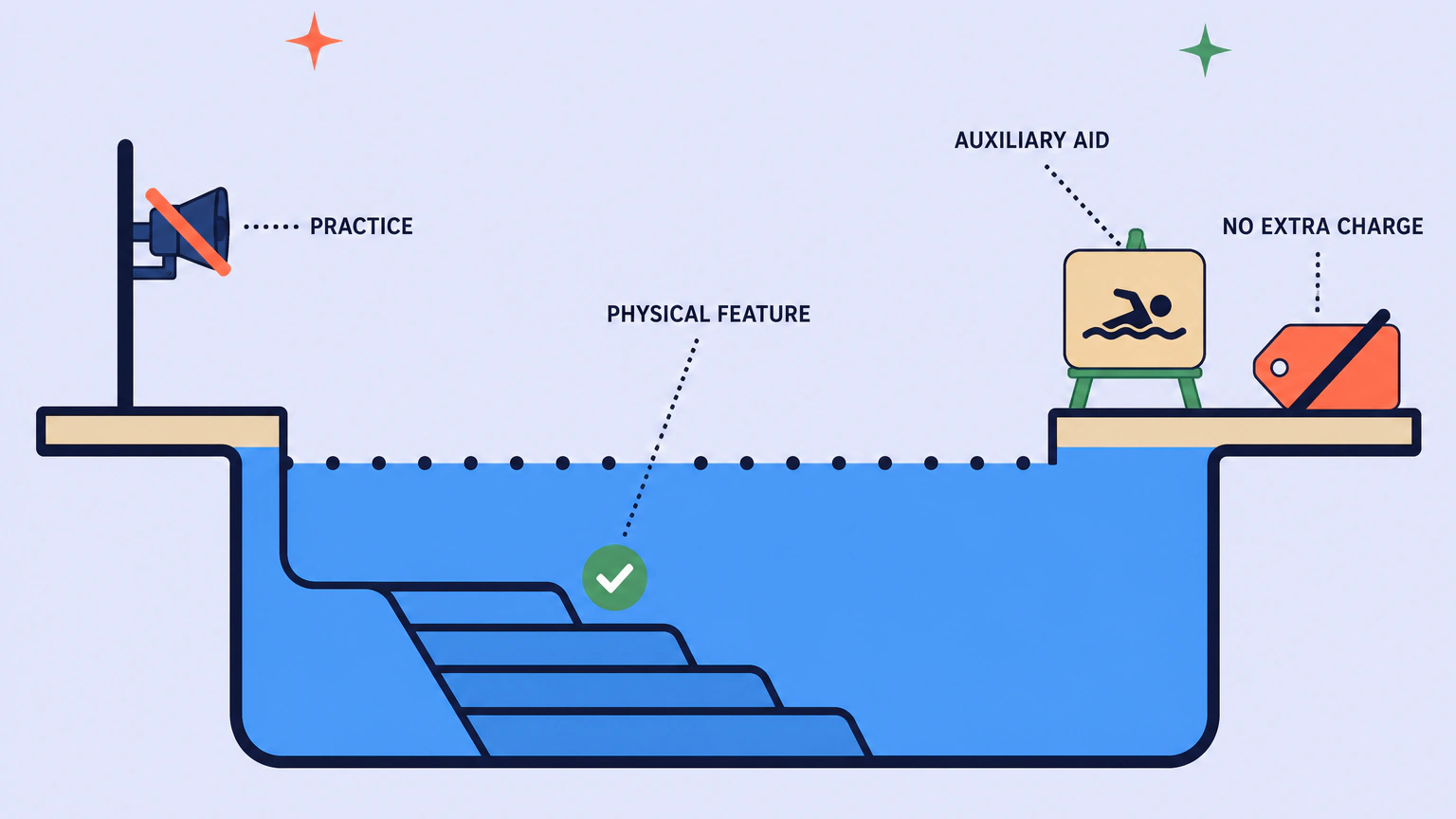
The Act splits the changes into three kinds. Knowing which one you need gives the pool something concrete to say yes or no to.
| What the Act calls it | What that is at a pool | What you would actually ask for |
|---|---|---|
| A provision, criterion or practice | How the pool runs its lessons: the timetable, class size, whistles, music | "Could she be in the quiet nine o'clock class, with the music off?" |
| A physical feature | The building: pool entry, changing rooms, lighting, the walk from the car park | "Could we use the sloped entry and the accessible changing room?" |
| An auxiliary aid or service | Something extra the pool provides: a second teacher in the water, visual cards, a support worker | "Could a second teacher be in the water with that group?" |
You do not pay for the adjustment
Section 20(7) is the sentence to keep. A provider who owes the duty can't make a disabled person pay its costs of meeting it. So if a second teacher in the water is the reasonable adjustment the pool must make, that cost belongs to the pool. It isn't an upgrade fee on your direct debit.
Be straight about where the line falls, because good centres are. An adjustment the pool is legally required to make is theirs to absorb. A different and pricier product, a private one-to-one instead of the group class, is something you've chosen to buy. So ask out loud: is the group class, with those changes, still open to us? If not, ask what makes the change unreasonable rather than accepting a quote.
Where the law stops, and what changes across the four nations
The duty has a limit, and it's fair to know it before you ring. Reasonable is doing real work in that phrase, and Schedule 2 says nothing requires a step that would "fundamentally alter the nature of the service". A pool doesn't have to become a therapy centre, or clear a public session for one family. It does have to think first. Ask it to tell you what it weighed up.
Then there's geography, which most guides skip. The Equality Act 2010 covers England, Wales and Scotland. Northern Ireland kept the Disability Discrimination Act 1995, where the duty bites only once a practice makes it "impossible or unreasonably difficult" for disabled people to use a service. That's different from the Equality Act's "substantial disadvantage" test, so where you live changes which legal test applies and where a complaint goes.
| Where you live | The law that applies | Where a claim goes, and by when | Free advice first |
|---|---|---|---|
| England | Equality Act 2010, ss. 20 and 29 and Sch. 2 | County court, within 6 months of the act (s. 118) | Equality Advisory and Support Service |
| Wales | Equality Act 2010, ss. 20 and 29 and Sch. 2 | County court, within 6 months of the act (s. 118) | Equality Advisory and Support Service |
| Scotland | Equality Act 2010, ss. 20 and 29 and Sch. 2 | Sheriff court, within 6 months of the act (s. 118) | Equality Advisory and Support Service |
| Northern Ireland | Disability Discrimination Act 1995, ss. 19 and 21 | County court, generally within 6 months of the act; 3 extra months if the dispute is referred for statutory conciliation within that period, and longer if the court considers it just and equitable (s. 25(3); Sch. 3, para. 6) | Equality Commission for Northern Ireland |
Mainstream, one to one, or a SEND only session
Swimming lessons for autistic children come three ways, and they aren't a ladder from worst to best. A mainstream class with changes, a one-to-one, or a session run only for disabled swimmers, often advertised as SEND swimming lessons. Each buys something different, and the right one depends on the child in front of you rather than on what the centre finds easiest to sell.
When one to one is the right buy
A one-to-one buys attention and control. There's no queue at the wall, no waiting a turn, and a teacher who can stop when your child needs to. For a child who bolts, or who needs one skill repeated for a month, that's money well spent.
What it doesn't buy is other children. A group is where a child learns to wait, share a lane and cope with noise, and a private lesson can quietly postpone all of that. It's also the easiest thing for a centre to sell you instead of changing the class, so ask about both. Some operators run dedicated disability swimming lessons of their own: Better sells one-to-one SEND lessons, and Halo's Rockhopper programme drops traditional grading in favour of individual milestones. Before you book a private teacher, ask who has been checked and how, because how criminal record checks work for people who teach your child varies across the four nations.
Progress you can still see when the stages stall
The hardest term is the one where your child works hard and no badge arrives. Swim England's guidance for parents and carers says learners with SEND take the same core awards, and "may be exempt from some skills where he or she is physically unable to ever achieve them". There's a smaller ladder underneath, too. The Alpha Step Awards break the beginning into three steps, covering entries, aquatic breathing, spatial awareness, rotation, buoyancy and coordination, and they feed into Stage 1. The I CAN Awards recognise single skills, for early learners and for anyone stuck at a level. All of that is England's framework, though. Scotland and Wales run their own programmes, so ask your pool which one it teaches.
Paying for it, and the funded route parents get ruled out of by mistake
Start here, because Better's Level Water partnership and Level Water's wider route have different terms. Better's inclusive swimming page describes its partnership as free lessons for children aged 4 to 11 with physical and sensory disabilities, and adds that "these funded classes are not currently available for children with learning, social, or behavioural disabilities". Level Water's wider route is subsidised, not generally free. Its FAQ for parents and carers offers one-to-one lessons at the partner pool's group-lesson price to children aged 4 to 11 "who cannot swim and cannot access mainstream swim lessons, for any reason", and says: "No diagnosis is required, there are no formal checks and we welcome self-referrals."
Read only Better's summary and you'd rule your autistic child out of Level Water's wider route. Apply direct to the charity instead. Its waiting list opens at three and a half, teaching starts at four, and lessons are usually one-to-one. Funding ends when your child passes Stage 3, joins a mainstream group or turns 12; only children who start at 11 have a 12-month limit. For the tiers underneath, what swimming lessons cost in the UK sets out council and private pricing.
Concessions, carer entry and what to ask the council
Two more routes, and neither is charity money. Better's Inclusive UK Membership gives a carer or personal assistant free entry when the swimmer comes for a lesson, which quietly halves the cost of the adult who has to be there anyway. Ask any operator whether it does the same.
Then the council. Free and discounted schemes are set locally, so they vary by authority and change with the budget. Ring the leisure team and ask three things: what concessionary rates exist, whether there's a disabled swimmer scheme, and whether SEND sessions are priced like a public swim or a lesson. Ten minutes on the phone beats a week of guessing.
Why this is a water safety question, not a hobby
We'd put swimming above almost every other activity on a family's list, and not for fitness.
The research is worth having, limits and all. Guan and Li, working through US death records, found that injuries accounted for more than a quarter of deaths among people with autism between 1999 and 2014, and drowning stood out sharply, at a proportionate mortality ratio of 39.89. That number is a share of deaths, not a child's odds: an autistic child isn't forty times more likely to drown, however it gets quoted.
The Australian work is the other half. Peden and colleagues looked at 667 drowning deaths of children and young people whose medical history was known, and 27 of them had an autism diagnosis. The relative risk came out at 2.85. But the confidence interval runs from 0.61 to 13.24, so it crosses one, and the size of the risk isn't settled. We'd rather say that than sell you a frightening number.
The most useful finding is about how, not how much. In a review of 23 US drowning deaths of children with autism, wandering came first in roughly three quarters of cases. Most happened in ponds, on average less than 300 metres from home, and most between noon and seven in the evening. We looked for a UK dataset that breaks drowning deaths down by autism diagnosis, and there isn't one we could find.
That changes what a lesson is for. The first skill that matters isn't front crawl. It's getting to the side, turning, floating on their back and shouting. So if the wait for the right class runs to a term, fill it. Teach the water rules at home, treat garden ponds and paddling pools as the risk they are, and take the first slot you're offered.
The swimming England's national curriculum requires
If your child attends a local-authority-maintained school in England, here's an entitlement worth using. The national curriculum says schools must provide swimming instruction in key stage 1 or key stage 2, and pupils should be taught to swim at least 25 metres, use a range of strokes and perform safe self-rescue. It's a curriculum subject rather than a treat, so the SEND support your child gets in class applies to it.
Whether it lands is another matter. Sport England's Active Lives survey for 2023 to 2024 found 70% of Year 7 pupils could swim 25 metres, against 77% of that year's Year 11s when they were in Year 7.
So ask the school three things. When is the swimming block timetabled? Who goes with your child in the water and in the changing room? And what happens if the coach journey is the part that fails? Ask before the letter comes home. For a family who can't buy private lessons, this is the swimming, and it's already paid for.
If the pool says no
Sometimes the answer is a flat no, and the tone tells you it's final. Two moves, in this order. Put the request in writing, in one short email, naming what you asked for and what you were told. Then ask for the centre manager rather than whoever answered the phone.
If that goes nowhere, we'd stop spending your patience there and ring elsewhere. What we promise about the providers we list sets out what we check before a pool joins our listings.
Who to ask in your nation
Free help comes first, and it's better than most parents expect. The Equality Advisory and Support Service advises individuals in England, Scotland and Wales, and it can try informal dispute resolution instead of court. It will sometimes write to a service provider on a client's behalf, which is often all it takes. It doesn't give legal advice, and the helpline runs Monday to Friday, 9am to 7pm, and Saturday, 10am to 2pm. In Northern Ireland, nidirect, the government's own advice site, says the Equality Commission for Northern Ireland gives free and confidential advice on disability discrimination.
The court route exists and is rarely the right one. A claim goes to the county court, or the sheriff in Scotland, within six months of what happened, though a judge can let a late claim in when it's just and equitable. We're not lawyers, and if a centre digs in over something this important, that helpline will know your case better than any guide can.
Questions parents ask
Can autistic children learn to swim?
Yes. Autism affects how a child experiences the lesson, not whether they can learn a stroke. What differs is the route in: fewer children in the group, the same teacher each week, a predictable running order, a quieter hall. Some start one-to-one and move into a group later. Others manage a mainstream class from week one, once the music goes off.
Is swimming good for autistic children?
Safety is the strongest case anyone can make for it. Drowning shows up out of proportion in the injury research on autism, so a child who can reach the side, turn and float has gained something real. Progress also breaks into small steps that still count, which is what Swim England's Alpha Step and I CAN Awards exist to recognise. Treat anyone selling swimming as therapy with caution.
What age can an autistic child start swimming lessons?
The same age as any other child. Swim England's programme starts with Duckling awards for pre-school swimmers, and Level Water, which funds lessons for children who can't access mainstream classes, takes applications from three and a half and teaches from four. The slot matters more than the birthday. A quiet weekday session often works where a packed Saturday morning class doesn't.
Can I get free swimming lessons for my autistic child?
Possibly. Better says its Level Water partnership offers free lessons to children aged 4 to 11 with physical and sensory disabilities. Level Water's wider route offers one-to-one lessons at the partner pool's group-lesson price to children aged 4 to 11 who can't swim and can't access mainstream lessons, "for any reason", with no diagnosis needed and self-referrals welcome. Apply direct. Councils run their own free and discounted schemes too, so ask yours.
Are one to one lessons better than a small group?
Better at some things, worse at others. One-to-one wins on attention and control, and on being able to stop the moment a child needs to. A group teaches waiting, sharing a lane and coping with noise, and those are skills too. Swim England suggests starting one-to-one where that helps, then moving across.
Do swimming teachers get any training in teaching autistic children?
Some do, and it's fair to ask by name. The Institute of Swimming runs a CPD course called "Making Your Lessons Engaging for Autistic Children". Chesterfield's team trained before starting its autism friendly sessions. This is optional CPD rather than a required qualification, so ask which course your child's teacher took, and when.