

On this page
- The short answer, and the two clocks people mix up
- Your instructor's cancellation terms, and what they can and cannot say
- Prepaid blocks and intensive courses, and getting money back for lessons you never had
- When the lessons stop, or the school does
- The escalation ladder, in the order that actually works
- Where you live changes the route, not the right
- The same framework can apply to other prepaid lessons
- Frequently asked questions
The short answer, and the two clocks people mix up
You cancelled last night, the lesson was this morning, and the invoice turned up anyway.
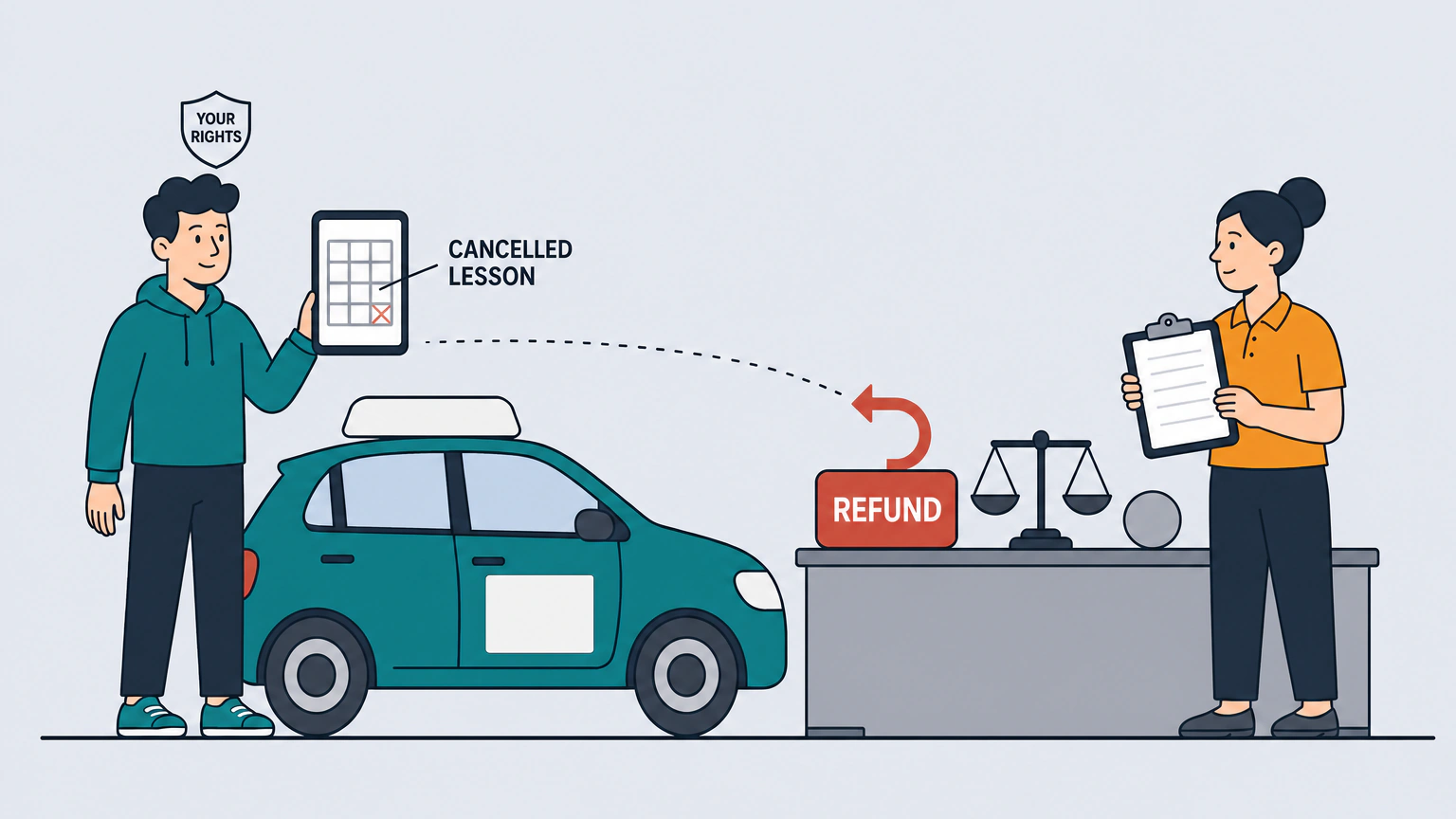
Cancel a driving lesson inside your instructor's notice window and you'll normally be charged the full fee. Every set of published terms we opened for this guide sets that window at 24 or 48 hours, and every one makes a late cancellation payable in full. Whether that charge is enforceable depends on whether the term is fair and the amount reflects the instructor's direct loss. Money you've already handed over for lessons you never received is a completely different question, and it may be recoverable, because a term that lets a school keep the fee for a service it never supplied is exactly the kind of term the Consumer Rights Act 2015 puts on its list of terms that may be unfair.
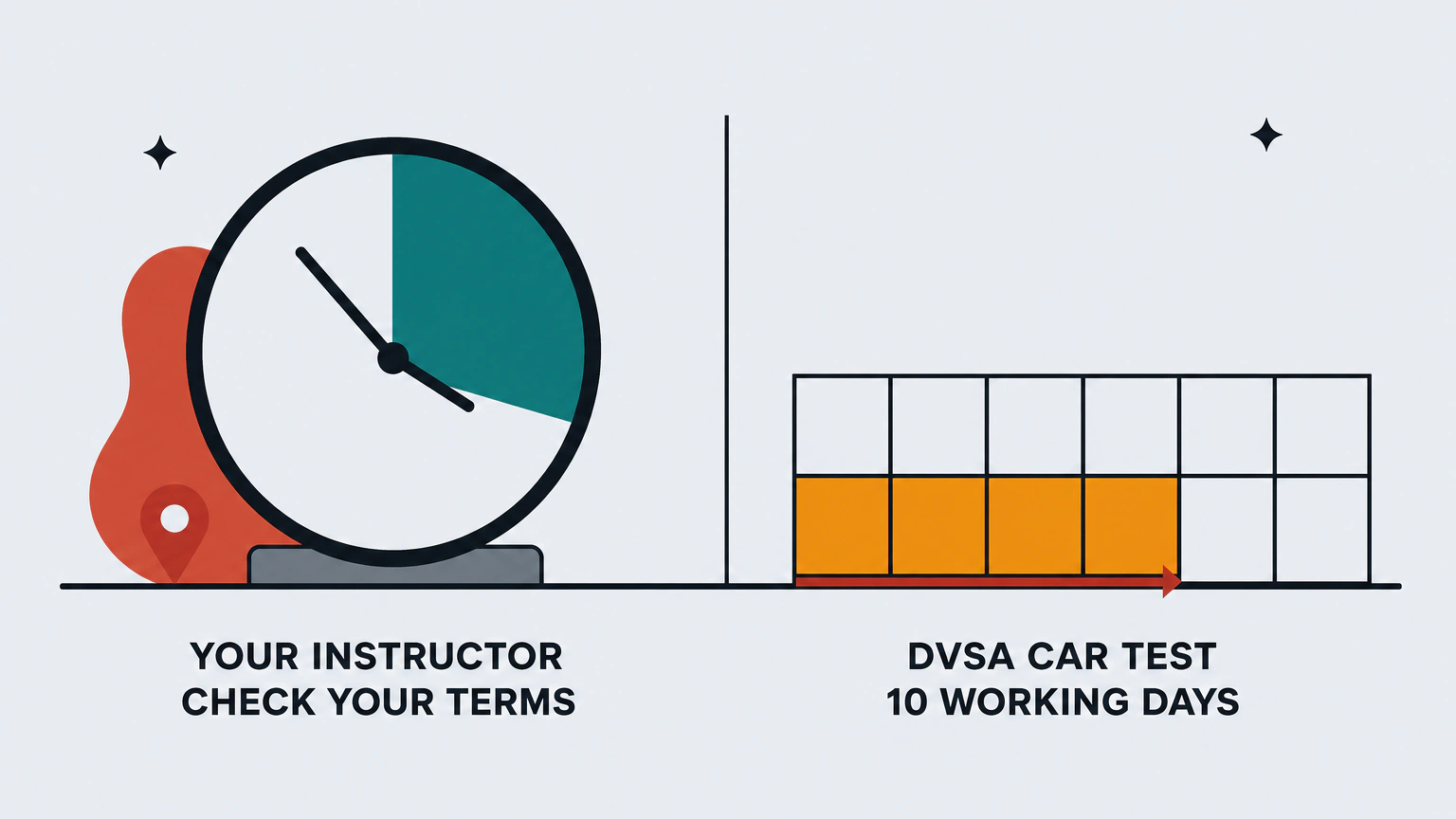
First, separate the two deadlines. People merge them constantly, and the merge costs money in both directions. One is your instructor's cancellation window, a term in your private contract with the instructor or school. The other is the notice the Driver and Vehicle Standards Agency needs to move a practical test, a published government rule with a forfeited fee behind it.
| What you are cancelling | Notice needed | What it costs you if you are late | Who sets the rule |
|---|---|---|---|
| A booked driving lesson | Check your instructor's terms | The terms we checked charged the full fee, but the amount must still be fair | Your contract with the instructor or school |
| A car practical test | 10 full working days | You normally pay again, though GOV.UK allows refunds for a short list of unavoidable reasons | DVSA, published on GOV.UK |
| Any other practical test | 3 full working days | You normally pay again, though GOV.UK allows refunds for a short list of unavoidable reasons | DVSA, published on GOV.UK |
For DVSA notice, Monday to Saturday count as working days. Sundays and public holidays do not.
What your instructor can charge you for a late cancellation
Of the six sets of driving school terms we read, four require 48 hours' notice and two require 24. All six charge the full lesson fee for anything later, and none of them offers a sliding scale, however good your reason.
Here's why, and it's worth understanding rather than resenting. A late cancellation may leave the instructor unable to refill the slot. But the full fee is enforceable only if the term is fair and the amount reflects the instructor's direct loss.
What DVSA charges you for a late change to a car test
DVSA's clock is published, fixed, and far longer than anything your instructor asks of you. You need 10 full working days' notice to change or cancel a car driving test, and 3 full working days for every other test. Less than that and you normally pay for the test again, though GOV.UK allows refunds for a short list of unavoidable reasons. Monday to Saturday count as working days and Sundays and public holidays don't, so a bank holiday weekend quietly swallows part of your notice.
Two traps sit under that. A car test can only be changed twice, and after that you have to cancel and rebook. And you have to do it yourself: GOV.UK is blunt that "your driving instructor is not allowed to change it for you", however helpfully they offer.
Your instructor's cancellation terms, and what they can and cannot say
A cancellation policy is a contract term, not a house rule, and contract terms have limits.
The terms you should have been given before your first lesson
DVSA publishes an ADI code of practice agreed with the driver training industry, last updated in November 2025. It's voluntary, it applies in England, Scotland and Wales, and instructors confirm they follow it when they update their registration. Section 2 asks the instructor to make you aware of their terms of business on or before your first lesson, and lists what those terms should cover. Since we run a directory, it's worth being straight that what our own checks do and do not cover is no substitute for reading these six things.
- The legal identity of the school or instructor, with a full postal address and a phone number that reaches them.
- The current price and duration of a lesson, so you can check what a "two-hour" slot actually bills at.
- The price and conditions for using the school car for your practical test. A separate charge, and often a surprise on the day.
- The terms for cancellation of lessons by either party. Both directions. Read this one twice.
- The terms under which lesson fees may be refunded, which governs your unused block if you stop or switch.
- The complaints procedure, including who it goes to.
If items 4, 5 and 6 never reached you, say so in writing at step one of the escalation ladder. It won't win a refund by itself, but it puts the school on the back foot about what you agreed to.
When a cancellation charge can be challenged
Section 62 of the Consumer Rights Act 2015 is the lever: an unfair term isn't binding on the consumer. A term is unfair if, contrary to the requirement of good faith, it causes "a significant imbalance in the parties' rights and obligations under the contract to the detriment of the consumer". That's judged on all the circumstances when the term was agreed, and on every other term in the contract.
Schedule 2 lists the shapes that may be unfair. Two bite here: a term making you pay "a disproportionately high sum in compensation or for services which have not been supplied", and one making you pay a disproportionately high sum for failing to meet your own obligations.
Now the honest limit. Section 64 keeps the price itself out of any fairness assessment, provided it was transparent and prominent, so you can't argue that £40 an hour is unfair. But section 64(6) pulls the shutter back up for the term types listed in Schedule 2. This is an argument about the cancellation charge, never about the lesson price.
The asymmetry test, and how to run it on your own terms in two minutes
Paragraph 4 of that Schedule is the one nobody quotes to learners. It flags a term letting the trader "retain sums paid by the consumer where the consumer decides not to conclude or perform the contract, without providing for the consumer to receive compensation of an equivalent amount from the trader where the trader is the party cancelling the contract".
Read that against what's published. Of our six sets of terms, only two say anything at all about the instructor cancelling, and both offer a rearranged lesson rather than money. One states its 48-hour requirement symmetrically, for pupil and instructor alike. That's what a balanced clause looks like.
So open your own terms and search for "cancel". Count how often the obligation runs towards you and how often it runs back. If you owe a full fee for 23 hours' notice and the instructor owes you nothing for cancelling at the kerb, that's a one-sided term with a name in the statute. Raise it politely, in writing. It's a strong argument, not a guaranteed refund.
Prepaid blocks and intensive courses, and getting money back for lessons you never had
This is where the real money sits. Across 775 driver training cost profiles on our own directory, the displayed range runs from £235 at the bottom to £1,170 at the top. A learner can expose that much when paying up front. Read how many driving lessons you actually need before deciding how big a block to buy.
The 14 day cooling off right, and exactly when it applies
Regulation 29 of the Consumer Contracts Regulations 2013 lets you cancel a distance or off-premises contract at any time in the cancellation period, without giving a reason. For a service contract, regulation 30(2) normally ends that period 14 days after the day the contract was entered into. If the trader failed to give you the required cancellation information, regulation 31 can extend it by up to 12 months.
One qualifier decides whether you have the right at all. A distance contract is one the school makes with you entirely by phone, website or app as part of an organised distance-sales system. An off-premises contract is generally one you make with the instructor while you're both away from the school's business premises, including at your home. A contract made at the school's office is usually on-premises, so this cooling-off right does not apply.
What you still have to pay for lessons already taken
Regulation 36(1) says the trader mustn't start the service before the cancellation period ends unless you expressly asked. For an off-premises contract, that request must be on paper, by email or in another form you can keep.
Where you did ask, regulation 36(4) makes you pay a proportionate amount for what was actually supplied, up to the moment you told them you were cancelling, calculated on the total price agreed. Four lessons out of ten means roughly four lessons' worth.
Then regulation 36(6), the sentence no competing page carries: you bear no cost at all if the trader failed to give you the required information about your right to cancel. That's the practical value of checking whether the school gave you the cancellation and payment information the law requires before you paid.
When the right disappears
Regulation 36(2) closes the window once the service has been fully performed, and only where performance began at your request and you acknowledged you'd lose the right on full performance. Both conditions, not either.
For a five-day intensive course, full performance can end the right early if you asked to start and acknowledged the consequence. A 20-hour block spread over three months is not fully performed within 14 days, but the ordinary cooling-off period still ends 14 days after the contract was made.
Red flags before you hand over a block payment. None of these means you're being cheated. Each one means ask, and get the answer in writing.
- A term that charges you for cancelling but promises nothing if the instructor cancels. Ask for symmetric wording before you pay.
- A block that expires after a fixed number of months with no refund of unused hours. Ask what happens to the hours you don't use.
- A large advance payment with no statement of where the money is held. The code asks instructors to safeguard and account for money paid in advance and to show you the details on request, so request them.
- Being told the cooling-off period is waived because the course starts soon. Starting early does not by itself erase the right. Full performance can end it early only if you asked to start and acknowledged that consequence.
- Pressure to pay by bank transfer for a block priced over £100 and up to £30,000. Paying the school directly by credit card keeps section 75 on the table; card payments may also qualify for chargeback.
When the lessons stop, or the school does
Two different failures, two different remedies. One is a service delivered badly. The other is a service that has stopped existing.
If the instructor keeps cancelling, arrives late or cuts lessons short
Section 49 of the Consumer Rights Act 2015 treats every service contract as including a term that the trader performs with reasonable care and skill. Section 50 adds that anything the school said or wrote to you about the service, and that you relied on, is a term as well. The "two-hour lessons" line on the website isn't marketing. It's the contract.
If the service doesn't conform, section 54 gives you two remedies. Repeat performance under section 55 means the work redone within a reasonable time, without significant inconvenience to you, at the trader's cost. Where that's impossible or they won't do it properly, section 56 gives a price reduction, which "may, where appropriate, be the full amount of the price".
You're also allowed to leave. Nothing ties a learner to an instructor, and if the relationship has broken down it's usually quicker to ask for the unused balance back and start comparing driving instructors and driving schools near you.
If the school stops trading
The honest answer is the uncomfortable one. If the school becomes insolvent, your prepaid balance is an unsecured claim in the insolvency, which usually means recovering little if anything through that process. That's why the card routes below matter more than anything else here, and why speed matters.
Before you pay, ask how the school safeguards and accounts for advance payments. The code asks every instructor to make those details available on request. The answer, or the reluctance to give one, tells you plenty.
The escalation ladder, in the order that actually works
Take these in order. Each step is cheaper and faster than the next, and skipping to the end throws away the leverage the earlier ones build.
Step one, the instructor's own complaints procedure, in writing
The code puts this first: complaints go to the instructor, school or contractor in the first instance, through their own complaints procedure. Email, not a phone call. Say what was agreed, what happened, what you want and by when. Everything after this depends on a dated written record, and plenty of disputes end right here.
Step two, Citizens Advice and Trading Standards
The code names Citizens Advice for an unsatisfactory business service. Its consumer service advisers give practical and impartial advice, tell you which law applies, and pass information about complaints on to Trading Standards, something you can't do yourself. The limit, in their own words: advisers "can't make a complaint for you or take legal action on your behalf". This step arms you. It doesn't fight for you.
Step three, DVSA, and precisely what DVSA will not do
GOV.UK asks you to contact the DVSA driving instructor team, at [email protected], if your instructor gives lessons shorter than agreed, keeps cancelling or arriving late, or doesn't provide lessons you've already paid for. Then it says the thing every learner should read twice: DVSA "can ask the instructor about the matter on your behalf, but they cannot help you get any money back".
Send your name and email, the instructor's full name, school and ADI number, their phone or email, their vehicle registration, and any receipts or screenshots. It isn't a refund route. In Northern Ireland the register belongs to the DVA.
Step four, chargeback and section 75
Section 75 of the Consumer Credit Act 1974 makes your credit card provider jointly and severally liable with the supplier for misrepresentation or breach of contract. It doesn't apply where the single item's cash price is £100 or less, or more than £30,000. A £600 block paid directly to the school by credit card can be covered; a £38 single lesson cannot.
Chargeback is a different animal: a card scheme rule rather than a statutory right, available on debit cards too, with its own time limits. Raise it early rather than waiting to see whether the school resurfaces.
Step five, a money claim, and what it costs to bring one
In England and Wales you claim online through the county court. GOV.UK points at mediation first, and for good reason: claim £10,000 or less and, if the defendant disputes it, you'll be told you must attend mediation anyway.
| Amount you are claiming | Court fee to issue online in England and Wales |
|---|---|
| Up to £300 | £35 |
| £300.01 to £500 | £50 |
| £500.01 to £1,000 | £70 |
| £1,000.01 to £1,500 | £80 |
| £1,500.01 to £3,000 | £115 |
| £3,000.01 to £5,000 | £205 |
| £5,000.01 to £10,000 | £455 |
Fees change from time to time. Help with fees is available on a low income or certain benefits, and Scotland and Northern Ireland run their own processes and scales. Then do the arithmetic honestly. Seventy pounds to chase £900 of unused lessons is worth it. Thirty-five to chase a £60 cancellation fee usually isn't.
Where you live changes the route, not the right
The Consumer Rights Act 2015, the Consumer Contracts Regulations 2013 and section 75 apply across the whole UK. The regulator and the court don't.
| Where you live | Who registers and regulates your instructor | Where a money claim goes |
|---|---|---|
| England and Wales | DVSA, and the ADI code of practice applies | A county court money claim, fees as above |
| Scotland | DVSA, and the ADI code of practice applies | Simple procedure in the sheriff court, for payment of a sum not exceeding £5,000 |
| Northern Ireland | DVA, not DVSA. Only registered ADIs and AMIs may charge for tuition, and you can ask to see the licence they should carry at all times | The small claims process in the County Court, for claims of not more than £5,000 |
Northern Ireland is the divergence most guides skip, because the code of practice doesn't reach there at all. If you're looking at providers across Northern Ireland, check the DVA licence rather than any code of practice claim.
The same framework can apply to other prepaid lessons
The same framework can apply whatever is being taught. A term of prepaid sessions with swimming lesson providers, a block of ten with personal trainers and gyms, a dance term or a term of music lessons can raise the same 14-day rule for qualifying distance or off-premises contracts, the same paragraph 4 asymmetry, and the same section 75 cash-price limits. If you're sizing a term up front, what a term of children's swimming lessons costs gives you a figure to hold a quote against.
One thing is specific to driving. Driving instructors sit on a statutory register with a regulator and a published code behind it. That makes the paperwork worth checking before the money moves.
We're not your solicitor, and this is general information about UK consumer law rather than advice on your contract. If a firm written complaint doesn't shift things, the Citizens Advice consumer service is free and it's the right next call.
Frequently asked questions
These are the questions people actually type, pulled from Google's autocomplete, from what GOV.UK answers on its own complaints page, and from the points the driving schools' terms pages address in their headings.
Do you have to pay if you cancel a driving lesson?
You may have to pay if you cancel inside the notice period in your instructor's terms. Every set we read requires 24 or 48 hours and charges the full lesson fee for anything later. But the term and the amount must still be fair and reflect the instructor's direct loss. If those terms never reached you before the first lesson, say so in writing.
Can I get a refund on unused driving lessons?
Often, but not automatically. Money paid for lessons never delivered is money for a service the school hasn't supplied, and a term letting it keep that is on the Consumer Rights Act 2015 list of terms that may be unfair. Ask in writing first. If the block's cash price is more than £100 and no more than £30,000, paying the school directly by credit card may give you a section 75 claim against the card issuer too.
What happens if my driving instructor keeps cancelling on me?
You get two remedies under the Consumer Rights Act 2015. The first is repeat performance: the lessons redone within a reasonable time, without significant inconvenience to you and at the instructor's cost. If that doesn't happen, you can ask for a price reduction instead. You can also report repeated cancellations to DVSA. Write the pattern down with dates first.
Do driving instructors charge for cancelled lessons they cancel themselves?
In the six sets of terms recorded in the brief, only two say anything at all about the instructor cancelling, and both offer a rearranged lesson rather than money. That one-sided shape is what paragraph 4 of Schedule 2 to the Consumer Rights Act 2015 describes as potentially unfair, so raise it politely and in writing.
Can you report a driving instructor, and will it get my money back?
You can report one, and no, it won't. DVSA takes complaints about short lessons, repeated cancellations and lessons paid for but not provided, at [email protected]. Its own page says it can ask the instructor about the matter on your behalf but cannot help you get any money back. Recovering money is a separate track.
How much notice do I have to give to change a car driving test?
Ten full working days, or you normally pay for the test again. Every other practical test needs 3 full working days. Monday to Saturday count as working days and Sundays and public holidays don't. GOV.UK lists a few short-notice refund exceptions. You can change a car test twice before you have to cancel and rebook, and you must make the change yourself: your instructor isn't allowed to.
Can I switch driving instructor if I have already paid for a block?
Yes. Nothing ties you to an instructor, and you can ask for the unused balance back. Quote the refund terms you should have been given before your first lesson. If the school refuses and the block's cash price is more than £100 and no more than £30,000, paying the school directly by credit card may give you a section 75 claim against the card issuer too.
Is a "no refunds" clause in driving lesson terms legal?
It depends what it covers. Applied to lessons the school never delivered, it's the kind of term section 62 of the Consumer Rights Act 2015 can strike out, because an unfair term isn't binding on you. Applied to a lesson you cancelled two hours beforehand, it may be enforceable if the charge reflects the instructor's direct loss. The dividing line is fairness and the loss caused, not simply whether the service was supplied.