

On this page
- What a provisional licence actually lets you do
- Who can apply, and from what age
- What it costs, start to finish
- How to apply, and what to have ready
- The week it arrives: what to do before your first lesson
- Driving on it: the supervision rules, and the fine that lands on you
- Six penalty points, and the loop back to the start
- What changed in 2026, and what is still only a proposal
- Common questions
What a provisional licence actually lets you do
The card lands on the mat and it looks like permission to drive. It's narrower than that, and the gap is where new drivers get caught.
Once you're old enough, it does three things. You can book your theory test. You can pay a DVSA approved instructor or a licensed trainee to teach you. And you can practise privately with someone who meets the supervision rules.
Four things it won't do. It won't let you drive alone, or without L plates front and back, or D plates in Wales. It won't put you on a motorway unless you're in England, Scotland or Wales, with an approved instructor in a car with dual controls. And it isn't insurance: whoever is at the wheel has to be insured for that car.
One phrase trips learners up regularly. "Independent driving" is a marked part of the practical test, not permission to go out alone.
A permission with conditions, then. Break them and the points land on the licence you just paid for.
Who can apply, and from what age
Two ages get muddled here, and they can sit a year apart: the age you can send the application, and the age you can legally move the vehicle. Apply early and the licence just waits in a drawer until the birthday.
The age rules, vehicle by vehicle
The application age is the same whatever you plan to drive: 15 years and 9 months. What changes is the day you're allowed to drive it.
| Vehicle | Youngest you can apply | Youngest you can drive it |
|---|---|---|
| Moped or light quadricycle (AM) | 15 years 9 months | 16 |
| Car (category B) | 15 years 9 months | 17 |
| Car, on enhanced rate PIP mobility | 15 years 9 months | 16 |
| Agricultural tractor (category F) | 15 years 9 months | 16, with conditions |
Tractors come with strings attached: a wheeled agricultural or forestry tractor no wider than 2.45 metres. A trailer must fit that width and have two wheels or four close-coupled wheels. You must have passed the category F test, or be travelling to it, taking it or returning from it.
Starting at 16 on the enhanced rate of PIP
A 16 year old can hold a full category B car entitlement if they receive Personal Independence Payment including the mobility component at the enhanced rate. That's the ordinary car entitlement a year early, not a special licence. It comes from regulation 9(4) of the Motor Vehicles (Driving Licences) Regulations 1999, which lowers 17 to 16 for a small vehicle driven without a trailer.
Three other routes reach the same place. Scotland's working age disability assistance qualifies at the enhanced mobility rate. The children and young people's equivalent qualifies at the higher rate if the award was in force immediately before the sixteenth birthday. There's also a transitional route for anyone who held higher rate Disability Living Allowance mobility immediately before their sixteenth birthday and has since claimed PIP.
The rule covers England, Wales and Scotland. Everything else runs normally: same £34 application, same tests, same L plates. Only the birthday moves.
What it costs, start to finish
Nobody sells you a provisional licence. The fees are fixed and published, so a site charging extra to "process" your application is charging for typing.
| What you are paying for | Online | By post |
|---|---|---|
| First provisional licence (car, motorcycle, moped) | £34 | £43 |
| Replace a lost, stolen or damaged licence | £20 | £20 |
| Renew the photocard after 10 years | £14 | £17 by post, £21.50 at a Post Office |
| Car theory test | £23 | Not available |
| Car practical test | £62 weekday, £75 evening, weekend or bank holiday | Not available |
| First full licence after you pass | Not available | Free, or £17 for a different photo |
| New provisional after a New Drivers Act revocation | Not available | £50 |
Two totals matter. The cheapest complete route from nothing to a full licence is £34, then £23, then £62: £119 in government fees, plus lessons, which have no set price.
The second total is the one to watch. Rebuilding a licence lost under the New Drivers Act costs £50 plus £23 plus £62, so £135, or £148 if the retest falls on an evening, a weekend or a bank holiday.
How to apply, and what to have ready
You start by signing in, or creating sign-in details if you don't have any. Next, GOV.UK tells you whether you need to prove your identity, which usually means photo ID like a passport. You confirm you can read a number plate from 20 metres. You must also have been given permission to live in Great Britain for at least 185 days. Then you pay the £34 by card. DVLA emails a confirmation, and the licence should arrive within a week, longer if they need extra checks.
Sort two things first. If you need glasses or lenses to read a plate at that distance, wear them for every lesson and for the test. You must wear them whenever you drive. And type your name and date of birth exactly as they appear on whichever document proves your identity.
Proving who you are without a UK passport
A UK passport makes this trivial. Write the 9-digit number on the application and keep the passport at home: DVLA doesn't want the book itself, and an expired passport's number is no good.
No UK passport? Two other doors.
The first is a share code. If you've ever applied to the EU Settlement Scheme, used the UK Immigration: ID Check app, or been given a UKVI account for a visa or an eVisa, you can generate one from the view and prove your immigration status service. Choose the "something else" option when it asks what the code is for, then write it on your application.
The second is posting an original document. DVLA takes a current non-EU, non-EEA passport carrying a visa sticker or stamp, a current Irish passport with no sticker needed, a travel document, evidence you receive a state pension, or a UK birth, adoption or naturalisation certificate sent with a second document from its list, such as a P45, P60 or payslip.
Photocopies of the main identity document get refused. So do laminated certificates and certified copies, including the Post Office certification service. GOV.UK puts the timing risk plainly: "Consider delaying your driving licence application if you need your passport in the next 4 weeks."
Then the rule almost nobody prints. If you didn't prove your identity by UK passport or share code, someone else must sign your form. Your photo needs no signature if you agree to DVLA checking your identity through a current passport or travel document. That person has to hold a valid GB photocard driving licence, live in the UK, know you personally, not be a relative, and not live at your address. DVLA will contact them, so ask first.
If you apply by post instead
Form D1 comes from most Post Offices. Fill it in, enclose a cheque or postal order for £43, and send it to the address on the form. That's £9 more than online and slower, so we'd only use it if the online service won't work for you. It's also the route for posting an original identity document.
The week it arrives: what to do before your first lesson
The card is here. Before booking anything, spend twenty minutes on the jobs that are free now and expensive later.
Start with the number plate. The examiner has you read one before the practical begins. Fail it there and the test stops, the fee is gone, and DVLA revokes your licence. Checking it on your own street is free: 20 metres is about five parked cars.
Then the instructor. Anyone charging for car lessons in Great Britain must be a DVSA approved instructor or a licensed trainee. They display a windscreen badge: green for qualified, pink for trainee. A missing badge is the warning sign, and our guide to how to read the badge in the windscreen covers looking someone up with DVSA.
We list driving instructors and driving schools near you, and we're straight about what our own checks do and do not cover. A listing on our site isn't a licence. The badge is. Before committing to a block booking, read how many lessons you are likely to need.
- Read a number plate at 20 metres, wearing whatever you'll wear to drive.
- Check the photocard for name, address and date of birth.
- Make sure you're insured as a learner before any private practice.
- Buy L plates that meet the size rules, front and back, or D plates in Wales.
- Check your supervisor meets the legal rules before you plan that first drive.
- Look at your instructor's badge: green for qualified, pink for a trainee.
Driving on it: the supervision rules, and the fine that lands on you
Here's what families get backwards. Drive without proper supervision and you risk a fine of up to £1,000 and up to six penalty points on your own provisional licence. Those points can carry into your full licence.
Red flag: four mistakes to avoid before you've taken a test. - Driving with nobody qualified beside you. Up to a £1,000 fine and up to six points, so check the supervision rules before you set off. - No L plate, or one that's the wrong size. Up to six points, so fit a pair that meet the rules. - Driving uninsured. An unlimited fine, a ban and up to eight points, so make sure you're insured as a learner before the key goes in. - A supervisor using a hand-held phone while supervising you. Illegal for them, so agree it goes in the glovebox.
Who is allowed to sit beside you
The person beside you must be 21 or over. They must have held a full licence for at least three years, from the UK, the EU, Switzerland, Norway, Iceland or Liechtenstein. And they must be qualified to drive the type of car you're learning in. A supervisor whose licence is restricted to a disabled-driver vehicle must also be able to take control of your steering and brakes in an emergency.
The car-type rule is the quiet trap. A parent with an automatic-only licence can't supervise you in a manual car, however many decades they've driven: they don't hold a full licence for that category. Our guide to what an automatic licence stops you driving explains the code 78 restriction.
One more surprises people: it's illegal for whoever is supervising you to use a hand-held mobile phone while they do it.
Insurance, L plates and motorways
Insurance follows the driver, not the passenger seat. In a car you own you need your own learner policy, and your supervisor is usually covered by it. In someone else's car, get added to the owner's policy as a learner or take out your own for that car. Your supervisor will need cover if they ever have to take the wheel. Drive uninsured and it's an unlimited fine, a ban and up to eight penalty points.
L plates go front and back, a red L on white, the right size, or a D plate in Wales. Leave one off or get the size wrong and that's up to six points. Take them off when a full licence holder drives the car.
A learner can drive on a motorway in England, Scotland or Wales, but only with an approved driving instructor and only in a car with dual controls. Never on private practice.
Pro tip: the law sets the supervisor's minimum age at 21, and insurers set their own on top. GOV.UK says some require the supervising driver to be over 25, which quietly rules out an older brother or sister. Check the policy before that first evening of practice.
Six penalty points, and the loop back to the start
This is the part that sends you back through the paperwork.
Points picked up on a provisional licence don't vanish when you pass. Any that haven't expired carry over onto your full licence. From there the New Drivers Act does the rest. An offence within two years of your first driving test that brings your total to six points or more triggers revocation.
Cancelled, not suspended. With a revoked full licence, you apply and pay for a new provisional, then sit both parts again, theory and practical, to get it back. DVLA publishes the fee for that, and it's £50.
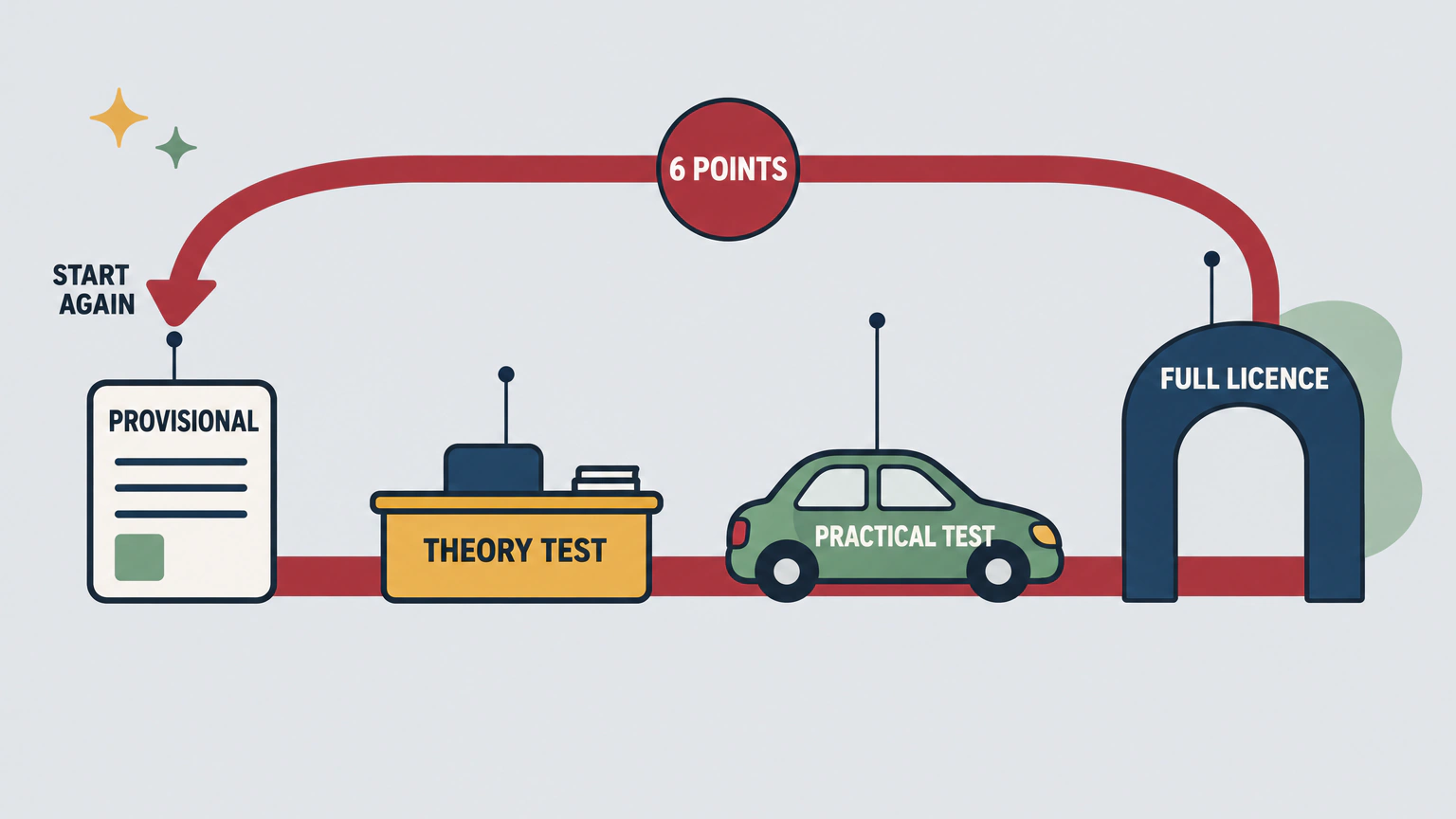
Driving unsupervised or with the wrong L plates can put points on your licence before your first test. They don't trigger revocation just because you pass. Another offence can, and rebuilding then costs at least £135 in government fees.
A theory pass certificate number lasts two years. After revocation, you have to pass the theory test again even if the old certificate hasn't expired.
If a revocation letter does land on your mat, we'd take it to a solicitor rather than argue it alone.
What changed in 2026, and what is still only a proposal
Two things get talked about as though they're the same. One is law, in force, with a date on it. The other is a consultation that closed and hasn't reported.
In Great Britain you now have to book your own car test
Since 27 April 2026, the application for a category B practical test has to come from the person taking it. The Motor Vehicles (Driving Licences) (Amendment) Regulations 2026 put it in as a flat prohibition: an application "may not be made by any other person on behalf of the applicant in person". The explanatory note says the effect is to require that applications "are made by the person intending to take the test". DVSA dates its corresponding booking-service change to 12 May 2026.
So a parent can't book it. Nor can a friend, nor one of the services that used to hunt cancellations for a fee. The learner needs their own driving licence number and their theory pass certificate number when they book. The ban covers England, Wales and Scotland.
In Northern Ireland, a six month wait from 1 October 2026
Northern Ireland has always run its own system, and on 1 October 2026 it moves further from Great Britain's. The commencement order made on 30 June sets that date for sections 16 to 19 of the Road Traffic (Amendment) Act (Northern Ireland) 2016. Four things arrive together. A category B provisional licence must be held at least six months before the practical test unless the holder is exempt. A logbook of approved training must be produced before the test unless exempt, and forging or misusing it becomes an offence that can lead to revocation. And the 45mph learner speed limit goes.
| Great Britain (DVLA) | Northern Ireland (DVA) | |
|---|---|---|
| Postal application form | D1, from most Post Offices | DL1, from main Post Office branches |
| Fee online | £34 | £62.50, the same as by post |
| Fee by post | £43 | £62.50 |
| How long it takes | About a week online | 10 working day target, allow six weeks |
| Learner speed limit in a car | Same as a full licence | 45mph, until 1 October 2026 for new licences and 1 April 2027 for older ones |
| Motorways on a provisional | Yes, with an approved instructor in a dual control car | With an approved instructor from 1 October 2026 for new car entitlements, or 1 April 2027 for older ones |
| Time holding the licence before the car test | No minimum | Six months from 1 October 2026, unless exempt |
| After you pass | Green P plates optional | R plates compulsory for a year, or two years for drivers who qualify under the new rules |
In Northern Ireland, check when your provisional entitlement begins, rather than when you send the application. If it began before 1 October, you have until 31 March 2027 to pass under the old rules. During that window you keep the 45mph limit and avoid the new six-month wait and logbook. Passing within it gives you the old twelve-month R plate period. If your entitlement begins from 1 October, the new rules apply straight away. They include limits on young passengers late at night for drivers under 24, during the first six months after passing. If you're learning there, our list of instructors across Northern Ireland is the place to start.
And then the thing that hasn't happened. The Department for Transport consulted on a minimum learning period for Great Britain: a minimum gap between theory test and practical, a minimum number of supervised hours, a mandated syllabus. It ran from 7 January to 11 May 2026 and it's closed, with the page still reading "We are analysing your feedback". Nothing in Great Britain has changed because of it, and any page telling a British learner they now need a set number of hours is describing a proposal.
Common questions
How much is a provisional driving licence?
£34 online in Great Britain and £43 by post. In Northern Ireland the DVA charges £62.50 either way. That's the whole fee, with no processing charge. In Great Britain, add the £23 theory test and a £62 weekday practical and the government's share comes to £119.
How long does a provisional licence last?
The photocard runs for ten years and then has to be renewed. In Great Britain that's £14 online, £17 by post, or £21.50 at a Post Office handling DVLA renewals. A Northern Ireland provisional expires on the same ten-year cycle, and renewing it there costs £30.
When can you apply, and when can you actually drive?
You can apply from 15 years and 9 months, whatever you plan to drive. Driving comes later and depends on the vehicle: 16 for a moped or light quadricycle, 17 for a car, and 16 for a car if you receive PIP including the mobility component at the enhanced rate.
How long does a provisional licence take to arrive?
About a week if you apply online in Great Britain, and DVLA emails a confirmation as soon as it goes through. It takes longer if they need extra checks, or if you posted an original identity document. In Northern Ireland the DVA aims to process a complete application within 10 working days. It asks you to allow at least six weeks for delivery.
Can you drive on your own with a provisional licence?
No, while you're learning to drive a car. You need a qualified person beside you, aged 21 or over, with a full licence for that type of car held for at least three years. Drive without them and you risk a fine of up to £1,000 and up to six penalty points on the licence you've just paid for.
What happens to your provisional licence when you pass?
In Great Britain, the examiner can arrange your full licence. The first one is free unless you want a different photo, which costs £17. Unexpired points carry over. An offence within two years of your first test that brings you to six points or more triggers revocation. You pay £50 for a new provisional and retake both tests.