

On this page
The short answer
Learning can take four figures and several months, and somebody has just asked you a question you hadn't thought about: manual or automatic? Nobody warned you it was a real decision. It is.
Learn in a manual if there's any real chance you'll need to drive one, because a manual pass covers both kinds of car and an automatic pass only covers automatics. If the clutch is genuinely the thing keeping you off the road, take the automatic and accept the trade: changing your mind later means sitting a second practical test, though not a second theory test.
Two things settle this, and neither of them is temperament. The first is that the gap in pass rates between the two is real. The second is that an automatic pass puts a restriction on your licence until you pass a manual test, and that changes what you may drive.
That restriction is the part worth slowing down for. Pass in a manual and you never think about any of this again. Pass in an automatic and it sits on your licence until the day you go back and take another test.
| What you are deciding | Test in a manual | Test in an automatic |
|---|---|---|
| What you can drive afterwards | Manual and automatic cars | Automatic and semi-automatic cars only |
| The code on your licence | No transmission restriction | Code 78 |
| The category shown on newer licences | Category B | Category B with restriction code 78 |
| The test itself | Four parts, about 35 minutes | Four parts, about 35 minutes |
| To gain the other entitlement later | Nothing to do | Pass a second practical test in a manual car |
| Theory test needed to upgrade | Not applicable | No theory test needed |
Sources: GOV.UK's guides to driving licence categories, driving licence codes, the car driving test and the car theory test. Great Britain.
What DVSA's own numbers show
One oddity explains some of the bad information on this subject. DVSA publishes a pass rate for automatic car tests and a pass rate for all car tests, but neither table gives a manual figure. Subtract the automatics from the total and the manual figure falls out.
| Financial year | Automatic tests | Automatic pass rate | Manual tests | Manual pass rate | Gap |
|---|---|---|---|---|---|
| 2015/16 | 114,994 | 39.3% | 1,422,741 | 47.7% | 8.4 points |
| 2018/19 | 185,043 | 38.8% | 1,479,176 | 46.7% | 7.9 points |
| 2021/22 | 242,713 | 41.7% | 1,295,601 | 50.2% | 8.5 points |
| 2023/24 | 455,276 | 42.8% | 1,489,949 | 49.4% | 6.6 points |
| 2024/25 | 479,556 | 43.9% | 1,360,261 | 50.4% | 6.5 points |
| 2025/26 | 589,483 | 44.6% | 1,409,138 | 52.3% | 7.7 points |
Figures come from DVSA tables DRT121A and DRT122E, covering car practical tests in Great Britain. DVSA publishes the automatic figures and the all-car figures. The manual columns are the difference between them. The gap column is the difference between the two rate columns as shown. Northern Ireland sits outside both tables.
Automatic tests went from about one in thirteen to nearly one in three
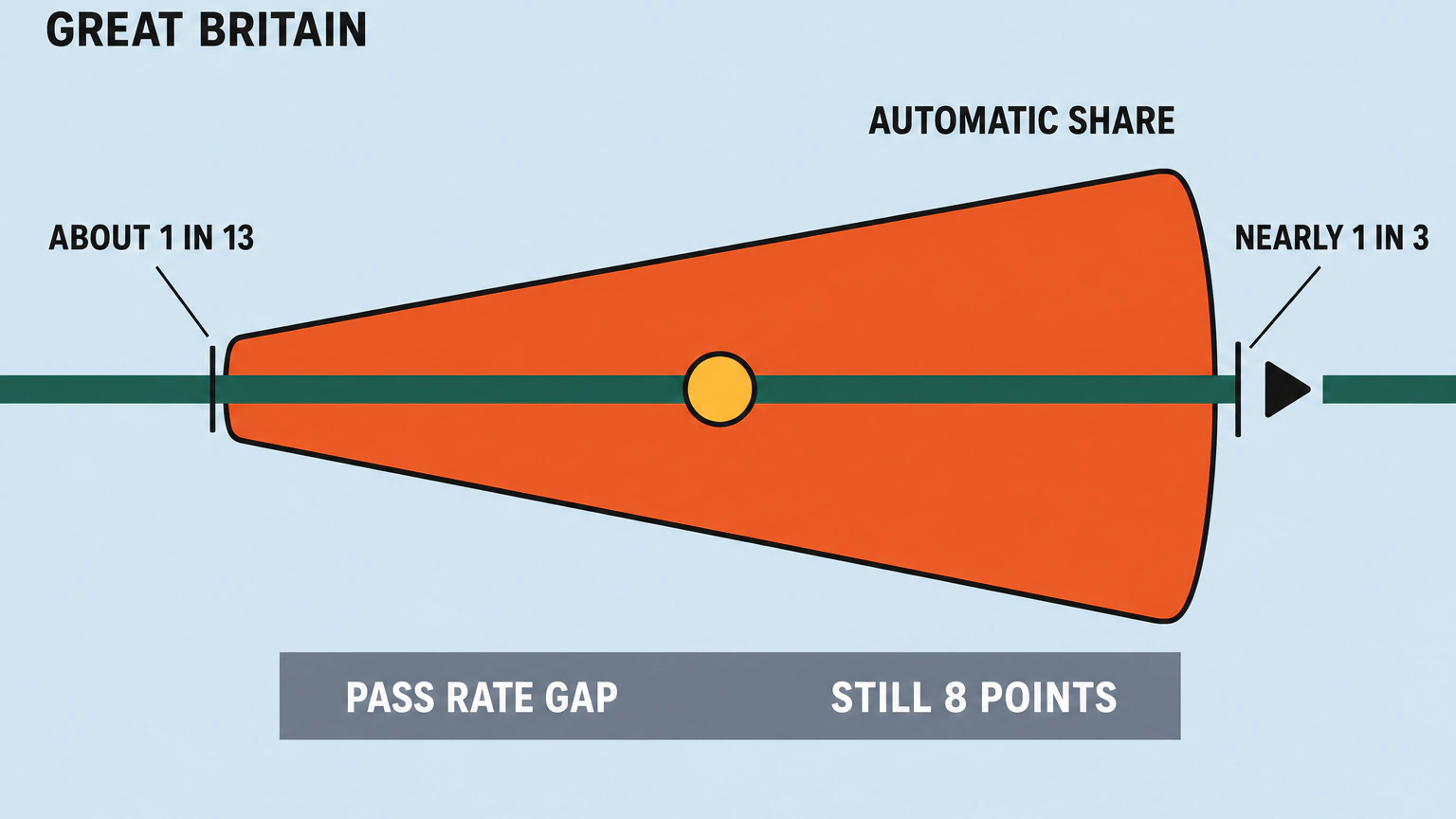
In 2015/16, learners in Great Britain sat 1,537,735 car tests and 114,994 of them were in an automatic. That's one test in thirteen. Ten years later, in 2025/26, the total had reached 1,998,621 and 589,483 of those tests were automatic, which is nearly one in three.
Look at that as a change in behaviour rather than a change in the test. Automatic and manual candidates take the same test. The figures do not say why automatic use rose. More than one in four new cars sold in the UK is now electric, according to the Department for Transport.
That's a genuine shift and it's worth knowing. It's also the only part of this story most guides tell you.
The pass rate gap has barely moved in ten years
Now the part that nobody does. In 2025/26, 589,483 automatic tests produced 263,121 passes, a rate of 44.6%. All car tests together came to 1,998,621 with 1,000,043 passes, or 50.0%. Take the automatics out of both sides and you're left with 1,409,138 manual tests and 736,922 manual passes. That's 52.3%.
So the gap in 2025/26 is 7.7 points, in manual's favour. Run the same subtraction back through the decade and the gap goes 8.4, 7.9, 8.5, 6.6, 6.5, 7.7. It wobbles. It doesn't close.
Automatic tests grew more than fivefold. The gap ended close to where it started.
Why the test itself is not the reason
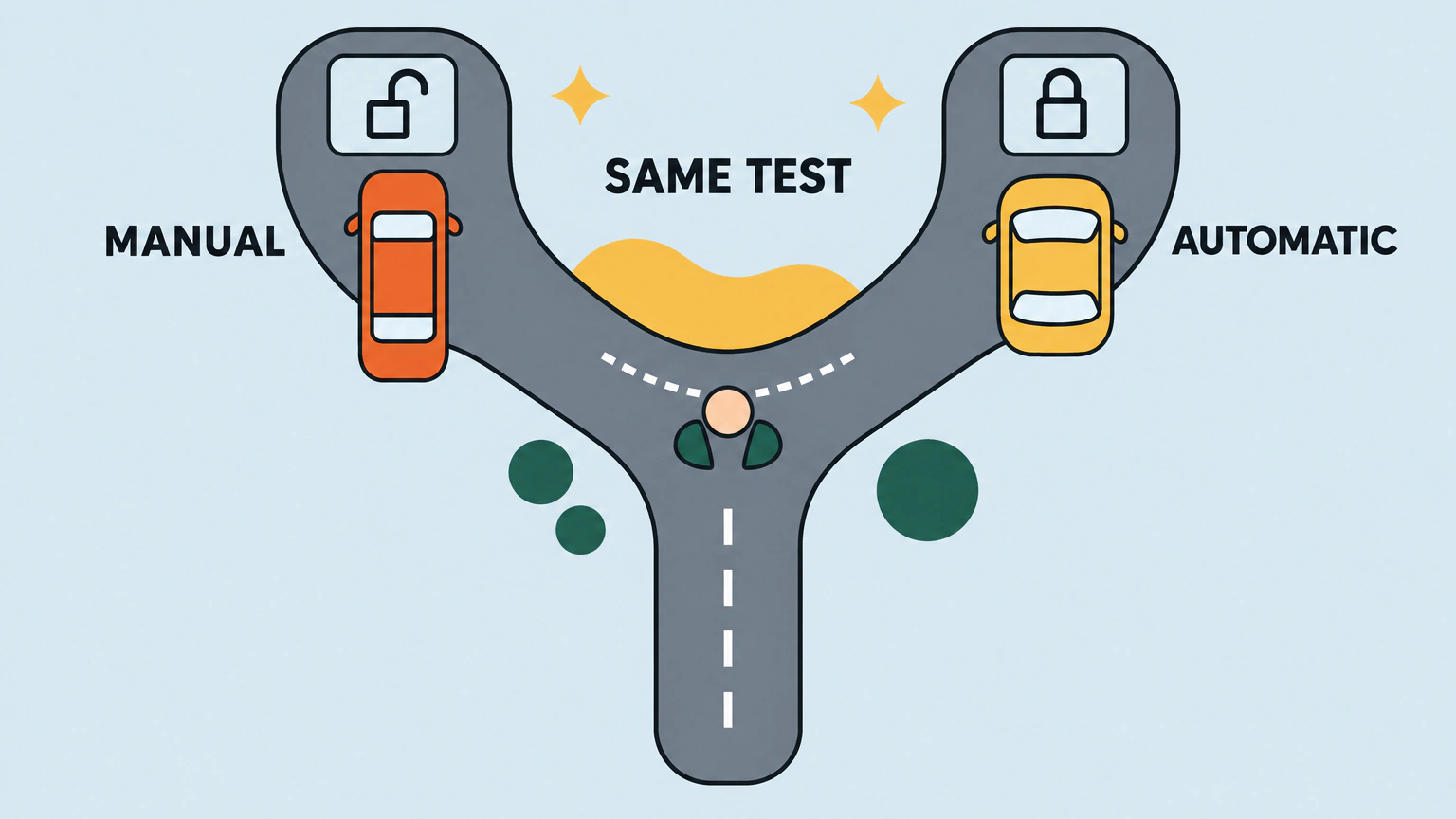
GOV.UK puts it in one sentence: "The test is the same for both manual and automatic cars." Four parts either way: an eyesight check, two vehicle safety questions, general driving including an independent section, and a reversing exercise. You'll drive for around 35 minutes whichever car you turn up in.
So a seven point difference between the two isn't a difference between two tests. It's a difference between two groups of people who chose differently. The tables do not record why candidates chose each transmission, so they cannot explain the gap.
Which leaves you with a much smaller question than the one you probably came in with. Seven points isn't a reason to pick a gearbox. What's on the licence afterwards is.
What an automatic licence stops you driving
One afternoon at a test centre decides the next forty years of your driving. This is the part that's genuinely hard to undo.
Code 78, and where you will see it
Turn a photocard licence over. The codes printed on the back tell you what conditions you have to meet to drive, and if you passed in an automatic, one of them is 78. DVLA's own wording for it is "restricted to vehicles with automatic transmission". On newer licences, the category is B and code 78 carries the automatic-only restriction. GOV.UK explains the entitlement as: "You can drive a category B vehicle, but only an automatic one".
Nothing about that is provisional. It's what your licence says you may drive, and it stays until you pass a manual test and DVLA issues a new one.
Red flag: A school's advertised first-time pass rate is not a DVSA statistic. Ask two questions of any figure you are shown: which financial year, and which DVSA table. Then take the two-line subtraction, automatic tests out of all tests, to any page telling you automatic learners pass more often.
The semi-automatic trap
This one catches people out. GOV.UK's test for what counts as an automatic isn't the badge on the boot. It is the pedal count. A manual car has three pedals. An automatic or semi-automatic car has two.
And the rule follows from that, in GOV.UK's own words: "If you take your test in a semi-automatic car you'll only be able to drive automatic and semi-automatic cars once you've passed your test." Same restriction, same code, same second test if you change your mind.
That matters more than it used to, because newer cars muddy the label. Paddles behind the wheel and a selector that clicks through numbers can feel like a manual. If it has two pedals, DVSA treats it as an automatic. Count the pedals in your instructor's car before your first lesson, not after your test.
Hire cars, work vehicles and driving abroad
Three situations turn code 78 from a line on a card into a real problem. All three are checkable now.
The first is a hire desk, especially abroad. Hire companies offer manual and automatic cars, so put your dates into the booking form for the country you have in mind and see what an automatic costs there. Do it now, not at an airport counter.
The second is work. A job advert either asks for a manual licence or it doesn't, and the wording sits in the requirements. Adverts in delivery, trades, care work with a pool car and anything involving a van are worth reading closely.
The third is borrowing. Your parents' car, a friend's car on a night out. If the car you'd realistically borrow has three pedals, an automatic licence puts it out of reach.
For plenty of people none of the three ever comes up, and we're not going to pretend otherwise. Find out which kind of learner you are before you book.
If you change your mind later
The decision is reversible. Automatic is a defensible choice rather than a trap, as long as you know what reversing it costs.
You keep your theory test pass
The single most common misunderstanding about upgrading is that you start again from scratch. You don't. GOV.UK's theory test guidance is flat about it: "You do not need to take the car theory test if you want to upgrade an automatic car licence to a manual one."
That's one of two fees you don't pay twice, and it removes the worst part of starting over. Your full automatic licence lets you book the manual upgrade without another theory test.
What the switch actually costs
The sum is short. One practical test at £62 to £75. However many manual lessons it takes you to be ready for it. Then the wait for a test slot, which is the part with no price on it at all.
We're not going to invent a lesson count, because nobody can honestly give you one for a driver who already holds a licence. If you want the wider evidence on how long a course actually runs, we've collected it under how many driving lessons you actually need. What we can tell you is the shape of the bill: a fee you can look up, plus tuition you can't, plus time.
One more piece of money, and it catches people mid-course. Switching gearbox can mean switching instructor. If you've paid for a block of lessons with someone who only teaches the other one, you need to know what you can get back if you stop mid course before you make the call. DVSA's fees and rules do move, and its own booking service is where today's numbers live.
What lessons cost, and where the national data stops
Money is why most people ask this question at all. Half the answer is published, fixed and identical either way. We could not find a credible national transmission split for the other half.
The fees are fixed and public
Your provisional licence costs £34 to £43, depending on how you apply. The theory test is £23. The practical test is £62 to £75. Those are GOV.UK's own figures, and not one of them changes with the gearbox you choose. That's worth saying, because the search results around this question imply otherwise.
What varies is tuition, and the best national anchor we have is DVSA's survey of working instructors. Asked what they charge for a standard one-hour lesson in October 2025, half of them said £36 to £40, and another fifth said £41 to £45. We've set out the full price spread, and how many hours learners actually take, in our guide to how many driving lessons you actually need.
What local price lists show
Current price lists show both patterns. Some schools charge more for automatic lessons, while others charge the same.
DVSA asked 3,342 instructors what they charge. The published report runs to over 9,500 words about their businesses, their hours, their waiting lists and their prices, and it doesn't use the word "automatic" once. No transmission split, anywhere. The ADI register statistics don't carry one either.
That doesn't make a local premium imaginary. It means the honest answer comes from current local quotes, not a national percentage.
Pro tip: Ask an instructor for their hourly rate for a manual lesson and their rate for an automatic, in the same message, and ask whether the automatic car carries a different block-booking price. Instructors answer that pair straight away, because it's their own price list rather than an opinion. Ask anything vaguer and you'll get a range.
Electric cars and the 2030 argument
The future-proofing case turns up in every conversation about this, usually from an adult who has read a headline. It's worth taking seriously, and then testing.
What 2030 and 2035 actually change
The dates are real and the government has restated them. In August 2026 the Department for Transport opened its review of the zero emission vehicle mandate with a plain statement: "New petrol and diesel cars will be phased out by 2030 and all new cars and vans will need to be fully zero emission by 2035." That consultation runs until 23 October 2026, and it asks whether the annual targets on manufacturers are still right.
More than one in four new cars sold is already electric. An electric car has no clutch and no gearbox to change, so every one of them is an automatic as far as your licence is concerned.
If you're seventeen now, that's the world you'll eventually be buying into. It's a genuine argument for learning in an automatic, and the strongest one there is.
Where future proofing stops being an argument
Here is the catch, and it is in the wording of the policy itself. The 2030 and 2035 dates apply to new cars. Many new drivers will buy used rather than new, and the phase-out dates do not remove manual cars from the second-hand market.
Then add everything that isn't your car. The friend's Corsa. The works van with a fleet policy. The hire car in France whose automatic price and availability you have not checked. None of that is touched by a phase-out date on new sales.
We'd put it this way. Future proofing is a good reason to choose automatic if you already know you'll only ever drive your own car. It's a weak reason if you can't say that yet, because the rule protects a market you won't shop in for years.
So which should you book
Time to decide. Work through this first, because every one of these is something you can actually go and find out this week rather than guess at.
- Whether anyone whose car you would realistically borrow drives a manual.
- Whether any job you are considering lists a manual licence in its requirements.
- Whether you expect to hire a car abroad in the next five years, and where.
- Whether the clutch specifically, rather than the road, is what is going wrong in your lessons.
- Whether an automatic instructor is actually available near you inside your timeframe, or only in theory.
- Whether you would be willing to pay for a second practical test if you changed your mind.
Book automatic if this is you
Book the automatic if the clutch is the specific obstacle. Not the roundabouts, not the parking, not the nerves. The clutch: stalling at junctions, hunting for the biting point on a hill start, spending every lesson thinking about your left foot instead of the road ahead. An automatic removes that obstacle. The seven point gap says nothing about that learner individually.
Book it if you know your own car will be electric, and you can say honestly that you won't be borrowing or hiring anything else.
And book it if the real choice is between an automatic and never learning at all. A licence with code 78 on it beats no licence by an enormous margin. Calling that a compromise misses the point. It's a decision with a known price attached.
Book manual if this is you
Book manual if anything on that list gave you a maybe. That's the whole rule, and the clearest recommendation we can give you.
The reason is asymmetry, not snobbery. If you learn manual and then drive automatics for life, you've lost nothing. Your licence already covers them, with no second test and nothing more to pay. If you learn automatic and find you need a manual, you go back to a test centre, pay again, and wait for a slot in a long queue.
One route is reversible for free. The other costs money and months. When you genuinely can't tell which way you'll go, take the free one.
Finding an instructor who teaches your choice
Start with DVSA's own find driving instructors service, which confirms somebody is approved and shows their grade if they declare it. Read its caveat, though, because it changes how you use it: "Approved driving instructors (ADIs) choose whether or not to be on this service, so not all ADIs will be listed." Plenty of good ones are simply absent. If a recommended instructor isn't on it, ring DVSA and check them by name and ADI number.
Then fill the gap the official list leaves. You can browse instructors by English city or go straight to driving instructors and driving schools near you and shortlist two or three who teach in the gearbox you chose. Ask each for their first available slot, not their opinion of automatics. We sell neither gearbox and take no side in your answer, which is unusual on this question. You can read what our own checks do and do not cover before you trust a word of it.
One last thing before you go. All of these figures are Great Britain, because DVSA runs the tests and the instructor register in England, Scotland and Wales only. In Northern Ireland the DVA runs both under its own rules, and some licence codes differ there too, so start instead with our listings for instructors across Northern Ireland.
Frequently asked questions
Can I drive a manual car with an automatic licence?
No. Code 78 on your licence means automatics and semi-automatics only, so a manual car sits outside what you're entitled to drive. The fix is to pass a second practical test in a manual, after which the restriction comes off and your licence covers both. You keep your original pass in the meantime.
Is it easier to pass the test in an automatic?
No, and the figures run the other way. In 2025/26, 44.6% of automatic car tests in Great Britain ended in a pass, against 52.3% for manual tests. That's not a statement about the test, which GOV.UK says is the same for both. It's a difference between two groups of learners who chose their car for different reasons.
Do I have to take the theory test again to upgrade to manual?
No. GOV.UK states it plainly: "You do not need to take the car theory test if you want to upgrade an automatic car licence to a manual one." You book a practical test in a manual car, at £62 to £75, and pass that. You do not need another theory test, so the upgrade costs you one test fee plus whatever lessons you need.
What is code 78 on a driving licence?
Code 78 is DVLA's shorthand for "restricted to vehicles with automatic transmission", printed with the other codes on the back of your photocard. On newer licences, the category is B and code 78 carries the automatic-only restriction. The restriction stays until you pass a manual practical test and DVLA reissues the licence without it.
Are automatic driving lessons more expensive than manual?
Sometimes. Current school price lists show both patterns. DVSA asked 3,342 instructors what they charge for a one-hour lesson in October 2025, and its report does not split prices by transmission. The most common price was £36 to £40 across all lessons. Ask two local instructors for both rates and compare real numbers.
If I only ever want to drive an electric car, do I need a manual licence?
No. An electric car has no clutch, and GOV.UK's test for what counts as an automatic is the pedal count: two pedals rather than three. So a licence carrying code 78 covers electric cars. The question worth asking is whether you'll only ever drive your own car, because a borrowed or hired manual is a separate problem.
Is it harder to find an instructor with an automatic car?
It depends entirely on where you live, and no official count settles it: DVSA's register statistics don't record which gearbox an instructor teaches in. Treat it as a local question with a two-minute answer. Search your postcode for both, ask each instructor for their first free slot, and compare the dates you're actually offered.