

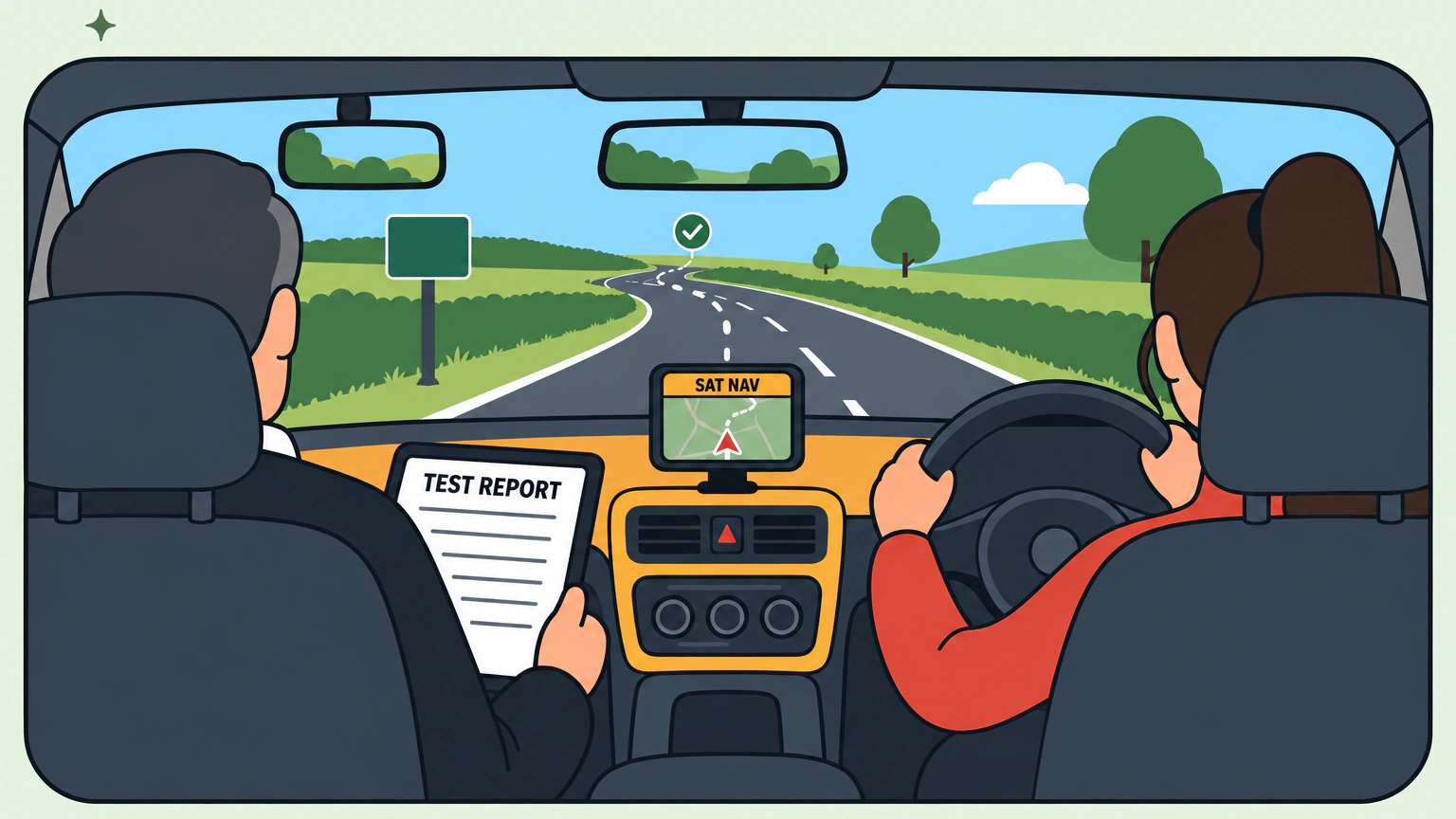
The car practical test in England, Scotland and Wales takes about 40 minutes, around 35 of them driving, and you pass with 15 or fewer driving faults and no serious or dangerous fault. Since 24 November 2025 it has three stops instead of four, an emergency stop on only about one test in seven, and independent driving that can fill the whole drive. Northern Ireland runs a different test, which changes again on 1 April 2027.
On this page
What happens on your test, step by step
Nothing on the day should come as a surprise, so here's what happens on a driving test in Great Britain, in order. Three things are worth knowing first. The examiner asks at the start whether you'd like someone in the back, usually your instructor. Test routes aren't published, so nobody can teach you "the route". And the examiner only stops a test early if your driving is a danger to other road users, so one mistake isn't the end of the drive.
If you have a disability, a health condition or a learning difficulty, say so when you book. The examiner can adjust, for example by giving you more time for directions or letting you follow traffic signs instead of a sat nav.
Your test, step by step (England, Scotland and Wales)
| Stage | What happens | What counts against you |
|---|---|---|
| At the test centre | The examiner checks your licence, you sign a short insurance and residency declaration, and you're asked whether your instructor should sit in | Missing documents or an unsuitable car: the test is cancelled and you pay again |
| Eyesight check | You read a number plate from 20 metres, or 20.5 metres for an old-style plate | Fail it and the test ends there |
| Tell me question | One vehicle safety question, answered before you drive | A wrong answer is one driving fault |
| General driving | Around 35 minutes on a mix of roads, never motorways | Each mistake is graded as a driving, serious or dangerous fault |
| Show me question | One safety task done on the move, such as washing the windscreen | Getting both questions wrong still counts as one driving fault. Losing control while doing it can fail you |
| Three stops | A normal stop, pulling out from behind a parked car, and a hill start | Stopping somewhere unsafe, rolling back, or pulling away without proper checks |
| One reversing exercise | Parallel park, park in a bay forwards or in reverse, or pull up on the right and reverse about 2 car lengths | Control and observation are marked separately |
| Independent driving | 20 to 35 minutes following a sat nav the examiner sets up, traffic signs, or both | A wrong turn is not a fault in itself |
| Emergency stop | On about 1 test in 7, and the examiner tells you it's coming | Slow reaction, poor braking or losing control |
| Your result | Given on the spot, with your faults explained and a summary sent by email or post | A pass is 15 or fewer driving faults and no serious or dangerous fault |
What to bring, and what gets a test cancelled
The cheapest way to fail is never to start. Turn up without the right documents, or in a car that breaks the rules, and the test is cancelled and you pay again. You need your UK licence, your theory pass certificate if you have it, and a car.
Your own car has to meet a few rules that catch people out. The speedometer must be a built-in mph one, and the car must be able to reach 62mph. A dashcam is fine if it faces outwards and records no sound inside. Self-parking, Tesla Autopilot and your own sat nav stay off. DVSA refuses cars that don't give the examiner all-round vision, including some convertibles, the Toyota iQ, the two-door Smart Fortwo and the Polestar 4 and 5. A hire car needs dual controls. Your own car doesn't.
Before you leave for the test centre
- Your photocard licence, or your paper licence and a valid passport
- The glasses or contact lenses you need to read a number plate at 20 metres
- In your own car, an extra interior mirror fitted for the examiner
- A passenger seat belt and a head restraint built into the seat, not a slip-on one
- L plates front and back, or D plates if you're in Wales
- No warning lights showing, legal tread on every tyre, and no space-saver spare fitted
- Taxed, MOT'd if it's over three years old, and insured for a driving test
- Not a car DVSA refuses, and proof it's safe if it's a recalled Citroen or DS
Most people skip that list by using their instructor's car, GOV.UK notes. In Wales it can carry D plates, and our driving instructors in Wales are listed by city.
The eyesight check and the two safety questions
The eyesight check comes first, and it's the one part that ends a test before you've moved. You read a number plate at 20 metres (20.5 for an old-style plate), wearing the glasses or lenses you drive in. Fail it and the test stops there. DVLA is told and your licence is revoked, and getting it back means a DVSA eyesight test at a driving test centre. If road signs have looked fuzzy lately, see an optician before you see an examiner.
Then come the show me, tell me questions, one before you drive and one on the move, from DVSA's published lists of 14 tell me and 7 show me. One or both wrong costs a single driving fault. What can fail you is unsafe driving while you do the show me task, so wait until it's safe. The examiner manual lets you use the car's own display to answer questions on fluid levels or tyre pressures, and it doesn't mark you on opening the bonnet. GOV.UK's full list of show me, tell me questions is worth an evening with your instructor.
What changed on 24 November 2025
If you've been reading older guides, some of what you've heard is now slightly wrong. DVSA trialled three adjustments at 20 test centres from April 2025. It ran the trial two months longer to see summer traffic, ended it in October 2025 and made the changes permanent from 24 November 2025. DVSA wanted a test "more reflective of the current everyday conditions motorists face", and it says learners "are still required to demonstrate the same core skills they have always needed".
DVSA's 24 November 2025 changes and GOV.UK's later wording
| Earlier position | Current position | |
|---|---|---|
| Stops at the side of the road | 4 | 3 |
| Emergency stop | About 1 test in 3 | About 1 test in 7 |
| Independent driving | About 20 minutes, following a sat nav or traffic signs | 20 to 35 minutes in the 8 January 2026 capture, following a sat nav, signs or both, and it can run the whole drive |
| Driving time GOV.UK gives | Around 40 minutes in the 5 December 2025 capture | Around 35 minutes by the 8 January 2026 capture |
| Extended test driving time GOV.UK gives | Around 70 minutes in the 5 December 2025 capture | Around 65 minutes by the 8 January 2026 capture |
| Skills you have to show | The national standard for driving cars | The same, DVSA says |
DVSA's examiner guidance puts the whole test, start to finish, at 38 to 40 minutes.
The point of the change is route design, and it's the part older guides miss. Every compulsory stop and every emergency stop needs a safe place to happen. With fewer of them to fit in, examiners can route tests onto higher-speed and higher-risk roads where the area has them. DVSA says these "will not replace urban driving". Still, a learner who has only practised around town could meet a fast rural road for the first time on the day.
As for the minutes, GOV.UK now says around 35 minutes of driving, where it used to say around 40. DVSA's examiner manual still puts the whole test at 38 to 40 minutes.
So we'd ask for a mock test, and for a lesson on the fastest roads near your test centre, slip roads included. If your instructor can't offer both, look for driving instructors near you for a mock test.
How the examiner marks your drive
Most guides skip this part, and it's the one that settles nerves. Examiners don't just count mistakes. They grade them, and DVSA publishes how in its manual, "Carrying out driving tests: examiner guidance". There are four grades, not three, because the smallest slips are never recorded. For each recorded grade, DVSA gives an example from one situation: pulling out of a junction.
| Grade | What it means | DVSA's example, pulling out of a junction | What it does to your result |
|---|---|---|---|
| Not recorded | A tiny slip that doesn't affect safety | No junction example. The guide's examples are dry steering and putting the handbrake on without pressing the button | Nothing |
| Driving fault, or minor | Falls short of a safe, competent driver, but nobody was put at risk | You looked, misjudged an approaching car, and it had to slow down | Up to 15 allowed. A habit in one area can be marked serious |
| Serious fault | Potentially dangerous, or against the law | You pulled out without looking properly, unaware of anyone who might have been there | Fail |
| Dangerous fault | Actual danger to you, the examiner, the public or property | You misjudged an approaching car so badly the examiner had to act to avoid a collision | Fail |
Fifteen minors is a limit, not a target
Up to 15 driving faults and no serious or dangerous fault is a pass. The 16th is a fail. But the manual adds a condition that the count hides. A learner who keeps making the same driving fault in one area "cannot be regarded as competent to pass the test", and the repeated fault can then be marked serious. The manual gives no number for when that happens.
Examiners test every fault with one question: "If this was the 16th fault, could you justify it resulting in the candidate failing their test?" It cuts both ways, because the same question decides whether a slip goes on the sheet at all.
As for "three minors in one box is a serious", DVSA prints no such rule. Aim for a clean drive, not a count.
What turns a small mistake into a fail
In plain terms, a driving fault falls short of safe, competent driving without putting anyone at risk. A serious fault is potentially dangerous or breaks the law. A dangerous fault involves actual danger.
At a junction, it looks like this. You look, misjudge a car, and it has to slow down: a driving fault. You pull out without looking properly: a serious fault, even if nobody happened to be coming. You misjudge a car so badly that the examiner has to act: a dangerous fault. Junctions deserve the practice, because "not making effective observations at junctions" tops DVSA's list of fail reasons. Our lessons guide sets out DVSA's top ten reasons people fail, and how many lessons it takes.
Three rules from the manual explain a lot of results. The cause normally decides where the fault is marked, unless the effect is worse. Approach a junction too fast, pull out badly, and that's the exception: it's marked as junction observation, not speed. Breaking the law, such as ignoring a red light or a stop sign or driving well over the limit, is serious by definition. And a dangerous fault is marked "regardless of any action taken by the examiner".
Going too slowly counts as well. The manual marks undue hesitation, and its example of a serious one is stopping and waiting when it's safe and reasonable to go. Take the gap a test-standard driver would. A queue behind you is never a reason to risk one you aren't sure of.
Stalling, crossed hands and other myths
DVSA's own Ready to Pass site takes on the playground folklore, and the news is good. Examiners have no pass quotas. One stall where you keep control isn't an automatic fail, though stalling and rolling back a long way, or stalling repeatedly, is. Crossing your hands on the wheel isn't marked in itself. The time of day doesn't change your chances. And exaggerated head movements for the mirror checks don't help, however much they make you look like an owl at Wimbledon.
The manual's own worked example even records a stall while pulling up at the side of the road as one driving fault, which is about as undramatic as marking gets.
Your result, and what happens next
The examiner tells you straight away whether you've passed and explains your faults. You choose whether the summary comes by email or post. Most people are too flooded with relief or disappointment to take much in, which is why the question at the start matters. Usually the person in the back is the instructor, and if yours is new to you, it's worth a minute to check your instructor is on the register.
Pro tip: take your instructor. DVSA encourages you to have your instructor sit in the back. Your results email tells you how many faults you made and what they were about, but not where you made them, and you'll struggle to take in the debrief on the day. Your instructor can note where things went wrong, and can listen to the feedback even if they didn't ride along.
If you pass
The examiner gives you a pass certificate and asks whether you want your full licence sent automatically, which means handing over your provisional. You can drive straight away. You'll still need insurance that covers you to drive on your own, so check the policy before your first solo trip.
Pass in an automatic and your licence covers automatics only, so read what an automatic licence stops you driving before you buy a first car. And for the first two years, six or more penalty points means your licence is revoked and you have to pass both tests again. Our provisional licence guide explains how the new-driver rule works.
If you fail, and when an appeal is worth it
The examiner explains the faults that failed you, or only the most serious if there were a lot. You rebook and pay again, £62 on a weekday or £75 on an evening, weekend or bank holiday, for a date at least 10 working days away. If you need to move it later, check how much notice you need to move your test.
Appeals are narrow. Nobody can change your result, not even a court. A court can only order a free retest or a refund, and only if the examiner didn't follow the law. Think no eyesight check, less than 30 minutes on the road, no reversing exercise or no show me, tell me questions. Disagreeing with the examiner's judgement isn't a ground. You'd go to a magistrates' court within 6 months in England and Wales, or a sheriff's court within 21 days in Scotland. If you have proof, a complaint to DVSA is quicker. An appeal is a court case, and GOV.UK warns you might have to pay significant legal costs if you lose, so get legal advice before you start one.
If DVSA cancels for bad weather, it automatically books the next available date. It sends you the details within 3 working days, or within 7 days after a long spell. You cannot claim expenses. A short-notice cancellation for another reason, such as an unwell examiner, lets you claim out-of-pocket expenses. But if you feel unwell or the car breaks down during the test, you pay again.
Taking your test in Northern Ireland
If you're learning in Northern Ireland, most of what you've read about the UK driving test describes someone else's test. The DVA runs the practical driving test in NI. You'll drive for about 40 minutes, and every test includes an emergency stop. Your one reversing exercise is reversing round a corner, turning in the road or reverse parking. Independent driving follows traffic signs, spoken directions shown on a diagram, or both, with no sat nav. The pass mark is the same. Bring your appointment letter, both parts of your photocard licence and a valid MOT certificate, and check the speedometer shows mph and km/h. The fee is £65 on a weekday and £95 on an evening or weekend.
| Great Britain (DVSA) | Northern Ireland (DVA), until 31 March 2027 | Northern Ireland, from 1 April 2027 | |
|---|---|---|---|
| Driving time | Around 35 minutes | About 40 minutes | Not announced yet |
| Emergency stop | About 1 test in 7 | Every test | Not announced yet |
| Reversing exercise, one of | Parallel park, bay park, or pull up on the right and reverse | Reverse round a corner, turn in the road, or reverse park | Not announced yet |
| Independent driving | 20 to 35 minutes, sat nav, signs or both | Traffic signs, spoken directions shown on a diagram, or both. No sat nav | About 20 minutes, with sat nav brought in |
| Show me, tell me | Tell me before you drive, show me on the move | Both asked after the eyesight check | Both asked and answered on the move |
| Pass mark | 15 or fewer driving faults, no serious or dangerous fault | The same | Unchanged, the Department for Infrastructure says |
| Car test fee | £62 weekdays, £75 evenings, weekends and bank holidays | £65 weekdays, £95 evenings and weekends | GDL does not change the test fee; check the current fee when booking |
If you still need someone who teaches the DVA test, our instructors across Northern Ireland are listed by city.
The new Northern Ireland test from 1 April 2027
Graduated Driver Licensing starts on 1 October 2026, and the new practical test follows six months later, on 1 April 2027. The Department for Infrastructure has named three changes to the test: about 20 minutes of independent driving, sat nav use, and show me, tell me questions asked and answered on the move. The standard for passing stays the same.
If your provisional licence started before 1 October 2026, you can take today's test up to and including 31 March 2027. From 1 April 2027, every learner must finish the GDL Programme of Training and Logbook before booking. If your provisional starts on or after 1 October 2026, you'll also wait at least six months before the test, unless you're entitled to Carer's Allowance. Our licence guide covers Northern Ireland's six-month rule and the six points that cancel a new licence. The Department hasn't published the rest of the new test yet, so if yours falls after March 2027, start practising with a sat nav now.
Common questions
We gathered these from what UK learners search for and the questions other guides answer, then answered them from DVSA's and the DVA's own guidance.
How many minors can you get on a driving test?
You can get up to 15 driving faults, often called minors, and still pass, as long as you have no serious or dangerous fault. The 16th driving fault is a fail. The catch is that a driving fault you keep repeating in one area can be marked as a serious fault instead, and DVSA's guidance gives no number for when that happens.
How long is the practical driving test?
Allow about 40 minutes at the test centre. DVSA's examiner guidance puts the whole test at 38 to 40 minutes, around 35 of them spent driving. On an extended test, the one you take after a driving ban, GOV.UK gives around 65 minutes of driving. In Northern Ireland the DVA test has about 40 minutes of driving.
Can you fail your driving test for stalling?
Not for one stall where you keep control of the car. DVSA's Ready to Pass site says you'll fail if you stall and roll back a considerable distance, or if you stall repeatedly. The examiner manual's own worked example, a stall while pulling up at the side of the road, is recorded as a single driving fault.
Do you still have to do an emergency stop?
Sometimes. Since 24 November 2025 it comes up on about one test in seven in England, Scotland and Wales, down from one in three. The examiner pulls you over first and shows you the signal they'll use. In Northern Ireland every test still includes one. You can take the test at any stage of pregnancy, but you must be able and willing to do an emergency stop.
Can your instructor sit in on your driving test?
Yes, and DVSA encourages it. The examiner asks at the start whether you'd like someone in the back. A relative or friend can come instead, as long as they're over 16, and whoever comes can't take any part in the test. They can also join you for the result and feedback, even if they didn't ride along.
What happens if you take a wrong turn on your test?
Nothing, in itself. A wrong turn isn't a fault, and the examiner will help you back onto the route. What can be marked is how you fix it. A late lane change to make up for the missed turn is judged like any other move, so stay in your lane and let the examiner reroute you.
Is the driving test different in Northern Ireland?
Yes. The DVA runs it, and every test includes an emergency stop. Turning in the road and reversing round a corner are still among the reversing exercises, and you can't use a sat nav for independent driving. The fee is £65 on a weekday and £95 on an evening or weekend. A new test with sat nav starts on 1 April 2027.