

On this page
- What a music grade actually is
- The grade ladder: level, hours and credits
- ABRSM, Trinity and RSL: what actually differs
- The Grade 5 Theory rule that stops families at Grade 6
- Do music grades count towards university?
- How to check a music qualification yourself
- What it costs: the exam entry and the lessons behind it
- Which board suits which learner
- Frequently asked questions
What a music grade actually is
A graded music exam isn't a certificate a teacher prints off at home. It's a qualification with a published level, a size in hours and a public entry on a government register.
The eight grades, and the step below Grade 1
Grades 1 to 8 run from beginner to advanced, and there's a step below Grade 1 most parents never hear about. ABRSM's Initial Grade is a regulated qualification in its own right, at Entry Level 3, with its own number (610/0064/1). Trinity publishes one too. Neither is a warm-up.
You don't have to climb rung by rung. ABRSM says candidates needn't complete one grade before the next, and Trinity lets a candidate enter at any grade. Nobody has to take grades at all: they're optional structure, not a gate on learning.
Who regulates them, and why it is not just Ofqual
Three regulators, not one. ABRSM's specification names Ofqual for England, Qualifications Wales for Wales, and CCEA Regulation for Northern Ireland.
The public register, Find a regulated qualification, carries an availability line worth reading: ABRSM's Grade 6 shows as available in England, Northern Ireland and internationally. Scotland sits outside all of this, on its own framework, the Scottish Credit and Qualifications Framework (SCQF), so check the levelling there rather than assuming the RQF answer travels north.
What "regulated" does and does not promise
Regulation buys published facts: the level, the size, the credit value and the grading scale, with an organisation accountable for them. It isn't a ranking. It puts no board above another and says nothing about your child's teacher.
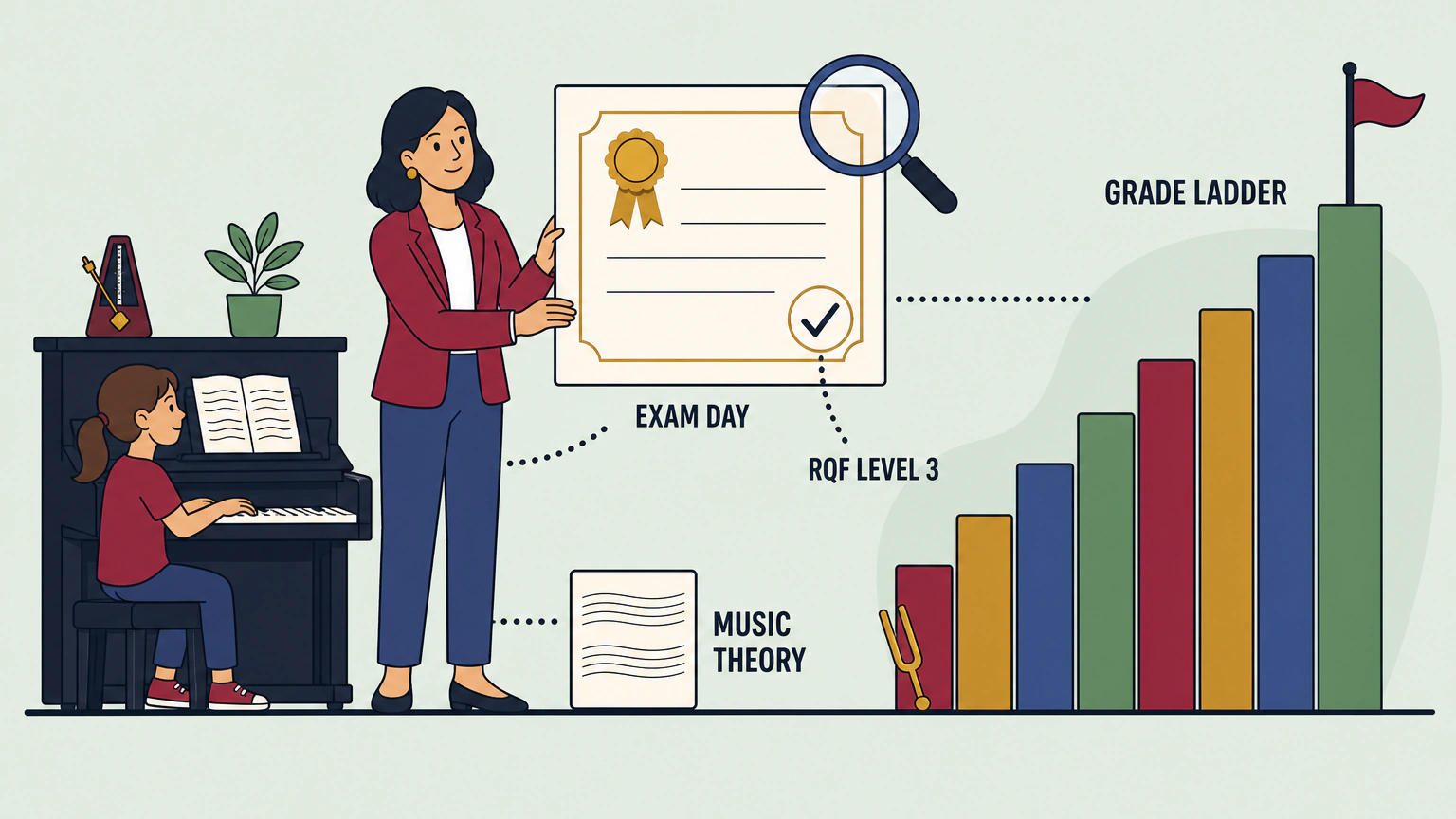
The grade ladder: level, hours and credits
Every grade has an official size, published by the board and repeated on the register.
| Grade | RQF level | Guided learning hours | Total qualification time (hours) | Credits |
|---|---|---|---|---|
| Initial Grade | Entry Level 3 | 8 | 40 | 4 |
| Grade 1 | Level 1 | 12 | 60 | 6 |
| Grade 2 | Level 1 | 18 | 90 | 9 |
| Grade 3 | Level 1 | 18 | 120 | 12 |
| Grade 4 | Level 2 | 24 | 150 | 15 |
| Grade 5 | Level 2 | 24 | 180 | 18 |
| Grade 6 | Level 3 | 36 | 220 | 22 |
| Grade 7 | Level 3 | 48 | 270 | 27 |
| Grade 8 | Level 3 | 54 | 320 | 32 |
ABRSM Music Performance grades, from the qualification specification, third edition, valid from 1 January 2025. Four rows cross-checked on Find a regulated qualification.
What "total qualification time" actually means
Guided learning hours are time with a teacher. Total qualification time adds the practice your child does alone, on the evenings nobody enjoys. Credits say it a third way, in the units the framework counts in.
ABRSM's footnote matters as much as the figures: these are estimates of average preparation time, guidance only, varying with experience and ability. 320 hours is not a promise that your child will pass Grade 8 in 320 hours.
What the hours say about how long a grade takes
Add the published total qualification time from Initial Grade to Grade 8 and you get 1,450 hours. At three hours a week including practice, that's roughly nine to ten years. Better to know that at the start.
Grade 1 is 60 hours, Grade 5 is 180, Grade 8 is 320. Each step costs meaningfully more than the last, so the hours pile up at the top of the ladder.
ABRSM, Trinity and RSL: what actually differs
| Board | Repertoire and character | Theory prerequisite for Grades 6 to 8 | Regulated on the RQF | Notes |
|---|---|---|---|---|
| ABRSM | Classical; Music Performance is performance only, Practical Music adds technique, notation and listening | Yes: Grade 5 or above in ABRSM Music Theory or Practical Musicianship, or Grade 5 in a Practical Grades solo Jazz instrument | Yes: Grade 6 is 603/5998/5, a Level 3 certificate | Initial Grade is its own Entry Level 3 qualification; any age may enter |
| Trinity College London | Classical and Jazz Grades plus Rock and Pop Grades, across piano, singing, strings, brass, woodwind, guitar and drums | No: Trinity states candidates at Grades 6 to 8 do not need Theory of Music qualifications | Yes: published as Level 3 qualifications, listed on the register under Trinity's own name | No age limits, and any grade may be entered without the earlier ones |
| RSL Awards (Rockschool and RSL Classical) | Contemporary band instruments (guitar, bass, drums, vocals, piano, keyboard, ukulele, horns) plus RSL Classical piano, violin and guitar | None published; photographic ID is required at Grades 6, 7 and 8 | Yes: its Grade 8 Performance Certificate is 610/4778/8, Level 3, with the same 54 guided learning hours, 320 hours and 32 credits as ABRSM's | Entry requires the grade book or a platform subscription |
From each organisation's own specification, entry guidance and fee pages, plus the register.
Choosing on repertoire, not on prestige
It's tempting to pick a board on reputation. Resist that. The boards differ in what your child plays, not in what the qualification is worth, and the register proves it: RSL's Grade 8 and ABRSM's carry the same level, hours and credits.
A teenager who wants rock guitar is better served by the board that publishes it, at no cost in points. Ask prospective guitar teachers which boards they enter candidates for.
Switching boards, and taking grades out of order
Nothing stops a candidate moving between boards. Take Grade 3 with Trinity and Grade 4 with RSL if that's what suits, with no registration to transfer.
One entry rule really bites, though. If you spend Grades 1 to 5 with a board that asks nothing of theory and then want Grade 6 with ABRSM, you have to clear its prerequisite first.
The Grade 5 Theory rule that stops families at Grade 6
The Grade 6 gate: before ABRSM will let anyone sit a Grade 6, 7 or 8 exam, that candidate must already have passed one of three things: Grade 5 or above in ABRSM Music Theory, Grade 5 or above in ABRSM Practical Musicianship, or Grade 5 in any Practical Grades solo Jazz instrument. Which means one thing for you: start theory alongside the practical grades, not after them.
Families meet it at the worst possible moment. Your child has just passed Grade 5 practical, wants to book Grade 6, and the entry form asks for a theory pass nobody mentioned two years ago. It's the meanest surprise in the system, and entirely avoidable.
Why the rule exists
An earlier edition of the specification set out ABRSM's thinking: a thorough understanding of the elements of music is essential for a full and satisfying performance at the higher grades. Fair enough, as arguments go.
It's also expensive. Grade 5 Music Theory has a published size of 90 hours and Grade 5 practical 180, a combined estimate of about 270 hours before a Grade 6 entry is possible on that route.
The accepted alternatives
The specification names three routes, and any one opens the door. What families miss is the wider list: ABRSM accepts qualifications from other boards and from school exams, and publishes it. Check yours before paying for a theory course you may not need. The list changes.
What the other boards require
Trinity says it in as many words: candidates at Grades 6 to 8 don't need Theory of Music qualifications to enter. RSL publishes no theory prerequisite either, and what it asks for at those grades is photographic identification. Entry rules move between syllabus cycles, so confirm before you book.
Do music grades count towards university?
Points start at Grade 6, and theory is worth less
Nothing below Grade 6 carries a single UCAS point, on any board. Grades 1 to 5 are real regulated qualifications worth nothing in tariff terms, which is hard to hear after years of Saturday mornings. Theory grades count too, at roughly a third to a half of the practical value.
| Board | Grade 6 (P/M/D) | Grade 7 (P/M/D) | Grade 8 (P/M/D) |
|---|---|---|---|
| Practical and performance grades | |||
| ABRSM | 8 / 10 / 12 | 12 / 14 / 16 | 18 / 24 / 30 |
| RSL Awards | 8 / 10 / 12 | 12 / 14 / 16 | 18 / 24 / 30 |
| Trinity College London | 8 / 10 / 12 | 12 / 14 / 16 | 18 / 24 / 30 |
| Theory grades | |||
| ABRSM, Trinity and RSL (identical) | 4 / 5 / 6 | 6 / 7 / 8 | 8 / 9 / 10 |
As published by each awarding organisation. P/M/D is Pass, Merit, Distinction.
Before you rely on a points total: all three boards currently publish the same Grade 8 figures, so the board isn't the risk. Most offers are still written in A level grades rather than tariff points, so read the course page, then use the UCAS Tariff calculator.
The current Grade 8 tables and a conflicting legacy page
ABRSM, RSL and Trinity currently publish Grade 8 practical at 18 for a Pass, 24 for a Merit and 30 for a Distinction. They agree at Grades 6 and 7, and the theory tables are identical.
"Currently" is doing work there: older pages with different figures are still in circulation. Put your own qualification through the UCAS Tariff calculator.
Universities that accept Grades 6 to 8 in a tariff offer
ABRSM's recognition guide, published in September 2024, names these universities as accepting Grades 6 to 8 in a UCAS tariff offer towards an undergraduate degree.
| University | Caveat |
|---|---|
| Anglia Ruskin University | Some courses may have specific stipulations |
| De Montfort University | n/a |
| Falmouth University | n/a |
| Liverpool Hope University | n/a |
| Norwich University of the Arts | n/a |
| Nottingham Trent University | Must have two A level equivalent qualifications in addition |
| Solent University | Points taken from the highest grade achieved only |
| Teesside University | Some courses have subject requirements that must also be met |
| University for the Creative Arts | n/a |
| University of Chester | Eight UCAS points in total, in addition to three A levels |
| University of Gloucestershire | n/a |
| University of Greenwich | n/a |
| University of Hull | n/a |
| University of Lincoln | n/a |
| University of Plymouth | Accepted for the majority of undergraduate degrees |
| University of Sunderland | Some specialised degrees may look for more subject-specific qualifications |
| University of West London | n/a |
| University of Westminster | n/a |
| UWE Bristol | n/a |
| University of Winchester | Maximum of 32 points per applicant |
Source: ABRSM, "ABRSM qualifications and university study", September 2024, which tells readers to check the university's own website.
The caveats matter more than the names. We chased one back to source: Winchester's own entry requirements confirm its points cap and add a condition the guide leaves out, two A levels or equivalent. The list tells you where to look, the university's own page what's true.
The realistic picture, including music degrees
A Grade 8 Distinction is a useful 30 points on top of your A levels, not a substitute for one of them. Offers are mostly written in A level grades, several of those universities cap what music can contribute, and no provider is obliged to accept a tariff qualification. We aren't an admissions office, so let the university's own page settle it.
Music degrees change the picture. ABRSM's September 2024 guide listed universities accepting its qualifications with or in place of A level Music for 2025 entry: Oxford (Grade 7 Music Theory or above instead of an A at A level Music), Cambridge (Grade 8 Music Theory at Merit or above), Manchester, Nottingham and Southampton (Grade 5 Music Theory), Durham, King's College London and Birmingham (Grade 6 Music Theory), Leeds (Practical Grade 8 Distinction, for its BMus in Music Performance) and York (Grade 5 Music Theory with a Grade 8 performance). Applying without A level Music is a far bigger prize than a points top-up.
The deadline that catches Year 13 applicants
This one is pure admin, and it costs applicants a year.
Trinity publishes the timing plainly: the exam has to have taken place by the second Friday in June for the result to reach UCAS in time, and a digital exam's recording goes up three weeks before that, so mid to late May. Trinity notifies UCAS itself. What the timings don't cover is a referred exam, which is exactly when a family needs them most.
How to check a music qualification yourself
You can check a certificate yourself in about the time the kettle takes. It names an awarding organisation, a title and usually a number, and all three are verifiable.
- Find the awarding organisation on the certificate. ABRSM, Trinity College London, RSL Awards, London College of Music and MTB are the likely names.
- Read the full qualification title, not just the grade. It looks like "ABRSM Level 3 Certificate in Music Performance (Grade 6)", and the level carries the weight.
- Look for the qualification number, in the form 603/5998/5. Not every certificate prints one; the specification always does.
- Search the title or number on Find a regulated qualification. A live entry shows the level, guided learning hours, total qualification time, credits, grading scale and the awarding organisation.
- Check the availability line. A qualification can be regulated and no longer awarded to new learners, which matters with an older certificate.
- In Scotland, or if it is not on the register, check your nation's framework. The register covers England and Northern Ireland; Scotland sits on the SCQF.
While you're checking, there's a second question parents assume someone else has answered: whether your child's teacher needs a DBS check.
What it costs: the exam entry and the lessons behind it
Exam entry fees
The exam is the cheap part. RSL Awards' UK fees for a face-to-face graded exam run from £59 at Debut (Entry Level 3) to £139 at Grade 8, with Grade 5 at £102, the same whatever the instrument. Trinity's fees for exams in 2026 run from £55 at Initial Grade to £138 at Grade 8 face to face, with Grade 5 at £99, and its digital exams come in cheaper. ABRSM publishes its own schedule, and we couldn't get its page to open, so check that one directly.
Two extras get left out of the comparison guides. An accompanist costs extra if your instrument needs one. And certificates carry fees beyond the digital one included in the entry, with RSL listing a replacement at £15.
The lessons are the real spend. Our own listings put piano tuition at £329 to £816, averaging £488. Singing runs £173 to £658, averaging £342. Guitar comes in at £101 to £532, averaging £174, and drums at £105 to £581, averaging £182. Those are our own aggregate of the teachers who list with us, not a survey of the market, and they shift with where you live. Compare them with what a term of children's lessons costs, then look at piano teachers near you or singing teachers locally.
Which board suits which learner
A classical player in traditional repertoire is well served either way: ABRSM and Trinity's Classical and Jazz grades are both well trodden, and the difference is exam design, not standing. If Grade 6 with ABRSM is the plan, start theory around Grade 3.
Band players are an easier call. RSL's Rockschool syllabuses and Trinity's Rock and Pop grades publish the repertoire your child already plays, and a drummer wants drum teachers who teach a contemporary syllabus rather than adapting a classical one.
Format matters more than repertoire to some children. ABRSM's Music Performance exams are performance only, with no examiner questions and no unseen material. Trinity and RSL take digital submissions.
And if a music degree is in view, theory is the grade that pays, because those university acceptances are written mostly in Music Theory.
Frequently asked questions
Do you need Grade 5 Theory to take Grade 6?
With ABRSM, yes, and it catches families out. Its specification wants a pass at Grade 5 or above in ABRSM Music Theory or Practical Musicianship, or Grade 5 in any Practical Grades solo Jazz instrument, before anyone can enter a Grade 6, 7 or 8 exam. Trinity and RSL publish no equivalent requirement.
ABRSM accepts a longer list of alternatives too. Check yours against it before booking a theory course.
Do music grades count as qualifications?
Yes, properly so. Graded music exams are regulated qualifications with published RQF levels, sizes in hours, credit values and their own qualification numbers, and they sit on the government's Find a regulated qualification service. ABRSM's Grade 6 is number 603/5998/5, a Level 3 certificate worth 22 credits, in the same regulated system as A levels.
Is Grade 8 music equivalent to an A level?
Same level, different size. Both sit at Level 3 of the Regulated Qualifications Framework, but an A level is a much larger qualification and the two aren't interchangeable. Grade 8 Distinction carries 30 UCAS points. An A* at A level carries 56.
So the accurate line at a parents' evening is "Grade 8 is a Level 3 qualification, like an A level", not "equals an A level".
Do I have to take exams to make progress?
No, and plenty of good musicians never sit one. What a learner gives up is an external benchmark, a deadline that concentrates practice and a certificate someone else can verify. What they keep is a year of the repertoire they actually want. For some children that trade is the right one.
How many UCAS points is Grade 8 worth?
All three boards currently publish Grade 8 practical at 18 points for a Pass, 24 for a Merit and 30 for a Distinction. Grade 8 Theory is worth 8, 9 and 10. Run your own qualification through the UCAS Tariff calculator rather than a number you half-remember.
Points only help where the offer is written in tariff points, and most aren't.
What age do children usually take Grade 1?
There's no minimum age for any grade, which surprises people. ABRSM says learners may be entered at any age and Trinity publishes no minimum or maximum age limits. What Grade 1 tends to follow is about 60 hours of preparation.
That's arithmetic from the published hours, not an average age.
Do universities prefer one board?
For general tariff purposes, no. All three boards' Grades 6 to 8 are Level 3 qualifications and the published values are identical, so nobody is quietly favouring one. Music degrees are the exception. ABRSM's published acceptances are written in its own grades, so if your child holds another board's qualification, ring the department and ask how they read it.
Exam fees are revised every year and the university lists get republished, so check the board's own fee page and the course page before you commit.