

On this page
- What's already decided before your child picks anything
- How an options form really works
- The EBacc has gone, so why is your school still pushing it?
- Which careers really need a particular GCSE
- The choices that are hard to undo at 16
- What each subject asks of your child for two years
- What to ask at options evening
- Wales, Northern Ireland and Scotland work differently
- Questions parents ask about GCSE options
What's already decided before your child picks anything
This part is England's system. Wales, Northern Ireland and Scotland do it differently, and they get their own section.
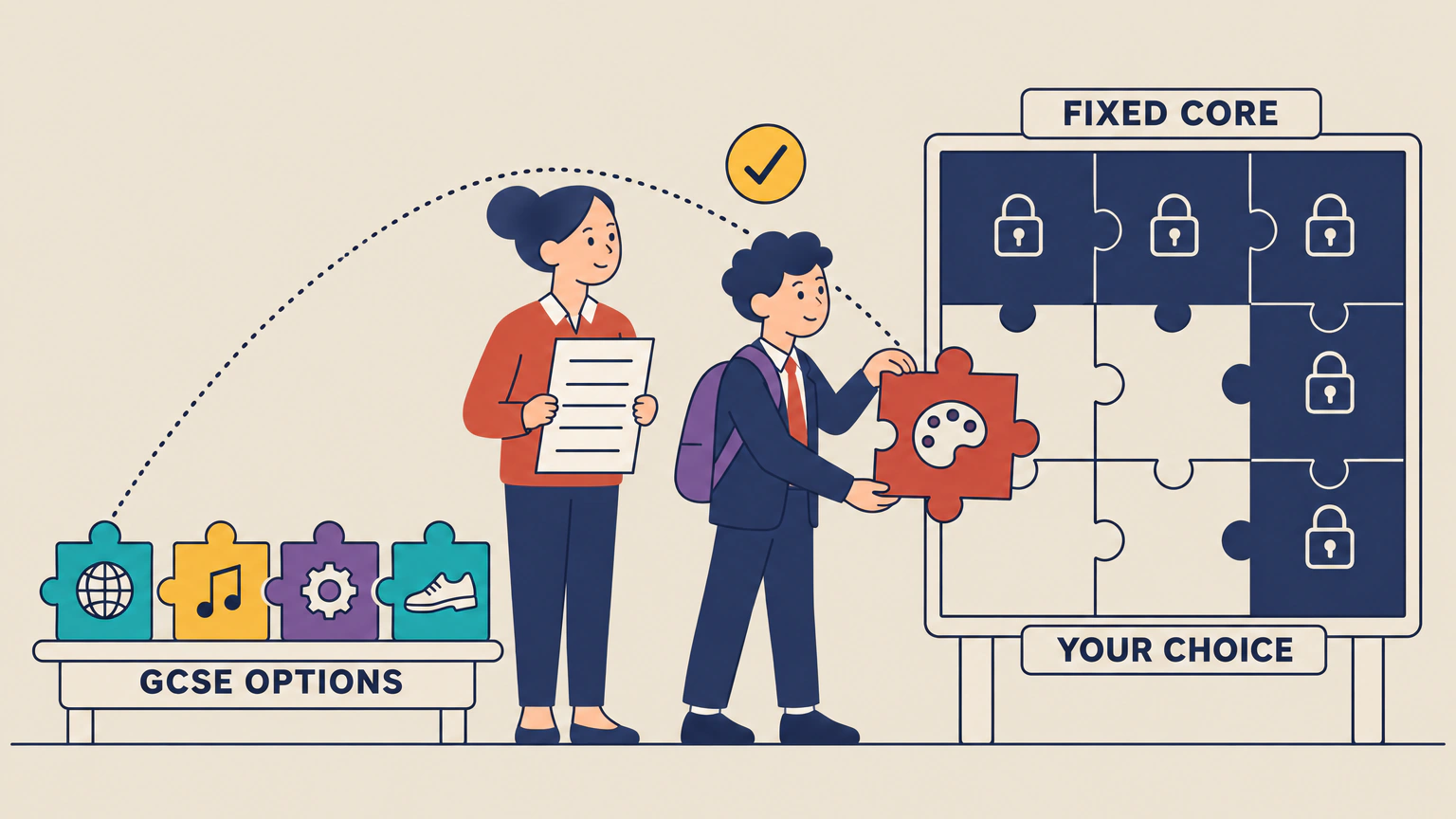
The core at key stage 4 is English, maths and science. Maintained schools must also teach computing, PE and citizenship, though none of those has to be a GCSE. They must provide religious education too, plus relationships, sex and health education. Our guide to the GCSE count shows how eight or nine GCSEs add up, so we won't rebuild it here.
Then each school adds its own rules, and the number of real choices varies more than most parents expect. Marling School in Gloucestershire gives four options, on top of both English GCSEs, maths, at least two sciences and a half GCSE in philosophy, ethics and belief. Ashlyns School in Hertfordshire also gives four, and religious studies is a GCSE for every pupil. Ashby School in Leicestershire puts triple science, a language and a humanity into everyone's core. That leaves two free picks.
What your school has to offer
Four "entitlement areas" sit behind the options form: the arts, design and technology, the humanities (geography and history) and modern foreign languages. England's national curriculum framework says none of them is compulsory after 14. But every pupil in a maintained school has a legal right to study a subject in each area. The school must offer at least one course in each, and the chance to take a course in all four.
That's less than it sounds. Under the Education Act 2002, the duty is met once one subject in each area is on offer. It's no promise of a place in the subject your child wants, or that two favourites won't clash.
That wording covers maintained schools. Academies must offer a broad and balanced curriculum, with English, maths and science up to 16, but the entitlement doesn't reach them yet. The Children's Wellbeing and Schools Act 2026 will bring academies under the national curriculum. So far, only the power to make regulations for that part is in force. Ask which kind of school yours is.
How an options form really works
The form is a request, not an order. Every school whose pages we read ran its options process in the spring term of Year 9. In the 2026 round, Lawnswood School in Leeds and Rushcliffe Spencer Academy in Nottingham held options evenings on 20 January, with forms due on 27 and 23 February.
Marling's booklet shows the machinery. Pupils pick four subjects from two pots and add two reserves. The school gets in touch if two subjects clash, if a course is too small to run, or if one is over-subscribed, and in that last case it may hold a draw, which is exactly as fair, and as maddening, as it sounds. Ashby reserves the right to withdraw any option if too few pupils pick it or staffing gets in the way. Ashlyns warns that it "cannot always guarantee" first choices.
Order matters where the form asks for it. Ashby wants a first choice and promises to do its "utmost" to honour it. At Marling, a draw for an over-subscribed subject starts with the pupils who put it down as their final option.
Treat the reserve as a real choice. Ashlyns tells families the reserve "may very well be one of your four". Marling uses reserves when subjects clash, when a course is too small to run, and when one is over-subscribed.
The EBacc has gone, so why is your school still pushing it?
The English Baccalaureate, or EBacc, was never a qualification. It measured how many pupils in a school took English, maths, the sciences, history or geography, and a language. Nobody ever held one. The Department for Education (DfE) took the EBacc out of school performance measures from the 2025 to 2026 school year, and it withdrew its EBacc guidance on 20 October 2026.
The catch is in DfE's accountability guidance, which says the former EBacc subjects "continue to count towards Attainment 8 and Progress 8", with "no changes" to how they're treated. Those are the two measures built on each pupil's best eight qualifications, and they still save three of the eight slots for sciences, history or geography, and languages, with combined science able to fill two of the three.
So your school still has a reason to steer pupils towards a humanity or a language. A booklet line like Ashlyns' "at least one, and preferably two" from history, geography, French and Spanish may well stay. The slot rules in full are in our guide to the GCSE count.
Then there's the change nobody can describe yet. The government consulted on a new shape for Progress 8, meant to guide choices for pupils starting GCSEs in September 2027. That's this year's Year 9. It said it would respond in the summer of 2026. DfE's guidance now says only that it will "confirm the policy position in due course", and the consultation page still says it's analysing the feedback. The government has also promised a legal right to triple science, after it helps schools build up their offer, so it isn't a right yet.
A school's steer is worth hearing. You're also allowed to ask whose interest it serves.
Which careers really need a particular GCSE
Almost none. We went to the bodies that set the rules, route by route.
What each route asks for at GCSE
| Route | What they publish | Does an option decide it? |
|---|---|---|
| Medicine | Of eight schools read for 2027 entry, none insists on three separate sciences. Sheffield, Leeds, Manchester, Liverpool and Birmingham take double or combined science at 6-6 | No. Grades decide it. Manchester wants seven GCSEs at grade 7 |
| Dentistry | The Dental Schools Council's 2027 guide covers 15 UK five-year courses. Birmingham alone names biology and chemistry, at grade 8, and doesn't mention double award | Only if Birmingham is the plan, so ask them |
| Veterinary medicine | Liverpool, Surrey and the Royal Veterinary College take double or combined science, with five GCSEs at grade 7 | No. Grades decide it |
| Adult nursing | NHS Health Careers: typically five GCSEs at grade 4 or above, possibly in English and a science, plus evidence of literacy and numeracy | No. The core covers it |
| Primary teaching | DfE criteria: the standard of grade 4 in English, maths and a science | No. The core covers it |
| Secondary teaching | DfE criteria: the standard of grade 4 in English and maths | No. The core covers it |
| Law | Solicitors Regulation Authority: a degree "in any subject" or equivalent, then the SQE. Sheffield's law degree names GCSE English Language at grade 4 | No |
| Engineering | Sheffield's mechanical engineering degree: A level maths plus physics, chemistry or biology, and GCSE English Language at grade 4 | No, but the GCSE maths grade matters |
| Architecture | Sheffield's architecture degree: GCSE maths and English Language at grade 4. Art isn't named | No |
| Police | The Met: GCSE English Language at grade 4 or equivalent, plus two A levels or a level 3 in any subject | No. The core covers it |
From each body's or university's own page, for 2027 entry where it prints one. University rows are examples, not the whole sector. Rules change each year, so the page for the year your child applies is the one that counts.
Only one route turns on a named science, and only at one dental school. Every other route turns on grades, or on subjects your child takes anyway. Today's Year 9 won't apply to university until autumn 2030, for courses starting in 2031, so take these as the shape of the rules, not the ones your child will face.
Medicine, dentistry and vet school
This is where the career tables online get it most wrong. We read eight medical schools' rules for 2027 entry: Sheffield, Leeds, Manchester, Liverpool, Birmingham, Edinburgh, Kent and Medway, and Nottingham. Seven say in their entry rules that double or combined science is acceptable. Nottingham's resit rule lists double science at 7-7. None of the eight insists on three separate sciences.
The bar is grades. Sheffield asks for five GCSEs at grade 7, and Nottingham for six. Leeds scores eight GCSEs, while Liverpool counts the best nine and Newcastle the best eight.
Two twists are worth a parent's attention. Kent and Medway Medical School wants biology, chemistry and physics, or double science plus one other subject. A child offering only two separate sciences there has to make an extenuating circumstances application. And the Royal Veterinary College asks for at least a grade 6 in physics "if taken as a separate GCSE", so triple science can add a hurdle rather than clear one.
Dentistry is simpler. Birmingham, with its grade 8 in biology and chemistry, is the one exception. Every other UK school in the Dental Schools Council's guide either takes double award or requires no separate science.
Our view: choose triple because your child likes science, not as insurance.
Teaching, nursing, law and the police
Most of these routes ask for a grade 4 in English, plus maths for teaching, which your child takes anyway. If that grade is the worry, read what happens if the English or maths grade falls short. DfE's teacher training criteria set that floor for every trainee teacher in England.
History isn't a requirement for law, whatever the career tables say, and neither is English literature. The Solicitors Regulation Authority's route, which covers England and Wales, asks for a degree in any subject. Nursing adds evidence of literacy and numeracy on top of the GCSE count. The Met polices London only, and some forces add entry rules of their own. None of these routes needs a chosen option.
Engineering and architecture
The GCSE that matters for engineering is maths, because the degree wants A level maths. All three sixth forms we checked ask for a grade 6 before A level maths, so it's worth knowing how many marks a grade takes in maths. Physics sits inside combined science, so it needn't be an option.
Architecture settles a question that comes up a lot: do you need art GCSE? Sheffield's architecture degree doesn't name it. That's one university's page, there for the shape. Art is still a good idea for a child who loves it, just for a different reason.
The choices that are hard to undo at 16
This is where a choice can bite, because a sixth form may ask for the GCSE before it lets your child start the A level. We read three that print their rules subject by subject.
Do you need the GCSE to take the A level?
| A level | Trinity Sixth, Halifax | Leeds Sixth Form College | William Farr School, Lincolnshire |
|---|---|---|---|
| French or Spanish | Grade 5 on the higher tier in that language | Spanish only: grade 5 in Spanish | Grade 5 in that language |
| History | Grade 5 in history if studied, plus 5 in English Language | Grade 5 in English or history | Grade 5 in history or a related subject |
| Geography | Grade 5 in geography if studied | Grade 5 in English or geography | Grade 5 in geography or a related subject |
| Art | No extra rule. A grade 4 in art or a portfolio is desirable | Grade 4 in an art subject, plus a portfolio | Grade 5 in art or a related subject |
| Music | Not listed | Not listed | Grade 5 in GCSE music, or grade 5 theory and grade 6 on an instrument |
| Computer science | Grade 5 in maths, or 5 in computer science and 4 in maths | Not listed | Grade 5 in computer science, and 5 in maths or physics |
| Psychology | Grade 5 in English | Grade 5 in maths, science and an essay subject | Grade 5 in religious studies or a related subject |
| Physics | 6-6 in combined science or 6 in physics, plus 6 in maths and A level maths | 6 in physics or combined science, plus 6 in maths | 6 in physics, or 6-5 in combined science with the 6 in physics |
| Maths | Grade 6 | Grade 6 | Grade 6 |
From each sixth form's own published entry requirements. Three sixth forms, chosen because each prints its rules subject by subject. Yours may differ, and a "related subject" is the school's call.
Of the subjects your child is free to drop, a language is the only one that needs its own GCSE at all three. Maths and physics ask for GCSEs too, but those sit in the core. Art needs an art subject at Leeds and accepts a related subject at William Farr. Computer science needs its own GCSE only at William Farr. History and geography need theirs at none, because each sixth form accepts another route. William Farr will even take an A level musician without the GCSE on grade 5 theory and grade 6 on an instrument, which is where knowing what music grades are worth pays off.
So if your child might want a language at 16, keep it now. That's the one piece of keep-your-doors-open advice we'd press.
Triple or combined science
Combined science counts as two GCSEs, and it keeps A level science open. Trinity Sixth takes 6-6, Leeds Sixth Form College takes a 6 in combined science, and William Farr takes 6-5 with the 6 in the subject. Triple can cost an option. At Marling, the third science is chosen as one of the four.
Our guide to the GCSE count carries the science tier warning, and it's worth reading before entries are confirmed. Ask how your school decides who takes triple. Some schools choose, and some let pupils choose.
Technical awards and BTECs
GOV.UK says most pupils at key stage 4 work towards GCSEs or Technical Awards, so a technical award is a proper option. These courses count, within limits. Liverpool's medical school counts no more than two level 2 BTEC or OCR awards among its nine GCSEs, and they can't stand in for English, maths or science. William Farr accepts a merit in the Cambridge National in Enterprise and Marketing for A level business, alongside a grade 5 in maths. It takes a merit in Sports Studies for A level PE. Check with the sixth form before you assume.
What each subject asks of your child for two years
Interest gets your child to the form. How a subject is assessed gets them through it.
How much of each GCSE is a written exam (AQA)
| Subject (AQA) | Written exam | Coursework or practical |
|---|---|---|
| Art and design | None | 100%: portfolio 60%, set assignment 40% |
| Music | 40% | 60%: performing 30%, composing 30% |
| Drama | 40% | 60% |
| Design and technology | 50% | 50% |
| Food preparation and nutrition | 50% | 50% |
| Physical education | 60% | 40% |
| History | 100% | None |
| Geography | 100% | None |
From AQA's specifications. Ofqual fixes these splits for every exam board in England.
Art's portfolio has no time limit, which suits some children and swallows others whole. A child building one outside school can find art classes near you. Music asks for at least four minutes of performance and three of composition, so a family weighing it up with no teacher yet may want piano teachers near you. PE assesses three activities, so a child with no sport outside school should ask what's on offer. In design and technology, the design-and-make task runs to about 30 to 35 hours. These are AQA's numbers, though Ofqual sets the music minimums and the three PE activities for every board.
What to ask at options evening
Seven things to ask before the form goes in:
- Which subjects sit in which block, and which pairs can't be taken together?
- What happens if a subject is over-subscribed, or too small to run?
- Does the school still expect a language or a humanity, and why?
- Is triple science one of the options here, and who decides who takes it?
- How much of this subject is coursework, and when does it fall?
- Which exam board does the school use for this subject?
- What's the last date to change a choice?
Wales, Northern Ireland and Scotland work differently
GCSE options across the UK aren't one system, and the choice itself changes at each border.
Wales. Pupils still choose for Year 10, but from a new set of National Qualifications. Qualifications Wales said its new GCSE The Sciences (Double Award) and GCSE Integrated Science (Single Award) would replace the current range of science GCSEs for learners starting in September 2026. So the triple-or-combined question works differently there. Work-related VCSEs reach schools in 2027.
Northern Ireland. Key stage 4 runs through Years 11 and 12, so choices come in Year 10. Under the Entitlement Framework, every post-primary school must give pupils access to at least 21 courses, with at least a third general and a third applied. Some of those courses may be taught alongside another school or college.
Scotland. There are no GCSEs. My World of Work says pupils choose their National 4 and 5 subjects between S1 and S3. They usually study seven to nine, including maths, English, a language, a science and a social subject.
Our guide to the GCSE count shows how the numbers differ in each nation. None of England's rules carries over.
Questions parents ask about GCSE options
The ones that come up most, answered short.
When do you choose your GCSE options?
Usually in the spring term of Year 9. In the 2026 round, Lawnswood and Rushcliffe Spencer both held options evenings on 20 January, with forms due in late February, and Ashlyns' deadline was 6 March. Some schools start GCSE courses in Year 9, so their pupils choose in Year 8. In Northern Ireland, the choice comes in Year 10.
How many GCSE options can you pick?
It's your school's call. Marling and Ashlyns both give four, and Ashby gives two on top of a core that already holds a language and a humanity. Most 16-year-olds in England take eight or nine GCSEs, and the core takes about five of those, so three or four is the usual answer. The options booklet is the only reliable number for your child.
Do you have to take a language at GCSE?
Not by law. Languages aren't compulsory after 14 in England, though maintained schools must give every pupil the chance to study one. Some schools still expect it, and Ashby puts one in everybody's core, so read the booklet. If your child might want a language at A level, keep it, because all three sixth forms we checked asked for the GCSE.
Is the EBacc being scrapped?
Yes. The government took the EBacc out of school performance measures from the 2025 to 2026 year and withdrew its guidance in October 2026. No pupil ever held one, so nobody loses anything. The subjects behind it still fill three slots in Attainment 8 and Progress 8, which is why some schools keep steering pupils towards them.
Can you do medicine without triple science?
Yes. Of eight medical schools we read for 2027 entry, none insists on three separate sciences, and seven say in their entry rules that double or combined science is acceptable. The grades are the harder part. Manchester wants seven GCSEs at grade 7, and Sheffield wants five.
Can you do A level history without the GCSE?
Yes, at all three sixth forms we checked. Trinity Sixth asks for a grade 5 in history only if your child studied it, along with a 5 in English Language. Leeds Sixth Form College accepts a grade 5 in English instead, and William Farr accepts a related subject. The rule belongs to each sixth form, so check yours.
Can you change your GCSE options?
Sometimes, and the window is short. Marling says a change after its deadline may be possible but can't be guaranteed, and nobody switches once Year 10 has started. The Grange School takes requests up to the first few weeks of Year 10, if the new mix fits the timetable. King Edward VI Grammar School in Chelmsford allows no change once the course has begun, except in very exceptional circumstances.
Start by finding your child's route among the careers we checked, then open the sixth form's own page for any subject they might want at 16. If a maths grade is what stands in the way, a maths tutor near you can help close the gap.