

On this page
- The short answer, in four questions
- The four day rule, and the trap inside it
- Who has to apply, and what you have to provide
- Body of Persons Approval, how dance and drama shows can be covered
- The rules that still apply under the four day exemption
- Scotland, Wales and Northern Ireland, what changes
- If something goes wrong
- Questions parents ask
The short answer, in four questions
Your child needs a child performance licence from the licensing authority if a charge is made in connection with the show, it is held somewhere authorised to supply alcohol, broadcast or included in a programme service, or recorded for use in a broadcast, programme service or film intended for public exhibition, unless nobody is being paid and either your child has performed on no more than three days in the previous six months or the organiser holds a Body of Persons Approval. The dance school or the production company applies for it, not you. In England, Wales and Scotland, the licensing authority may refuse to grant an application received less than 21 days before the first performance; Northern Ireland's period is 30 days. Those rules come from section 37 of the Children and Young Persons Act 1963 and the national regulations described below.
Take these four in the order the law asks them. Any one of them can settle the answer on its own.
- Is a charge made in connection with the performance, is it on premises authorised to supply alcohol, broadcast or included in a programme service, or recorded for use in a broadcast, programme service or film intended for public exhibition? If none of those applies, no licence is needed.
- Is anyone being paid anything for your child taking part, beyond expenses? If yes, a licence is needed, because payment cancels both exemptions.
- Has your child performed on more than three days in the last six months? If yes, a licence is needed for the next performance day.
- Will your child miss any school for the show or its rehearsals? If yes, ask the school to authorise the absence; missing school does not itself decide whether a licence is required.
The performances the law actually covers
Section 37(2) of the 1963 Act covers four things: a performance for which a charge is made, whether for admission or otherwise; a performance in premises that may be used to supply alcohol; a broadcast performance, or one included in a programme service, which is where live streaming sits; and a performance recorded by any means for use in a broadcast or in a film intended for public exhibition. Your child also counts as taking part if she stands in for a performer at a rehearsal or in preparation for a recording.
Filmed and broadcast work is the one parents least expect, and it's worth knowing before an audition through acting classes and workshops.
| The situation | Licence needed? | Where the rule comes from |
|---|---|---|
| A show where a charge is made, whether for admission or otherwise | Yes, unless an exemption applies | CYPA 1963 s.37(2)(a) |
| A performance in premises licensed to sell alcohol, for example a theatre bar, pub or hotel | Yes, unless an exemption applies | s.37(2)(b) |
| A live broadcast, including internet streaming | Yes, unless an exemption applies | s.37(2)(c) and (d) |
| A performance recorded for use in a broadcast or in a film intended for public exhibition | Yes, unless an exemption applies | s.37(2)(e) |
| Rehearsals and preparation during the performance period | Treated as taking part in the performance | s.37(2) closing words |
| A show organised by the child's own school | No, provided nobody is paid | s.37(3)(b); DfE advice 1.3.6 |
| A show organised by a dance school, circus school or conservatoire the child attends only for training | Yes, unless the four day rule or an approval applies | DfE advice 1.3.6 table |
| Paid sport, or working as a model where payment is made | Yes, and the section 37(3) exemptions do not apply | s.37(1)(b); DfE advice 1.3.1 |
The two exemptions, and the payment rule that cancels both
Section 37(3) lifts the requirement only where no payment in respect of your child taking part, beyond expenses, goes to her or to anyone else. That condition sits above both exemptions rather than beside them, so a fee paid to a choreographer for her solo removes the exemption even though the money never reaches her.
Where nothing is paid, one of two further things has to be true. Either she has not performed on more than three days in the previous six months, which is the four day rule, or the performance is arranged by a school, or by a body of persons approved by the council in whose area it takes place. Neither exemption covers paid sport or paid modelling.
The four day rule, and the trap inside it
This is the exemption most amateur shows rely on, and the one parents misread. The Department for Education puts it plainly: a child who has not performed on more than three days in the last six months needs no licence for a fourth day. Beyond that, a licence is required unless another exemption applies.
What counts as one of your three days
The count runs across any performance covered by section 37(2), not just the ones your current dance school knows about. The department is explicit that the days count regardless of whether a licence was in place, and regardless of whether your child performed under someone else's Body of Persons Approval. Festivals, competitions and last term's show all go into the same tally.
It's a rolling six month count that follows your child, not an allowance that resets with each production, and whoever relies on it needs reasonable grounds for believing the number. Graded shows and festival circuits, the kind ballet schools run, build it up fastest.
Pro tip: Keep your own day count. The six month tally follows your child across every performance covered by section 37(2), including performances under a licence or BOPA, and no organiser can see the history from before she joined. A note on your phone with a date beside each performance makes you the only person in the room who knows the number.
Why missing school changes the answer
Missing school does not by itself remove the section 37(3) exemptions. In England, the School Attendance (Pupil Registration) (England) Regulations 2024 define a regulated performance to include both licensed performances and those exempt under section 37(3), so an authorised person at a maintained or non-maintained special school may grant leave for either.
Where a licence names the dates she will be away, section 37(7) treats that absence as authorised and the school doesn't need to grant permission separately. If the licence gives a number of days instead of dates, and she attends an independent school, an academy or a free school, the head teacher decides each date.
Who has to apply, and what you have to provide
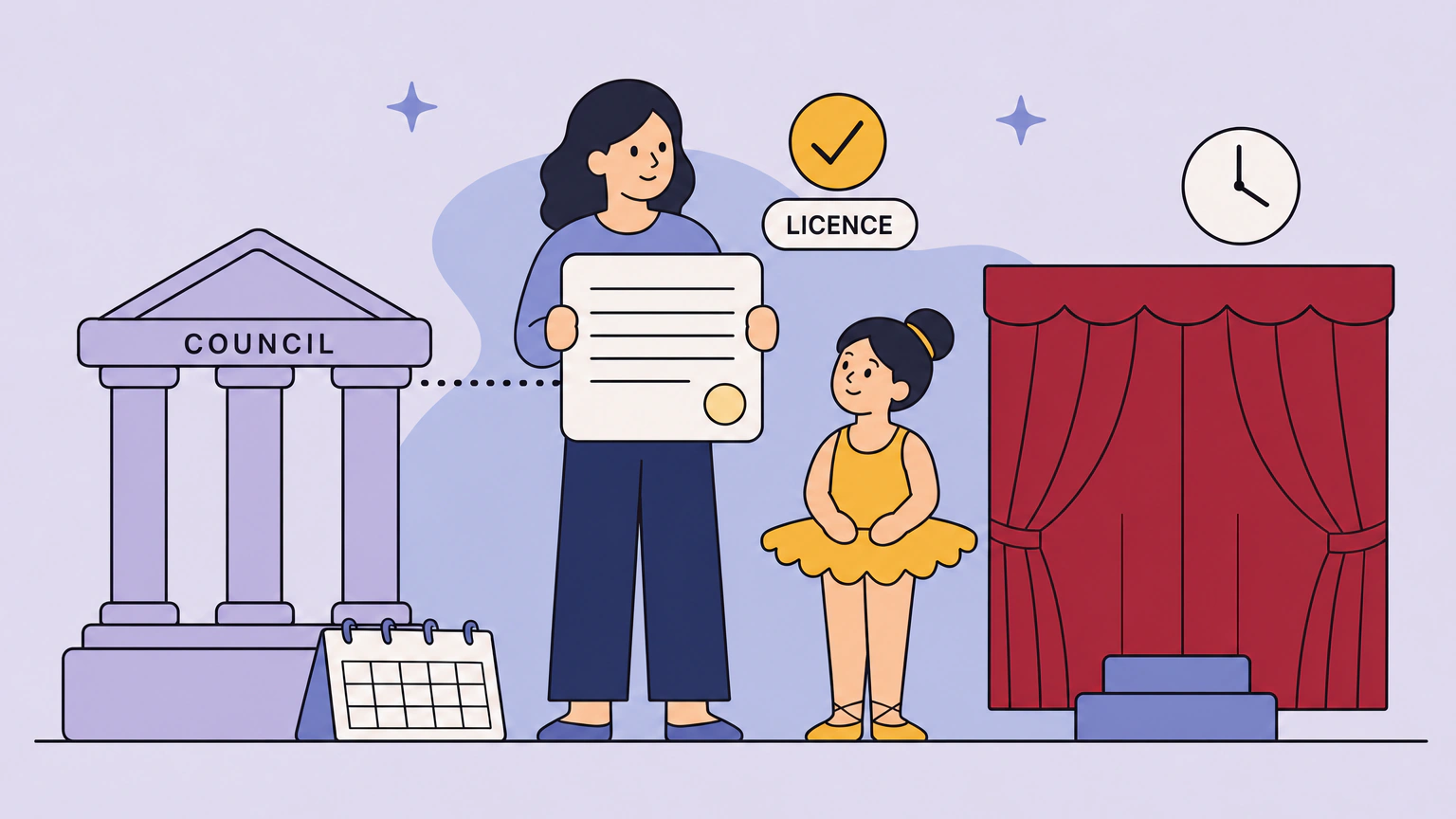
The applicant isn't you. Regulation 4(1) requires a written application from the person responsible for organising the activity or engaging the child, or for producing the performance. The licence comes from the council where your child lives, even when the show is somewhere else.
The 21 day deadline
The council may refuse to grant a licence if the application doesn't reach it at least 21 days before the first performance. Refusing is a choice the council has rather than an automatic bar, but 21 days is the deadline councils plan around. Leeds City Council asks for that notice and says it tries to issue within about ten working days where it can.
Work backwards from that date. A school announcing its show three weeks out is already at the line, and the organiser still needs signed forms and documents from every family first.
What the parent signs and supplies
The application must be signed by both the applicant and a parent, and carry the information and documents the Regulations specify. Councils ask for proof of your child's age, usually a birth certificate, and a recent colour photograph. Where school time is involved, Leeds asks for a school permission letter on headed paper, Bradford accepts either a headed letter or a school email, and Brent asks the organiser for a child protection policy and a risk assessment.
The council can ask for more before deciding. Regulation 7 lets it request a medical examination, a report from the head teacher, or an interview with you, your child, the applicant, the proposed chaperone or a private teacher. None of that means something is wrong. It's the council making sure your child is fit to take part and that her education won't suffer.
Body of Persons Approval, how dance and drama shows can be covered
Many amateur shows never involve an individual licence. The organisation applies once for a Body of Persons Approval, a BOPA, from the council where the performance takes place, and while it runs it replaces individual licences from each child's home council. Any organisation can apply, professional or amateur, provided nobody is paid beyond expenses.
What a Body of Persons Approval does not do
An approval is narrower than it sounds. It doesn't authorise absence from school, it doesn't survive any payment made in respect of a child taking part, and days performed under it still count towards your child's four day tally. Councils grant them at their discretion: Leeds and Bradford ask for a child protection policy, insurance, and health, safety and fire certificates when the venue is not a council building.
Supervision is the part that matters most on the night. Where a show runs under an approval rather than a licence, the legislation doesn't require a council approved chaperone, so cover is whatever the organisation has arranged. Ask these eight questions in writing.
- Are you applying for individual licences, or do you hold a Body of Persons Approval for this show?
- Which council are you applying to, and by what date?
- Is anyone being paid anything in connection with the children taking part?
- Will any rehearsal or performance fall in school time?
- Who is the named chaperone for my child's group, and how many children will that chaperone have?
- What time will my child arrive, and what time will she be released?
- Where will the children change, and how are the age groups separated?
- Who do I contact on the night if my child is unwell?
A well run school answers all eight in a paragraph. If yours can't, that's worth weighing when you next choose a class, and comparing dance schools near you costs nothing.
The rules that still apply under the four day exemption
Regulation 19 applies Part 4 of the 2014 Regulations to licensed performances and to four day rule performances alike. So the times, hours, breaks and overnight rest below bind licensed performances and performances using the four day rule, but not school or BOPA performances solely because they are exempt under section 37(3)(b).
Hours, finish times and breaks by age
In England, regulation 21 sets the earliest and latest times your child may be at the place of performance or rehearsal, and regulation 22 sets the maximum hours. Those hours include any approved education delivered during the licence period, even when the lessons happen away from the venue.
| Age of child | Earliest time | Latest time | Maximum hours at the venue in one day | Maximum hours performing or rehearsing in one day |
|---|---|---|---|---|
| Birth until the child reaches 5 | 07:00 | 22:00 | 5 | 2 |
| 5 until the child reaches 9 | 07:00 | 23:00 | 8 | 3 |
| 9 to school leaving age | 07:00 | 23:00 | 9.5 | 5 |
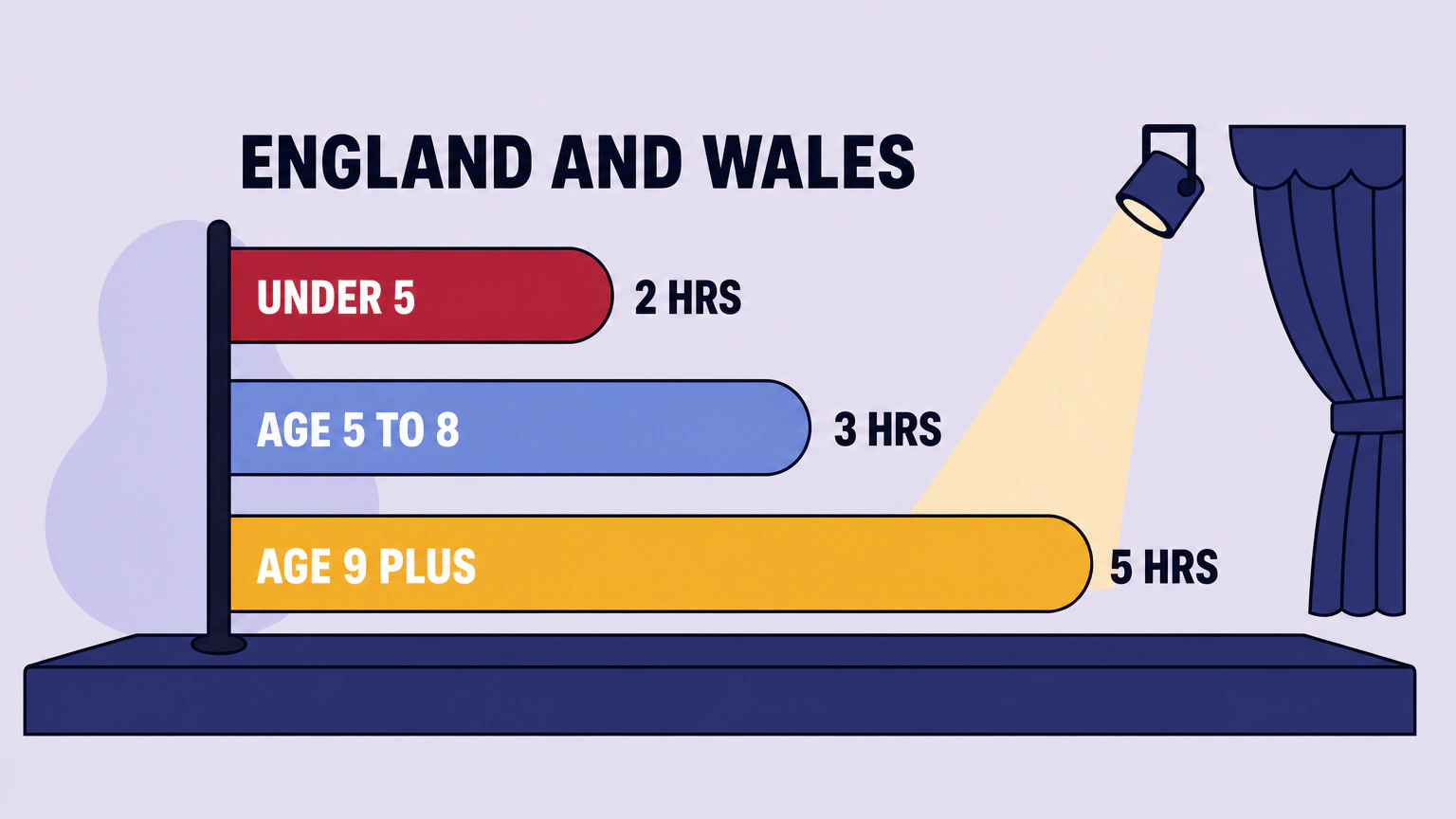
The longest unbroken stretch of performing or rehearsing is half an hour under five and two and a half hours from five upwards. Breaks must include a 45 minute meal break once a child under five has been at the venue for four consecutive hours, or a child aged five or over for more than four consecutive hours. Regulation 24 requires an overnight break of at least twelve hours between attendances. Regulation 26 adds that a child must not perform or rehearse on more than six consecutive days, though that rule and the council's power to allow performing outside the table times both apply to licensed shows only.
Chaperones, and the one to twelve limit
Under a licence your child must be supervised at all times by a council approved chaperone unless she is with you or with a teacher who ordinarily provides her education. One chaperone may look after twelve children at most, or three where the chaperone is her private teacher. If she is injured or falls ill in a chaperone's care, the licence holder must ensure you and both the licensing and host authorities are told immediately.
For a licensed performance, the chaperone must be approved by the child's licensing authority, and approval takes time and may involve a fee. Leeds' page still lists £14.40 for a volunteer chaperone licence and £54.40 for a professional one, while also saying they would rise to £21.50 and £70 from 1 January 2026. Because the page has not reconciled those statements, confirm the current fee directly; it also lists an optional £7.50 ID card, £10 replacements, three year validity and a process it says takes 12 to 16 weeks. It involves references, an interview and a DBS check, the same vetting logic behind how DBS checks work for people who teach your child.
Scotland, Wales and Northern Ireland, what changes
The 1963 Act runs across England, Wales and Scotland, but each nation has its own regulations underneath it, and Northern Ireland runs on a separate instrument. Wales tracks England almost exactly. Scotland adds a signature, and Northern Ireland changes the deadline, the vocabulary and the body you apply to.
| Nation | The instrument | Notice before the first performance | Who signs the application | Worth knowing |
|---|---|---|---|---|
| England | Children (Performances and Activities) (England) Regulations 2014, SI 2014/3309 | At least 21 days, or the council may refuse to grant it | The applicant and a parent | Approvals for a body of persons come from the council where the performance takes place, not where the child lives |
| Wales | Children (Performances and Activities) (Wales) Regulations 2015, SI 2015/1757 (W. 242) | At least 21 days | The applicant and a parent | The hours and finish-time tables are the same as England's, checked side by side for this article |
| Scotland | Children (Performances and Activities) (Scotland) Regulations 2014, SSI 2014/372 | At least 21 days | The applicant, a parent, and the head teacher where school time is involved | A chaperone may extend the finishing time by up to 30 minutes in circumstances outside the licence holder's control, against up to an hour in England |
| Northern Ireland | Children (Public Performances) Regulations (Northern Ireland) 1996, SR 1996/481 | At least 30 days | The applicant, who must be the person responsible for the production, and a parent | The instrument still names education and library boards and uses the word matron rather than chaperone. Those boards merged in 2015, and applications now go to the Education Authority's Children in Entertainment and Employment Team |
If something goes wrong
Two situations account for most of the trouble a parent runs into: a licence that doesn't arrive, and a request for money nobody can explain.
If the council refuses the licence
A council may grant a licence only if it is satisfied that your child is fit to take part, that proper provision has been made for her health and kind treatment, and that her education will not suffer. If it's satisfied on all three, section 37(4) says it must not refuse. A refusal must come with written reasons, and the responsible person, meaning the applicant rather than you, may appeal to a magistrates' court against a refusal, a revocation, a variation or a condition.
Councils enforce this too, and can inspect rehearsal venues, performance venues and the place a licensed child receives her education. Causing or procuring a child to perform in breach of the licensing requirement is an offence under section 40 of the 1963 Act, punishable by a fine, imprisonment or both. That is why a well run dance school treats the paperwork as seriously as the choreography.
What you should never be asked to pay
None of the five council pages we checked in August 2026 lists a charge for the performance licence itself, and Sheffield City Council states plainly that its licences are issued free of charge. Chaperone licences are separate and may be charged, as the Leeds page shows. So a request to pay a licence fee to a school or an agency deserves a plain question: what is this payment for, and who receives it? Check the answer against your own council's page, because practice varies.
Red flag: four answers that should make you ask more.
- "We never need a licence for our shows." No organiser can know that in advance, because it turns on each child's own six month count. Ask which exemption they are relying on, in writing.
- "You will need to apply for the licence yourself." The Regulations put the application on the organiser. Ask them to confirm in writing who is applying, and to which council.
- "There is a licensing fee to pay to us." Ask what it covers and who receives it, then check what your own council charges.
- A call sheet keeping primary age children at the venue past the latest time for her age. Ask for arrival and release times in writing before show week.
Questions parents ask
Does my child need a performance licence for the school play?
Almost certainly not. Section 37(3)(b) exempts a performance given under arrangements made by a school, and the Department for Education's test is whether the school is responsible for organising and producing it. That covers your child's own school, provided nobody is paid in respect of a child taking part.
A dance school she attends only for training doesn't qualify, because it isn't providing her main education.
Who applies for the licence, the parent or the dance school?
The dance school or the production company. Regulation 4(1) requires the written application to come from the person responsible for organising the activity, engaging the child, or producing the performance. You sign it as a parent and supply the documents, and the council where your child lives grants it.
An organiser who tells you to apply yourself hasn't planned the show properly.
What is a Body of Persons Approval, and does it cover my child?
A Body of Persons Approval is granted to an organisation by the council in whose area a performance takes place, and while it runs it replaces individual licences from each child's home council. It covers your child only if nobody is paid in respect of her taking part, and it never authorises absence from school.
Days performed under someone else's approval still count towards her four day tally.
How long does a child performance licence take to come through?
Allow at least 21 days in England, Wales and Scotland, and 30 days in Northern Ireland, and preferably longer. In Great Britain the licensing authority may refuse to grant an application received less than 21 days before the first performance; in Northern Ireland, the Education Authority may refuse if it receives the application less than 30 days before the first performance. Leeds City Council asks for 21 days' notice and says it tries to issue within about ten working days where it can, though turnaround varies by authority and season.
Ask the organiser for the submission date, not just a promise that it's in hand.
Can my child miss school to be in a show?
A licence is not always required just because school time is involved. In England, the 2024 attendance rules allow an authorised person at a maintained or non-maintained special school to grant leave for a regulated performance whether it is licensed or exempt under section 37(3); ask the school for leave in advance. Where a licence names dates, section 37(7) treats the absence as authorised.
Evening, weekend and school holiday performances avoid the question entirely.
Does a child performance licence cost anything?
None of the five council pages we checked in August 2026 lists a charge for the performance licence itself, and Sheffield City Council states that its licences are issued free of charge. Chaperone licences are separate: Leeds' page still lists £14.40 and £54.40 while also saying they would rise to £21.50 and £70 from 1 January 2026, so confirm the current fees directly.
What happens if a show goes ahead without a licence that was needed?
The organiser carries the main compliance burden, but section 40 also covers a parent or guardian who allows a child to take part in breach of section 37. The offence can be punished by a fine, up to three months' imprisonment or both, and councils may inspect rehearsals, performances and education arrangements to check compliance.
We can tell you how the law works, not how it applies to one particular child in one particular show. Practice varies between councils, so if something specific is worrying you, ring your own council's child employment or child performance team.