

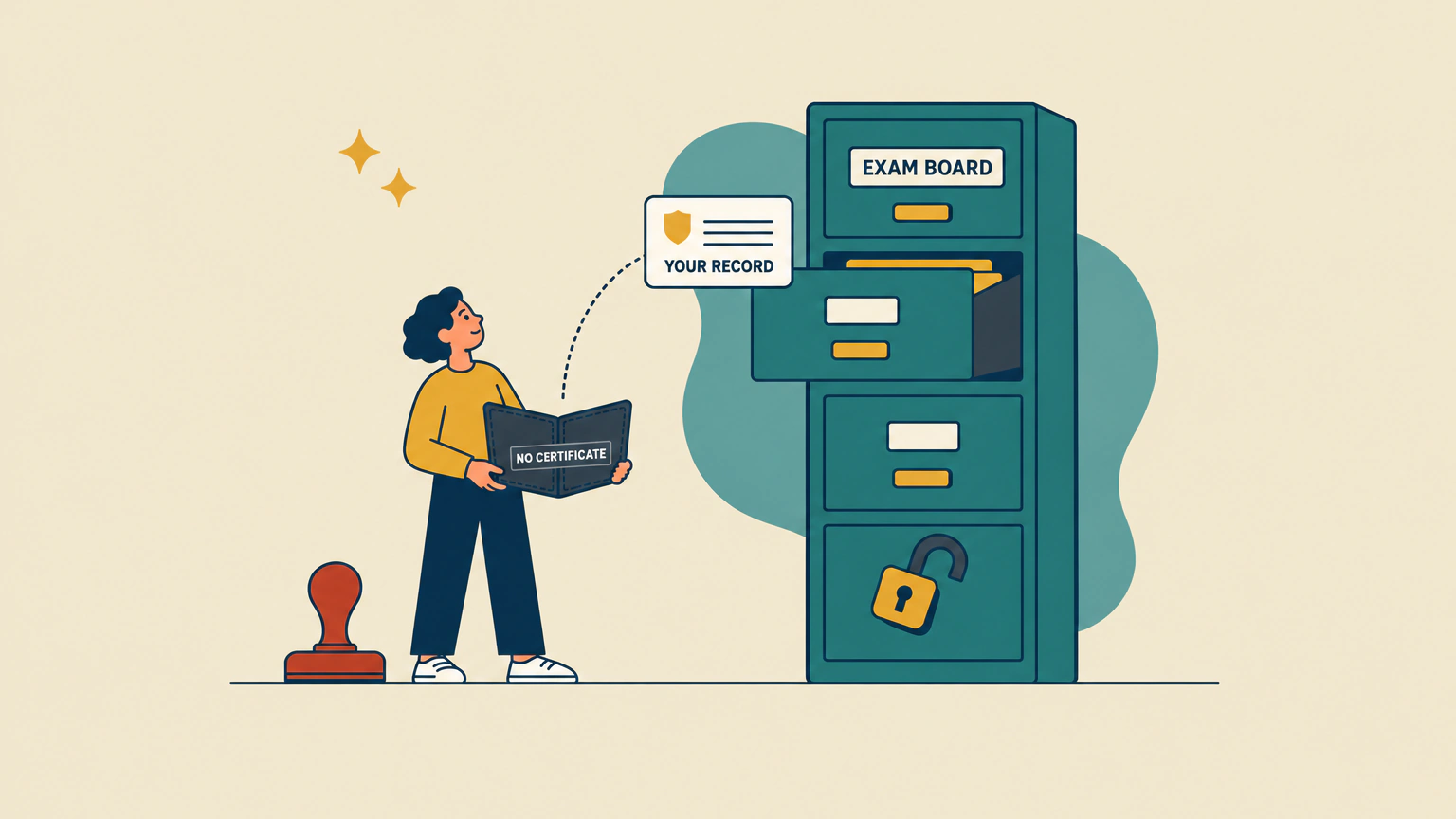
You can't get a replacement GCSE certificate. What you can get is a certified statement of results, which counts as official proof. UK standard-service prices start at £30 and reach £64, depending on the board and document. And if you sat your exams in England from 2012, Wales from 2014, Northern Ireland from 2015 or Scotland from 1995, there's a free record that may save you the fee entirely.
On this page
- Start here, because one of these routes costs nothing
- There is no such thing as a replacement GCSE certificate
- Finding the exam board that holds your results
- What the boards charge, and why the totals are not comparable
- The rules are not the same in all four nations
- How to apply, and what to have ready
- Questions people ask about lost GCSE certificates
Start here, because one of these routes costs nothing
Before you pay anyone, find out whether you need to. Where and when you sat your exams tell you whether to check the free record first. It can still have gaps, so an exam-board statement may be needed.
Two free records are worth checking first. One covers England, Wales and Northern Ireland, and reaches back to 2012 at the earliest. The other covers Scotland and reaches back to 1995. We'd try the one for your nation before you open a single fee page. If your year is inside its range, you may never need the paid route at all, and if it isn't, we'll show you how to pay a board the least.
England, Wales and Northern Ireland: your personal learning record
The Department for Education keeps a personal learning record, or PLR, for learners in England, Wales and Northern Ireland. GOV.UK calls it "a permanent online record of your qualifications and achievements". It lists general and vocational qualifications, including GCSEs, A levels, BTECs, diplomas and Functional Skills. A copy costs nothing.
Ask your learning provider first, meaning any school, college or training provider you're enrolled with. Going straight to the DfE can be slow, because it says its own copy can take up to a month to arrive by email.
If no provider can help, download the DfE's request form from GOV.UK. Type your answers, since handwritten forms aren't accepted. Email it back with two proofs of identity, one for your name and date of birth and one for your address. The form asks you to encrypt and password-protect the attachments. Someone then phones you for the password.
Add your unique learner number if you know it. It's the 10-digit number awarding bodies have printed on certificates since March 2013.
Scotland: your My Qualifications Scotland account
Scotland's free route is the better one, because you look your results up yourself. Qualifications Scotland, the body that now runs exams there, offers a free My Qualifications Scotland account. In its own words, the account "will let you see all the qualifications you completed since 1995". That includes results from the years when the Scottish Qualifications Authority was in charge.
It does a second job too. The account shows the name and address held on your record. Check both before you order anything, because a replacement certificate is printed in the name on file.
When the free record will not have your grades
GOV.UK sets out the limits plainly. A PLR only covers qualifications gained in England from 2012, Wales from 2014 and Northern Ireland from 2015. It only shows qualifications regulated by Ofqual, the exams regulator for England. Anything the DfE didn't fund may be missing, and the DfE says it isn't responsible for chasing gaps.
In Scotland the line is 1995. Earlier awards came from bodies such as the Scottish Examination Board, and you'll order them from Qualifications Scotland instead.
Fall outside those lines and the free record can't help. The exam board is your route, and the next question is what it will send you.
There is no such thing as a replacement GCSE certificate
Plenty of people go looking for a replacement certificate. GOV.UK says outright that there isn't one: "You cannot get a replacement certificate for an O level, CSE, GCSE or A level". Your exam board sends a "certified statement of results" instead.
That sounds like a downgrade. It isn't. The statement is the document the system is built to issue, and GOV.UK says you can use it "in place of your exam certificate, for example for a university application".
You'll still see "replacement certificate" on the boards' own pages. That's because boards may give you one for other qualifications, such as NVQs.
What a certified statement of results actually is
What arrives is an official document listing your subjects and grades. Pearson prints its version on certificate paper with a hologram "that proves the document's authenticity". It may not look like your original, but it carries the same information. Pearson doesn't offer PDF copies.
You can't leave anything off, either. OCR has to show every passing grade you got with it in a series, and CCEA issues all the results it holds for the series you ask about.
Expect the name to drift. AQA and CCEA say "certified statement". OCR and Pearson say "certifying statement". WJEC sends an electronic letter of confirmation by default, and a printed statement if you ask for one. Each grade on it stood for a band of marks on the day, and if you're curious, here's what those grades were worth in marks.
Whether an employer or a university will accept one
Yes, as a rule. CCEA says its statement "is accepted by employers and educational institutions in lieu of the original certificates". If an employer or university has doubts, Pearson says you can reassure them it's an official document issued to replace the original.
Often the stronger move is to have the board send proof straight to whoever asked. AQA will post a confirmation letter directly to an employer or university on request. OCR emails a PDF confirmation to one named contact, at £64 per series. WJEC emails its letter to a third party you choose. Pearson will send your document to up to two addresses on one application, as long as the recipients differ, so you and your employer can each get it.
Check first that the organisation will accept the format, as WJEC advises. And if a course wants to know about your A levels, here's what your grades are worth in UCAS points.
Finding the exam board that holds your results
Finding out GCSE results from years ago starts with one free phone call. Ring the school or college that entered you, because it knows which board it used. Tell them the year you left and the subjects you took.
If you left in the last year, ask about the original certificate too. WJEC says certificates reach schools within 12 weeks of results being published. OCR says schools are "required to retain certificates for a period of 12 months after they are issued", and Pearson and WJEC say much the same. After that, the original may be gone.
Not sure of the year? OCR and Pearson both publish exam years by date of birth. OCR's table puts GCSEs in 2005 and A levels in 2007 for anyone born between September 1988 and August 1989.
If the board that ran your exams no longer exists
Plenty of the old regional boards have gone. Their records didn't. GOV.UK publishes the full map of who took over what, and the main lines run like this.
| Records now held by | Boards it absorbed | Worth knowing |
|---|---|---|
| AQA | AEB, SEG, SEREB, SWExB, ALSEB, JMB, NEA, NEAB, NWREB, TWYLREB, YHREB | Almost every northern and southern regional board ended up here |
| Pearson Edexcel | BEC, BTEC, EDI, JCBSPA, LCCI, LEAG, LREB, M&MREB, TEC, UESEC, ULEAC, ULSEB | The London and business education lines |
| OCR | EMREB, MEG, OCEAC, OCSEB, RSA, SREB, SUJB, UCLES, UODLE, WMEB | The Oxford, Cambridge and midlands lines |
| Pearson Edexcel or OCR | EAEB, the East Anglian Examinations Board | They hold part of it each, so try both |
The East Anglian board is the one genuine split. If it was yours, apply to one and keep the other in reserve. In Northern Ireland, the records of the two older exam councils, NISEC and NISEAC, sit with CCEA.
If your school has closed, or cannot help
A closed school doesn't close your file. The boards keep their own records, and they search them by the school as it was when you sat the exams. That's why OCR asks for its name and full address from that time, plus a note if it merged or changed its name while you were there.
So if nobody at the school can help, apply to the board most likely to hold your results. Don't expect a shortcut by phone. AQA won't give results over the phone or by email, citing security and data protection law, and OCR won't either.
If the first board finds nothing, AQA says you may need to try another. A wrong guess costs more at some boards than at others. OCR refunds half its fee when it can't find your results, while AQA keeps its fee after five days, because the fee pays for the search. In Northern Ireland, CCEA will tell you what records it holds through a free subject access request.
What the boards charge, and why the totals are not comparable
Line the fees up and they look like one market, with a few pounds between the boards. They aren't. Each board sells a different unit: one application, one exam series, one document, or one certificate covering everything. An exam series is a single sitting, such as all the GCSEs you took one summer.
| Exam board | What you receive for a GCSE | Fee, and what one fee covers | Wait before it is sent |
|---|---|---|---|
| AQA | A certified statement of results, posted only | £50.25 per application, covering a search of up to two exam series | Up to 20 working days, then 5 working days in the post |
| Pearson Edexcel | A certifying statement of results, posted only | £58 per application to a UK address or £80 outside the UK. One application covers one qualification type across the exam sessions you list | 20 working days, plus about 4 to produce and 3 to 5 in the post |
| OCR | A certifying statement of results; OCR issues replacement certificates only for vocational qualifications such as NVQs | £64.00 per exam series | 90 per cent inside 20 working days; OCR asks for four weeks |
| WJEC and Eduqas | An electronic letter of confirmation by email, or a printed certifying statement | £30 for the first emailed document and £10 each after, or £40 for the first printed one and £20 each after | About 2 weeks emailed, about 6 weeks printed |
| CCEA | A certified statement of results | £30 for one statement and £10 for each additional one, each covering all subjects at one level in one exam season | CCEA emails the payment details once it has checked your form and ID |
| Qualifications Scotland | A genuine replacement certificate on hologrammed paper | £40, whatever the number of years or subjects | Not given on the order page |
Boards change these fees, so what you pay is whatever the board's own page says on the day you apply.
A few extras sit outside that grid. OCR will fast-track results from 2000 onwards for £20 more, plus postage. Pearson's priority service costs £80 to a UK address. AQA adds £20 for each address outside the UK.
The trap: one fee does not buy one document
Take one ordinary case. You sat GCSEs one summer and A levels two summers later, say 2005 and 2007. That's two exam series, posted to a UK address at standard speed. Here's what each board charges for exactly the same request.
AQA charges £50.25, because one application covers a search of up to two series. A third series would need a second application, taking you to £100.50. OCR charges £64 for each series, so two cost £128. CCEA charges £30 for the first statement and £10 for the next, which makes £40. WJEC's emailed letter works the same way, £30 plus £10. Its printed statement runs £40 plus £20, so £60.
Pearson is the odd one out. It charges £58 per application, and each application covers one type of qualification, with every sitting listed on it. So two GCSE sittings cost £58. GCSEs and A levels count as two types, which means two applications and £116. The one thing Pearson doesn't publish is what extra copies or extra addresses cost. Those only show up at checkout.
Qualifications Scotland charges £40 flat, however many years or subjects you have, though it's only an option for Scottish qualifications.
So the same two sittings cost £40 at CCEA and £128 at OCR. That's 3.2 times as much, and the only thing that changed is the board your school happened to use.
| Exam board | Two exam series, standard service, UK address |
|---|---|
| AQA | £50.25, because one application covers both |
| Pearson Edexcel | £58 if both sittings were GCSEs, since one application lists every session; £116 for GCSEs plus A levels, one application each |
| OCR | £128.00 |
| WJEC and Eduqas | £40.00 emailed, or £60.00 printed |
| CCEA | £40.00 |
| Qualifications Scotland | £40.00, and one certificate carries everything from 1995 |
What proof of your GCSE grades will cost you
If you are not sure, use the year you left school.
A series is one sitting. GCSEs in one summer and A levels in another are two.
AQA will search two exam series for you on one application.
From£50.25
There is no free record for that year, so the board is your route.
Faster options, where the board offers one, are listed underneath.
- AQA doesn't offer a fast-track service.
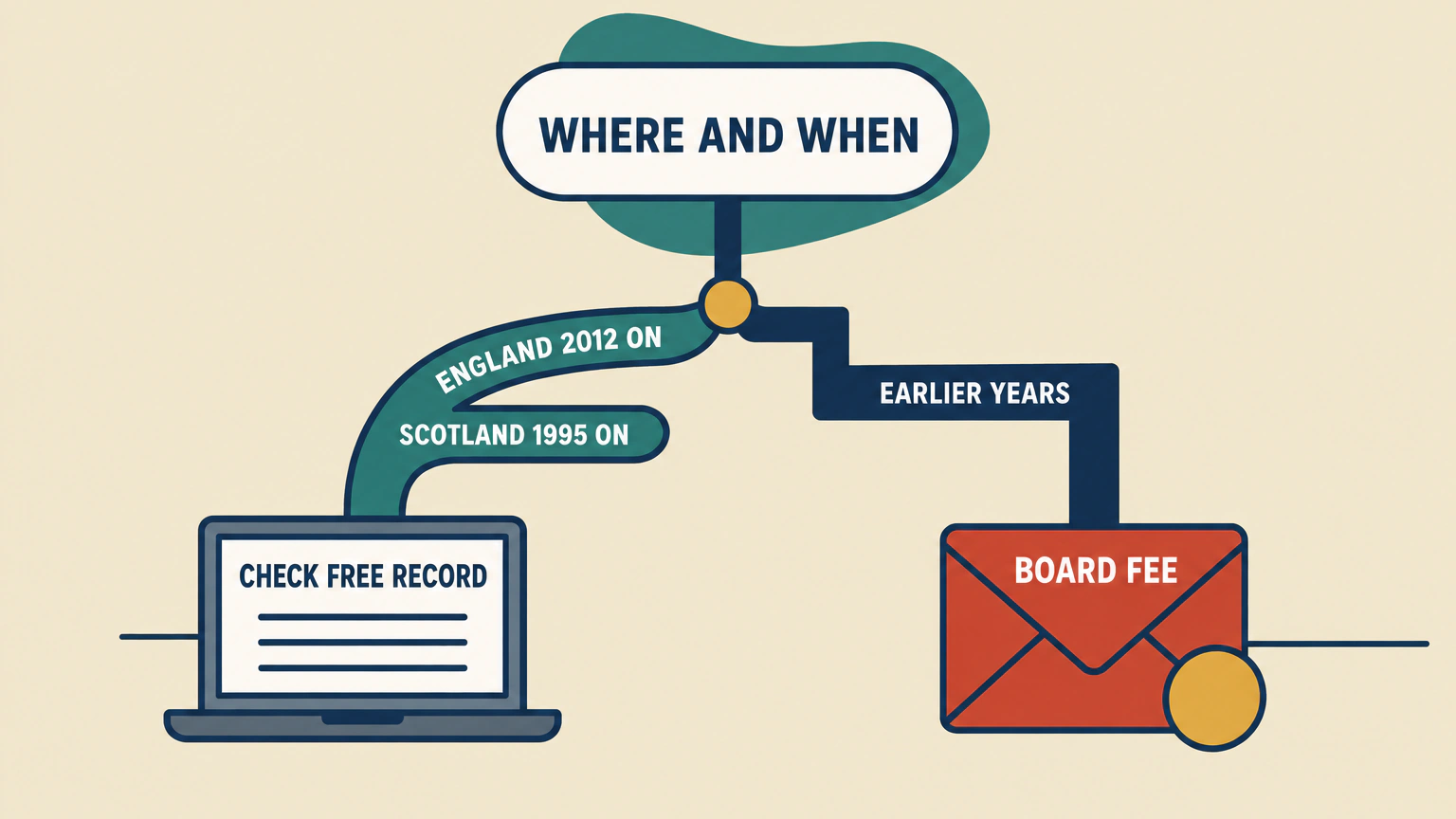
Where and when you sat the exams decides which free record to check before you pay
- England, 2012 onwards: check your free personal learning record
- Wales, 2014 onwards: check your free personal learning record
- Northern Ireland, 2015 onwards: check your free personal learning record
- Scotland, 1995 onwards: check your free My Qualifications Scotland account
- Any earlier year, in any nation: the exam board's fee
A personal learning record can still have gaps, so check it before you pay.
The same two exam series cost £40.00 at CCEA and £128.00 at OCR, because the boards do not sell the same unit.
Fees and cut-off years are taken from GOV.UK and from each awarding body's own published pages.
The rules are not the same in all four nations
Where you sat the exams changes more than the board. It decides whether a free record exists at all, and how far back it reaches.
| Where you sat the exams | The free service | Earliest year it covers | If your year is earlier |
|---|---|---|---|
| England | Personal learning record, held by the Department for Education | 2012 | Apply to the exam board and pay its fee |
| Wales | Personal learning record | 2014 | Apply to WJEC, or to whichever board entered you |
| Northern Ireland | Personal learning record | 2015 | Apply to CCEA, or to whichever board entered you |
| Scotland | A free My Qualifications Scotland account | 1995 | Order a replacement certificate from Qualifications Scotland for £40 |
The years are inclusive, so a qualification gained in England in 2012 is covered.
Scotland is the real outlier. It runs its own qualifications rather than GCSEs, and it now has a new awarding body. The Education (Scotland) Act 2025 created Qualifications Scotland, which has taken over from the Scottish Qualifications Authority. GOV.UK hasn't caught up. Its guide still tells Scottish readers to contact the SQA.
Three things set Qualifications Scotland apart. For results from 1995 on, it issues a genuine replacement certificate on hologrammed paper, not a statement, while older awards from its predecessors come on a Certified Statement. It replaces a certificate free if you were certificated in the last four months and nothing on your record has changed. And it replaces certificates free of charge "for any care experienced learner", at any stage of life, once a professional who can confirm your care status certifies the order.
If the grades you recover fall short of what you need now, look for a tutor who teaches your nation's exams, since a Scottish course and an English GCSE aren't the same thing. We list teachers and tutors across Scotland, and you can find a teacher in your part of England too.
How to apply, and what to have ready
The boards are blunt about incomplete forms. AQA and WJEC will both cancel an application with too little ID or detail to search, or one where you haven't answered a query within seven working days. OCR warns that an inaccurate form may be delayed. Gather everything first.
- The year and the month you sat each set of exams, because every board searches by series rather than by name alone. Qualifications Scotland is the exception, since one certificate carries everything from 1995. If you're unsure of the year, use OCR's or Pearson's exam-years-by-birthdate guide.
- The name you were registered under at school, plus a marriage certificate, deed poll or decree absolute if it has changed since. AQA wants a decree absolute together with your birth certificate.
- A scan or photograph of your passport, driving licence, ID card or birth certificate. CCEA accepts photo ID only, and OCR wants an image file rather than a PDF.
- The name and address of the school or college that entered you, as it was when you sat the exams.
- A debit or credit card that is not American Express, which AQA does not accept. WJEC and CCEA send payment details after they've checked your form, and WJEC takes a bank transfer.
- Your unique learner number, printed on any certificate issued since March 2013. The DfE's request form asks for it if you know it.
- Try the free record first, and pay a board only once you know it will not cover your year.
- Apply to each board separately, and pay each one, if your subjects were split across two of them. At Pearson, GCSEs and A levels need an application each as well.
Red flag: The free routes are official ones: your personal learning record from the DfE, and a My Qualifications Scotland account. Beyond those, the boards guard your results closely. AQA says only you can apply for your past results, WJEC won't take an application from a third party, and Pearson wants your signed consent before anyone applies for you. So a site charging to "check your qualifications online" is, at best, filling in a form you could fill in yourself. Start from GOV.UK's list of exam boards, apply through the board's own website or published email address, and never send a passport scan or card details anywhere else.
Today, check the free record for your nation. If it can't reach your year, ring the school and ask which board entered you. And if the grades that come back are lower than a course or employer wants, it's fixable. Start with who actually has to resit English and maths, then look at maths tutors near you, or English language schools if English is the gap.
Questions people ask about lost GCSE certificates
Can I get my GCSE certificates for free?
You may get free proof even when the original is gone. Your personal learning record costs nothing and covers qualifications gained in England from 2012, Wales from 2014 and Northern Ireland from 2015. In Scotland, a free My Qualifications Scotland account shows everything from 1995. And if you sat your exams in the last year, your school may still hold the original.
How far back do exam boards keep results?
Decades, though not everything survives. CCEA's service covers certificates from 1963, and AQA handles CSEs taken from 1965. Older records are slower to find. AQA is warning of delays for academic years before 1994, and Pearson says academic qualifications from before 1996 can take longer, because the results sit on microfiche or old systems. Pearson can't search EDI or LCCI records from before 1996 at all.
Can an employer check my GCSE results without asking me?
No. None of the boards offers a public lookup, whether your results are from last year or 25 years ago. AQA says only you can apply for your past results, and Pearson needs your signed consent before anyone else applies. What an employer can do is ask you to have the board send confirmation straight to them. In Scotland, Qualifications Scotland runs an authentication service for employers checking grades you've given them.
What if I do not know which exam board I used?
Ask the school or college that entered you first, because it knows. Failing that, the logo at the top of any old certificate usually names the board, as Pearson points out, and GOV.UK's map shows who took over a board that's gone. In Northern Ireland, CCEA will confirm for free whether it holds your records. Otherwise apply to the likeliest board. OCR refunds half its fee if it finds nothing.
Do I need my GCSE certificates for a university application?
If the university asks for proof, a certified statement does the job. GOV.UK gives a university application as its own example of where the statement can stand in for the certificate. AQA can post a confirmation letter straight to the university, and WJEC can email its electronic letter of confirmation there directly. The DfE's request form even lists a UCAS application as a reason to ask for your free personal learning record.
How long does a certified statement of results take to arrive?
Three to six weeks at most boards, and less by email. AQA allows up to 20 working days, then five for the post. Pearson aims for 20 working days, plus about four to print and three to five by courier. OCR finishes 90% of applications within 20 working days and suggests applying four weeks ahead. CCEA allows up to 21 days including post. WJEC's emailed letter takes about two weeks.