

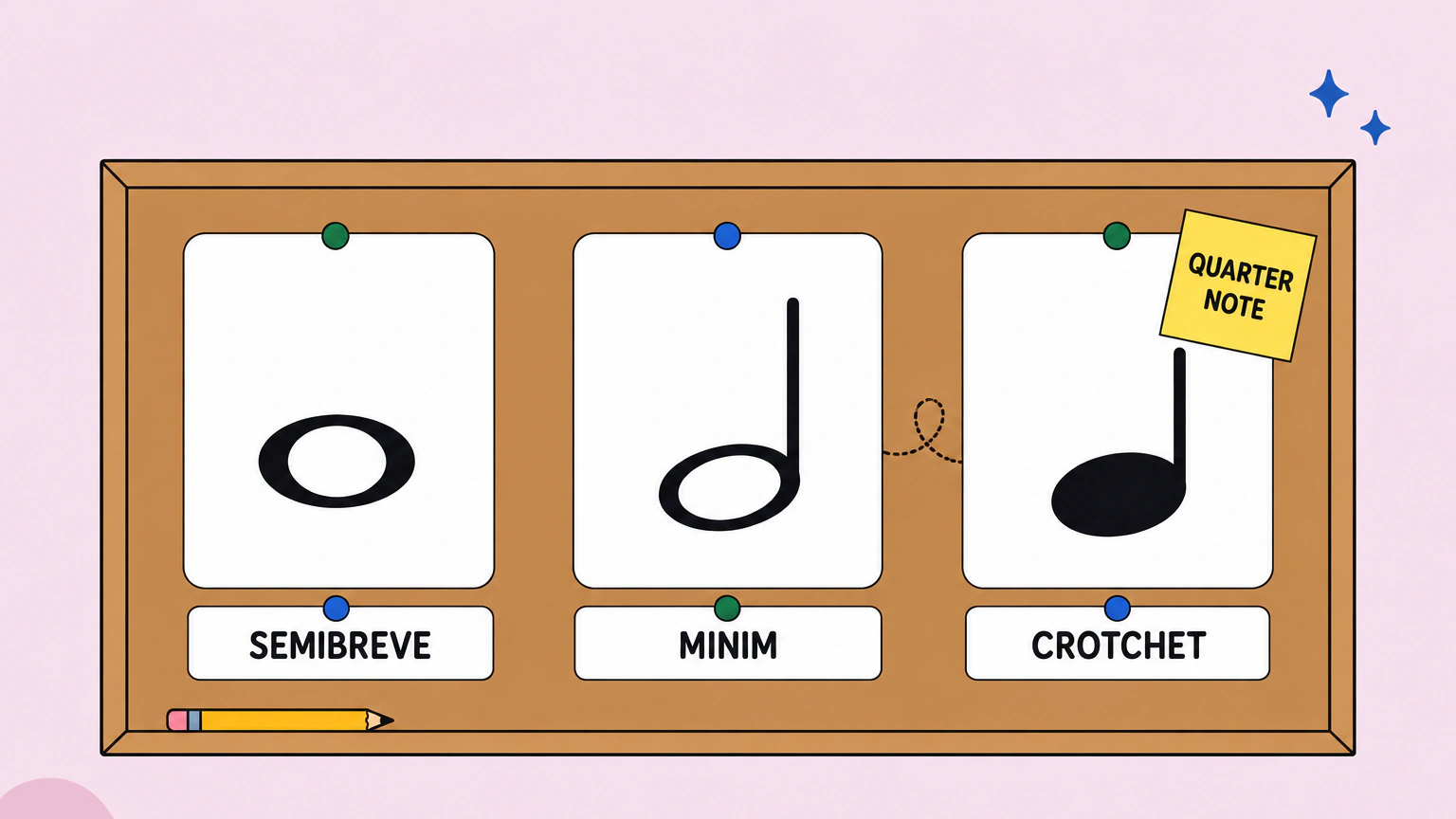
Every musical note tells you two things: where it sits on the stave gives its letter name, from A to G, and its shape tells you how long to hold it. From the semibreve down, each note (minim, crotchet, quaver, semiquaver) lasts half as long as the one before. How many beats that makes depends on the time signature, so a crotchet is one beat in 4/4 and half a beat in 2/2.
On this page
The seven letter names and where they sit on the stave
Start with pitch. Music uses only seven letter names, A to G, and they repeat up and down the keyboard, so after G you're back at A. Notes are written on the stave, five lines with four spaces between them. The clef at the start of each line of music tells you which letter belongs where.
If your child sings "doh, re, mi" at school or in a choir, that's tonic sol-fa. Sarah Glover of Norwich devised it to teach children to sing, and John Curwen made it popular. It names each note by its place in the key rather than by its letter.
Treble clef and bass clef
The treble clef is also called the G clef. Its curl circles the second line up, and a note on that line is G. The bass clef is the F clef. Its two dots sit either side of the fourth line up, and that line is F. Know one note and you can count up or down the alphabet to find all the others.
Treble is for higher music, bass for lower. At the piano, the right hand usually reads the treble stave and the left hand the bass. Most people learn the lines and spaces with a rhyme or two, and here are the ones you'll hear most:
| Clef | Lines, bottom to top | Spaces, bottom to top | Middle C | The rhyme most people learn |
|---|---|---|---|---|
| Treble clef (G clef) | E, G, B, D, F | F, A, C, E | On a ledger line just below the stave | Lines: Every Good Boy Deserves Food. Spaces: FACE |
| Bass clef (F clef) | G, B, D, F, A | A, C, E, G | On a ledger line just above the stave | Lines: Good Boys Do Fine Always. Spaces: All Cows Eat Grass |
Middle C, where the two clefs meet
Middle C sits on a ledger line, a short extra line, just below the treble stave. You'll also find it on a ledger line just above the bass stave. It's the same note, with two places to write it. On a piano with a lock, it's usually the C nearest the keyhole.
That double address is why it matters. Middle C sits where the two staves meet, so musicians often use it as their reference point. Once you can find it in both clefs, the rest of the keyboard has somewhere to hang from.
Pro tip: landmark notes. The rhymes get most people started, and they're worth learning. Many teachers then move you on to landmark notes: middle C, the treble clef's G line and the bass clef's F line. Read everything else as a step or a skip from the nearest landmark, and the two clefs stop feeling like two lists to memorise. They become one long ladder with middle C in the middle.
Sharps, flats and the twelve notes in an octave
A sharp (♯) raises a note by a semitone, also called a half step. A flat (♭) lowers it by one. Sharps and flats add five more notes in between the seven letters, so there are twelve different notes before the pattern starts again an octave higher, at the next note with the same letter.
A natural sign (♮) cancels a sharp or flat. You'll see it when a piece has been playing F sharp, say, and the composer wants a plain F for a moment.
So the letter, plus any sharp or flat, tells you which note to play. The shape tells you how long to hold it.
What each note looks like and how long it lasts
| British name | American name | What it looks like | Length in crotchets |
|---|---|---|---|
| Breve | Double whole note | Hollow oval with one or two upright lines either side | 8 |
| Semibreve | Whole note | Hollow oval, no stem | 4 |
| Minim | Half note | Hollow oval with a stem | 2 |
| Crotchet | Quarter note | Filled oval with a stem | 1 |
| Quaver | Eighth note | Filled oval, stem and one tail | ½ |
| Semiquaver | Sixteenth note | Filled oval, stem and two tails | ¼ |
| Demisemiquaver | Thirty-second note | Filled oval, stem and three tails | ⅛ |
These lengths hold in every piece. How many beats each one counts as depends on the time signature.
The shapes are easiest to learn as one family, each built from the one before. Draw a hollow oval and you have a semibreve. Add a stem and it's a minim. Colour the head in and it's a crotchet. Add a tail, the little flag on the stem, and it becomes a quaver, and a second tail makes a semiquaver.
Every step halves the length. One semibreve lasts as long as two minims, four crotchets or eight quavers, in any piece you'll ever play. Whether a crotchet counts as one beat is a separate question, and the time signature answers it.
Crotchet or quarter note? You'll hear both
British teachers, British books and ABRSM's theory syllabus use semibreve, minim and crotchet. If you've learned from an American video or an app, you'll probably know them as whole, half and quarter notes. ABRSM lets Grade 1 candidates use either set.
Which system makes more sense is an old argument. MyMusicTheory, a UK theory site written by teacher Victoria Williams, notes that Americans see their names as "more logical and mathematical". Then it shows where the fractions fall apart: "when the time signature is 6/8, an 'eighth note' lasts for one third of a beat, or one sixth of a bar". The American names have British defenders too. They do follow a neat logic, the argument goes, so learn both.
We'd go with the names your teacher uses, and keep the other set handy for apps and videos.
One spelling tip while you're here. Crotchet has a t in the middle. Leave it out and you're in the knitting aisle, because crochet is the yarn craft. Fittingly, the music word comes from the Old French crochet, a little hook.
Dots and ties make a note longer
A dot after a note adds half its value again, so a dotted crotchet lasts a crotchet and a half, or three quavers. A second dot adds a further quarter of the original, which makes a double-dotted minim three and a half crotchets long. Early on you'll meet the dotted minim far more often than the dotted semibreve, which lasts six crotchets and rarely turns up in a beginner's pieces.
If the note sits on a line, its dot goes in the space just above.
A tie is a curved line joining two notes of the same pitch. You play them as one sound, lasting as long as both together. It's also how a note carries on across a bar line.
Red flag: watch where the dot is. A dot after a note makes it half as long again, so a dotted minim lasts three crotchets. A dot above or below the note does the opposite: it's a staccato mark, and it tells you to play the note short and detached. Same dot, opposite job.
Rests: the same lengths, in silence
Every note value has a matching rest that lasts exactly as long, and it borrows the note's name: a crotchet rest, a quaver rest, a minim rest. Count them just as you'd count the notes.
One exception is worth knowing early. When a whole bar is silent, it gets a semibreve rest whatever the time signature, even in 3/4, where a bar has room for only three crotchets and a semibreve note wouldn't fit. So a lone semibreve rest tells you to sit out the whole bar, however many beats it holds.
Why a crotchet isn't always one beat
The chart on the fridge says a crotchet is one beat. Then the next piece opens with 2/2 or 6/8, and the counting stops working. Nothing about the crotchet has changed. It still lasts two quavers, and two crotchets still make a minim. What's changed is which note counts as the beat, and the time signature at the start of the piece decides that.
What the two numbers in a time signature mean
The top number says how many. The bottom number says of what, and it names a note: 4 means crotchets, 2 means minims and 8 means quavers. So 3/4 means three crotchet beats in every bar, and 2/4 means two.
Here the American names earn their keep. The 4 is a quarter note, the 2 a half note and the 8 an eighth note, which is far easier to remember than any rule.
Sometimes you'll see a large C where the numbers should be. That's common time, and it means exactly the same as 4/4. A C with a vertical line through it is alla breve, the same as 2/2.
In 2/2 the minim takes the beat
In 2/2 there are two minim beats in a bar. Musicians call it cut time or alla breve, and you'll meet it in marches and quick music. A bar of 2/2 holds exactly what a bar of 4/4 holds, four crotchets' worth, but you count it in two.
That halves every count. A crotchet is half a beat, a quaver a quarter of a beat, and a semibreve fills the bar at two beats, so 2/2 is tidy. 6/8 is where it gets interesting, and where all three times end up side by side.
In 6/8 you count six quavers but feel two beats
6/8 is compound time. The bottom 8 means you count quavers, and there are six in a bar. But they come in groups of three, and each group, worth a dotted crotchet, is one beat. So a bar of 6/8 holds six quavers and two beats.
Three crotchets and six quavers take exactly the same time, which is why 3/4 and 6/8 can look interchangeable on paper. They don't sound it. A bar of 3/4 falls into three crotchet beats, the swing of a waltz, while 6/8 falls into two groups of three, and that grouping is what gives it a lilt.
A plain crotchet in 6/8 lasts two quavers, which is two-thirds of a beat. When three equal notes fill a 6/8 bar, the middle one is usually written as two tied quavers, so you can still see where the second beat starts.
The rule of thumb: a 6, 9 or 12 on top means compound time, and the beat is a dotted note worth three of the bottom number. At a very slow tempo, players and conductors may count all six quavers. Each note lasts just as long either way.
| Note | In 4/4 (crotchet beat) | In 2/2 (minim beat) | In 6/8 (dotted crotchet beat) |
|---|---|---|---|
| Semibreve | 4 beats, a whole bar | 2 beats, a whole bar | 2⅔ beats (8 quavers), longer than a bar |
| Dotted minim | 3 beats | 1½ beats | 2 beats (6 quavers), a whole bar |
| Minim | 2 beats | 1 beat | 1⅓ beats (4 quavers) |
| Dotted crotchet | 1½ beats | ¾ of a beat | 1 beat (3 quavers) |
| Crotchet | 1 beat | ½ a beat | ⅔ of a beat (2 quavers) |
| Quaver | ½ a beat | ¼ of a beat | ⅓ of a beat (1 quaver) |
| Semiquaver | ¼ of a beat | ⅛ of a beat | ⅙ of a beat (half a quaver) |
Working out any note's length in four steps
- Read the bottom number of the time signature. 2 means minims, 4 means crotchets and 8 means quavers.
- Read the top number. If it's 2, 3 or 4, that bottom-number note is your beat, and the top number tells you how many beats fill a bar.
- If the top number is 6, 9 or 12, the beat is a dotted note worth three of the bottom-number notes. So 6/8 has two dotted crotchet beats, 9/8 has three and 12/8 has four.
- Count how many bottom-number notes your note lasts, adding half again for a dot. In 6, 9 or 12 time, divide that count by three to get the beats.
How long is this note?
Pick the note you can see, any dots after it, and the time signature at the start of the piece.
1 beat
In 6/8, a dotted crotchet (dotted quarter note) lasts one beat.
That's 3 quavers, ½ of the bar. In 6/8 the beat is a dotted crotchet, three quavers long.
The bottom number of the time signature decides which note is the beat, and in 6/8 the beat is a dotted crotchet.
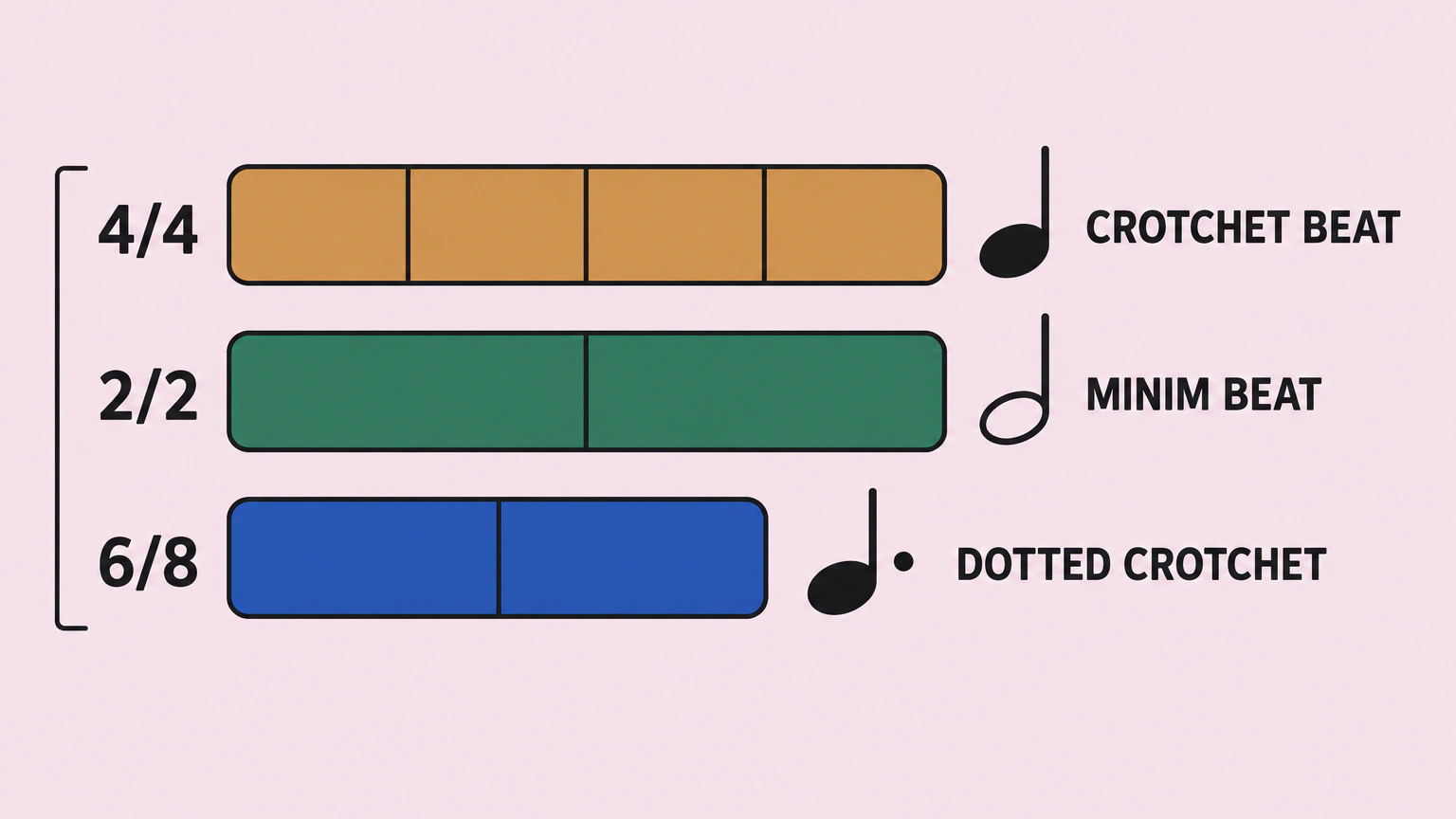
- 4/4Crotchet beat. Four crotchet beats fill the bar.
- 2/2Minim beat. Two minim beats, and the bar is the same length as a bar of 4/4.
- 6/8Dotted crotchet beat. Two dotted crotchet beats, each three quavers long, and the bar is three quarters the length of a bar of 4/4.
Rests work the same way, with one exception: a semibreve rest on its own means the whole bar is silent, whatever the time signature.
Other symbols you'll meet on your first page
Notes and rests aren't the only musical symbols on a beginner's first page. A handful of other notation signs change a note's pitch, its loudness or the way you play it, and every one of them is on ABRSM's Grade 1 list. Keep the dot from earlier in mind: beside a note it lengthens it, but above or below the head it's staccato.
| Symbol | What it tells you |
|---|---|
| Sharp (♯) | Play the note a semitone higher |
| Flat (♭) | Play the note a semitone lower |
| Natural (♮) | Cancel a sharp or flat, whether it was written beside the note or set by the key signature |
| Tie: a curve joining two notes of the same pitch | Play one note lasting as long as both together |
| Slur: a curve over notes of different pitches | Play them smoothly, one flowing into the next |
| Staccato: a dot above or below the note head | Play it short and detached, usually about half its written length |
| Pause (fermata): a sign above a note or rest | Hold it longer than written, for as long as the player or conductor chooses |
| Repeat signs | Play the passage between them again; an end sign on its own sends you back to the start |
| p and f | p (piano) means play softly; f (forte) means play loudly |
| Crescendo and diminuendo | Get gradually louder, or gradually softer |
Where this fits if you're taking music theory exams
If your family is heading towards graded exams, the notes map neatly onto ABRSM's eight music theory grades. You sit Grades 1 to 5 online whenever you're ready, while Grades 6 to 8 are paper exams on set dates.
Grade 1 covers the five everyday note values, both clefs, middle C and the three simple time signatures, 2/4, 3/4 and 4/4. Then 2/2 arrives at Grade 2, and 6/8 waits until Grade 3, along with the demisemiquaver. For what each grade is worth once it's passed, and the Grade 5 theory rule, see our guide to what music grades are actually worth.
| ABRSM theory grade | Note values it adds | Time signatures it adds | On the stave |
|---|---|---|---|
| Grade 1 | Semibreve, minim, crotchet, quaver and semiquaver, their rests, ties and single dots | 2/4, 3/4 and 4/4 | Treble and bass clefs, note names including middle C, sharps, flats and naturals |
| Grade 2 | Triplets | 2/2, 3/2, 4/2 and 3/8 | Two ledger lines above and below each stave |
| Grade 3 | The demisemiquaver and its rest | 6/8, 9/8 and 12/8 | Notes beyond two ledger lines |
| Grade 4 | The breve and its rest, double dots and duplets | Every simple and compound duple, triple and quadruple time | The alto clef |
Learning to read music with a teacher
A chart can tell you what a dotted crotchet is. A teacher makes you clap it, hears that you're rushing the dot, and catches the habit before it sets. That's the part no chart can do.
If you're looking for lessons, ask two things before you book. Will they teach reading music from the first lesson? And which exam board, if any, do they prepare pupils for? You'll find piano teachers near you in our directory, and piano is where you meet both clefs at once. The same two questions work for guitar lessons, singing teachers and drum teachers. Paying for a first term? It's worth reading up on whether Tax-Free Childcare can pay for your child's lessons.
Then try one thing tonight. Pick a single line of the piece on the stand, and name every note's letter and length before anyone plays it.
Common questions
Is a crotchet the same as a quarter note?
Yes. Crotchet is the British name and quarter note the American one for the same note, a filled-in head on a plain stem. The American name describes its length against a whole note, which happens to match its beat in 4/4. In 6/8 it's still a crotchet, but there it lasts two quavers, two-thirds of a beat.
How many beats is a semibreve?
Four in 4/4, where the crotchet takes the beat, and two in 2/2, where the minim does. In 3/4 it's longer than a bar, so you'd see it written as tied notes. Its rest is the exception: a semibreve rest on its own marks a whole silent bar in any time signature, even 3/4.
How many beats are in a bar of 6/8?
Two. Each beat is a dotted crotchet, and each one splits into three quavers, so six quavers make up the bar. At a very slow tempo, players and conductors may count all six instead. The notes themselves don't change length, only the way you count them.
What does the bottom number in a time signature mean?
It tells you which note is being counted: 2 means minims, 4 means crotchets and 8 means quavers. In simple time, such as 3/4 or 2/2, that note is the beat. In 6/8, 9/8 or 12/8 it's the note the beat divides into, so the beat itself is a dotted crotchet, three quavers long.
How many musical notes are there?
Seven letter names, A to G, which repeat in every octave. Sharps and flats add five more notes between the letters, which makes twelve different notes before the pattern starts again. Note lengths are a separate count: a beginner starts with five everyday values, from the semibreve down to the semiquaver.
What's the difference between a crotchet and a quaver?
A quaver lasts half as long as a crotchet. You can see it on the page: both have a filled-in head and a stem, but a quaver adds one tail, or a beam joining it to its neighbours. In 4/4 that's half a beat against the crotchet's one. In 6/8 quavers are usually beamed in threes, one group per beat.
Do you have to use the British names in a music theory exam?
Not at ABRSM Grade 1. Its syllabus teaches semibreve, minim and crotchet, but beside the Grade 1 note values it says "candidates may use the terms 'whole note', 'half note', etc." If your child is sitting a different board's theory exam, ask their teacher which names it accepts rather than guessing.