

On this page
Reformer or mat Pilates: the short answer
You've got two timetables open and one class costs twice the other. Reformer vs mat Pilates is where nearly everyone starts, and it's the right question asked slightly wrong. The useful version is which one you should book first.
Start on the mat if you're still deciding whether you like Pilates. It costs roughly half what a reformer class does, and it teaches the vocabulary you'll also hear in a reformer class. Start on the reformer if what you want is the machine holding your position while you learn the shapes. Book one that says beginners on the timetable, rather than turning up to a general class and hoping.
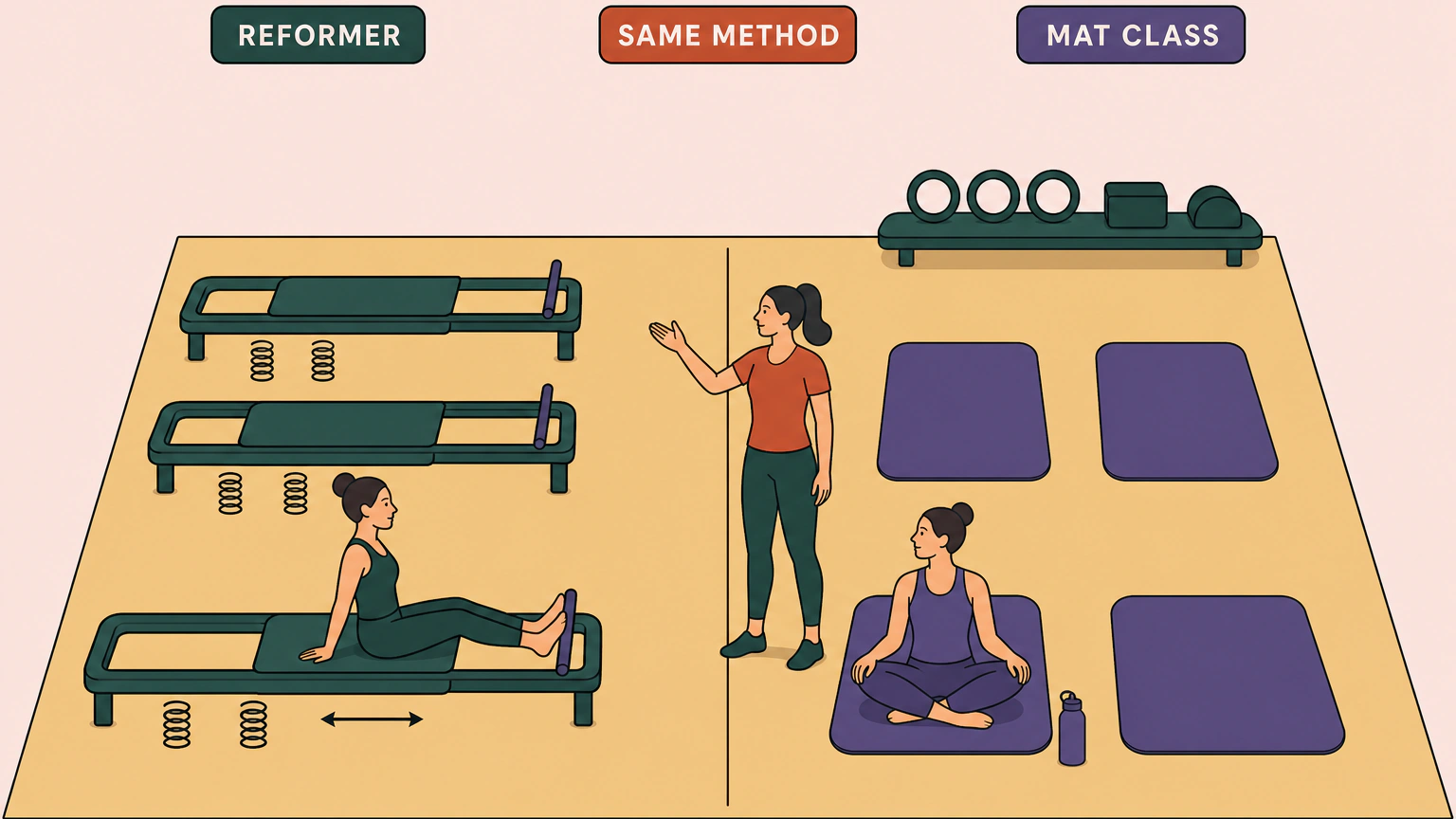
Both rooms teach the same method. "The reformer is often seen as intimidating, but it was actually designed to support the mat work," Ajia Lee Forster of Move Union told Which?. The machine is a low bed with a sliding carriage and springs underneath. The mat is a mat. What changes is what holds you up, how many people are in the room with you, and what leaves your account each month.
Start on the mat if you are still deciding
A mat class is the cheaper way to find out whether you like this at all. Which? puts a group mat class at £10 to £25, against £20 to £45 for reformer. Local leisure and community centres are worth checking alongside studios.
What the mat gives you is time with the language. Neutral spine, ribs down, breathing wide into the back of the ribs: you'll hear the same instructions in reformer classes, where the teacher also has springs and straps to manage. Time on the floor lets you learn those cues without the machine.
What you give up is worth saying out loud. The floor doesn't give the carriage's mechanical feedback, and a bigger room can mean less of the teacher. If you like the floor but fancy a different flavour of it, compare nearby yoga classes on the same timetable.
Start on the reformer if you want the machine to hold your form
The carriage gives you feedback the floor can't. When you rush or lose control, its movement can show you before the teacher has to say a word.
Springs can also support movements you can't yet manage unaided by reducing how much of your body weight you have to control. Some beginners move more comfortably on the machine on day one for exactly that reason, which is why "mat pilates vs reformer for beginners" has no single answer.
There's one condition, and it matters more than the studio's photographs. Book a class the timetable actually calls beginners, foundation or introduction. Then say on booking that it's your first time on a reformer. A studio that drops a first-timer into a full general flow class is doing you no favours. The good ones won't.
What the price difference actually buys
Money first, because that's the bit you came for. A group reformer class runs about twice a group mat class in the UK. Private sessions cost more in both formats.
Which? published these bands in February 2026. They vary by class type and location, so read them as the shape of the market rather than the price on your street. Read across a row instead of down a column, too. The number that surprises people isn't the group price. It's the private one.
| Class type | Typical group class | Typical private session | Usual class size |
|---|---|---|---|
| Mat Pilates, studio or leisure centre | £10 to £25 | £50 to £120 | No equipment cap, set by the room |
| Reformer Pilates, studio | £20 to £45 | £70 to £200 | Six to twelve, capped by machines |
| Reformer at home | £150 to £7,000, one off cost of the machine | Not applicable | One |
Prices and the class-size band as published by Which?, 16 February 2026. Its running text gives mat as £12 to £30, and we've used the figure from its own cost table.
Why a reformer class costs about twice a mat class
A mat class needs a floor. A reformer class needs a reformer for every person in it, the space to lay them out, and somebody to service them. That's most of the answer.
Count the machines and you've counted the places a reformer class can sell. A mat class can take more people in the same space, so one rent bill is spread across more fees. If you're comparing nearby timetables, barre classes use a barre and light weights rather than a room full of reformers.
Then there's who's holding the clipboard. Which? notes that some reformer classes are led by physiotherapists, and those cost more again. You're paying for a clinician's hour, which is a fair price for what it is. Just know that's what you're buying before the direct debit starts.
Intro offers, class packs and what they lead to
Intro offers can be genuinely good, and we'd use them. They're a cheaper way to look at a studio before committing, and we'd try one at every studio within travelling distance.
The block booking is where the real money sits. A class pack looks like a discount, and it is, right up until you read the expiry date. Some packs expire quickly, and time off sick can burn classes you've already paid for. Ask two things before you tap: how long the pack lasts, and what happens to classes you don't use.
Memberships need a third question, and that's notice. Three months deserves a second read, especially on a rolling contract. A studio's contract may include a cancellation fee, but government guidance says it must not be excessive and should reflect losses the business cannot reasonably avoid. The rules on what a provider can charge when you cancel work much the same here as they do anywhere else you buy lessons.
Where to see local prices for yourself
Postcode can move the price. A reformer class in central London and one in a market town can sit at opposite ends of that £20 to £45 band.
So look at what's actually near you, not at a national average, ours included. We hold 601 cost profiles behind our Pilates category, and we'd still rather you saw the real timetables. Pilates teachers near you is the place to start. The studio's own booking page is where the number that matters lives.
Class size is the difference few studios advertise
Few pages publish the class size. Of the nine pages we read on this comparison, two gave a number. Which? published a general band, while Chilli Pilates gave the maximum for its own studios.
It matters like this. In a smaller room, the teacher has more chances to see and correct you. In a larger one, more of the instruction has to go to the whole group. Neither one is a scandal. They're different products at different prices, and you should know which you've booked.
Six to twelve people in a small reformer group
A reformer room is capped by hardware. Which? puts small group classes at six to twelve people. A studio can only take as many people as it has beds.
YMCA Awards, which awards the regulated reformer certificate, defines that qualification around reformer sessions for groups of six or more. That's a boundary for the qualification, not a rule that a studio class must start at six.
A mat class has no equipment ceiling. The number is set by the room and the timetable, so a busy leisure centre can hold a much larger class. That's the trade in a line. The mat class costs less and usually gives you less of the teacher.
If you want attention rather than atmosphere, ask for the number before you book. A studio that won't tell you how many people are in the room has told you something anyway.
Ask before you pay: how many people are in the class, and how many machines are in the room. How long a class pack lasts, and what happens to the classes you don't use. And if it's a membership, how much notice you have to give to leave. Three questions, one email, and the answers tell you more about a studio than its photographs ever will.
Is the reformer harder than the mat?
No, and that belief has the mechanics backwards.
One thing first, because it's what you're really worried about. We're not clinicians. If you're pregnant, recovering from surgery or working around an injury, speak to your GP or physiotherapist before you book, and tell the teacher either way.
What the springs do, in both directions
A spring can support you or add resistance, and which one it does depends on the exercise, your position and the spring setting.
The springs resist the carriage as it travels, but the reformer can also reduce how much of your body weight you have to manage. Whether they support or challenge you depends on the movement, your position and the setting.
So "mat is the beginner option" isn't a rule. It's true of some exercises and false of others, and the teacher chooses the setting for each movement and adjusts it when someone needs a different setup. That choice is real work, and it's one reason a reformer teacher needs training a mat teacher doesn't. When a setting feels wrong for you, you're allowed to say so.
Why beginners welcome means two different things
The phrase looks identical on two websites, and the class behind it can be very different.
On a mat timetable, beginners welcome usually means the class is mixed. Regulars will do the full version, you'll be offered an easier option, and you'll be fine. It's a real invitation. It just isn't a beginners class.
On a reformer timetable it ought to mean something stricter. The machine is set up for you before you arrive, the repertoire is cut back to the foundations, and the teacher expects to explain the straps twice. Plenty of studios run exactly that. Others use the same words for a general class that simply doesn't turn people away.
So ask which one it is. "Is this a beginners class, or a mixed class that beginners can join?" is a fair question, and it takes one line to answer.
Who is teaching you, and how to check
We read nine of the pages that come up for reformer vs mat Pilates, from studio blogs to a Which? feature, and not one of them mentions a qualification. Not the awarding body, not the level, not what the person setting your springs actually trained in.
That silence is odd, because the answer is public and checking it takes about five minutes. It's also the part of this decision where a beginner has the least to go on. Better to check properly than to trust the tone of a website.
Nobody has to be qualified to teach Pilates in the UK
Teaching a Pilates class is not a reserved activity in the UK. The government's Regulated Professions Register includes Pilates-based matwork instructors under CIMSPA membership, but says no activities are reserved and only CIMSPA's postnominals are protected. Other legal duties can still apply to the teacher or business.
A keyword search for pilates returns 0 professions, against 281 regulated professions in total. The service warns that a zero can also mean the profession is listed under another name, which is what makes the CIMSPA entry important here.
The contrast is what makes it land. That same register does list Approved Driving Instructor and Approved Motorcycle Instructor. Britain regulates the people teaching you to drive, but it does not reserve the activity of teaching Pilates. Personal trainers sit under the same CIMSPA membership route, which is worth knowing if you're booking both.
None of that is an attack on Pilates teachers. Many hold substantial qualifications. It only means you have to look, because the state isn't checking a Pilates certificate before someone teaches a class.
| Route | What it is | What it publishes | Where you can check it |
|---|---|---|---|
| YMCA Level 3 Diploma in Instructing Pilates Matwork (610/4340/0) | The occupational entry qualification for teaching mat Pilates | 206 guided learning hours, 443 total qualification time | Ofqual, Find a regulated qualification |
| YMCA Level 3 Certificate in Instructing Pilates Studio Reformer: Groups (610/6206/6) | Sits on top of a Level 3 matwork qualification; scope is group reformer sessions | 95 guided learning hours, 219 total qualification time | Ofqual, Find a regulated qualification |
| YMCA Level 3 Certificate in Instructing Pilates Studio Reformer: Groups and one to one (610/4342/4) | Adds one to one reformer work to the same base | 149 guided learning hours, 341 total qualification time | Ofqual, Find a regulated qualification |
| Pilates Foundation, Matwork Teacher Training | Membership body route, matwork only | Minimum 450 training hours over 9 to 12 months | Pilates Foundation |
| Pilates Foundation, Comprehensive Teacher Training | Membership body route, studio apparatus and matwork | Minimum 1,050 training hours over 16 to 24 months | Pilates Foundation |
Figures as published by each body. Guided learning hours cover teaching, supervised study and invigilated assessment under immediate supervision. Total qualification time also includes preparation, study and assessment done without that supervision. The Pilates Foundation counts its own training hours its own way, so those three columns of numbers aren't a like-for-like race. These are the figures each body publishes, not a ranking of who teaches better.
The regulated route puts matwork first, then the reformer on top
There's an order to this YMCA route, and it happens to be the same order we'd recommend to you.
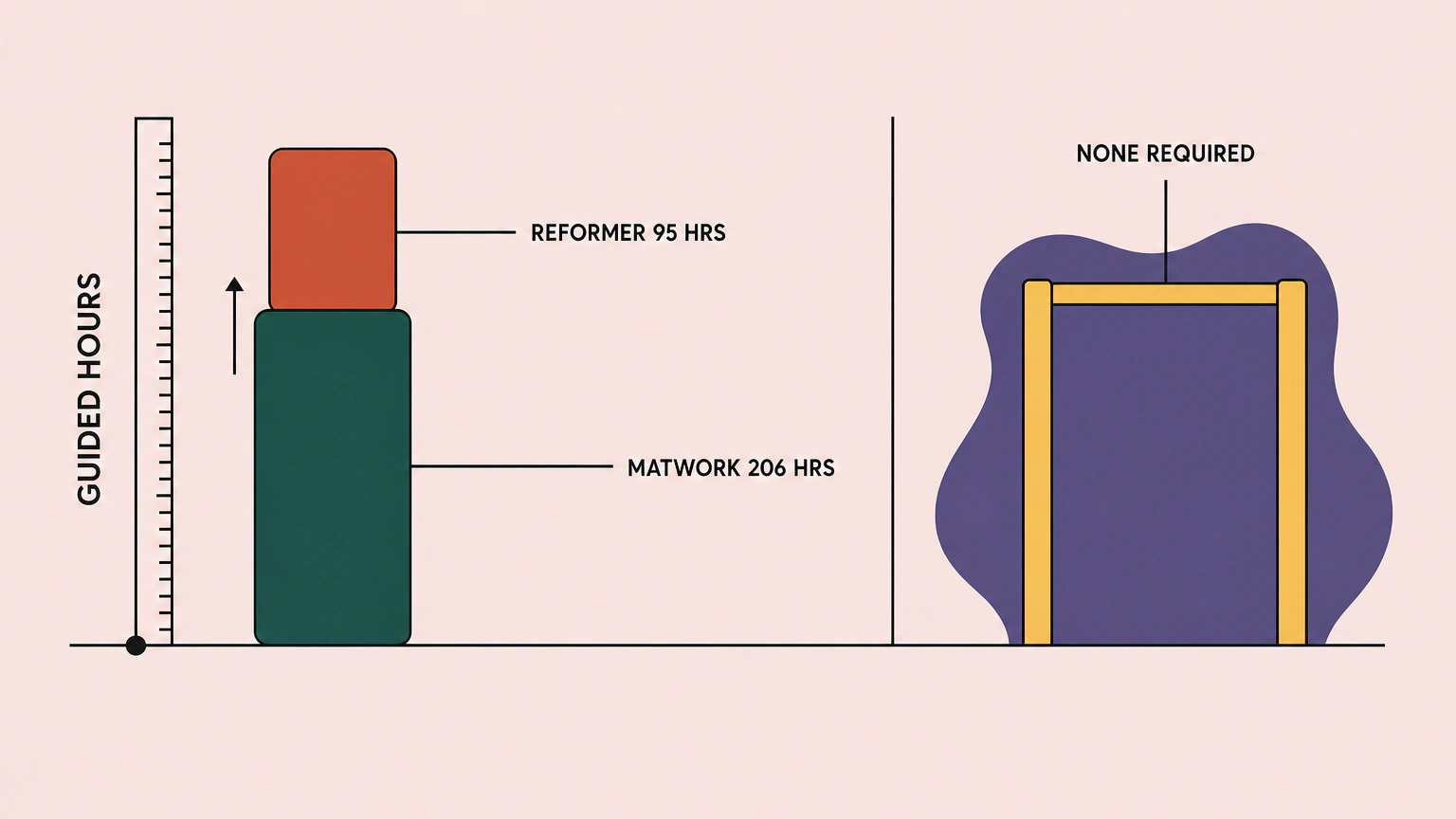
YMCA Awards runs the Ofqual-regulated Pilates qualifications. Its Level 3 matwork diploma is the occupational entry qualification, the one that says you can teach Pilates for a living. Its reformer certificate isn't a way in at all. The entry requirements say the learner must "Hold an appropriate Level 3 Pilates matwork qualification".
So a teacher holding this YMCA reformer certificate first held a Level 3 matwork qualification. YMCA recommends, but does not require, six months of matwork teaching before the course. Mat isn't the junior version of this. It's the floor this route is built on, in both senses.
That gives you something practical to do with a teacher's bio. A reformer certificate on its own, with no matwork qualification underneath it, is worth one polite question. Plenty of excellent teachers trained outside this route entirely, and it's still fair to ask.
What the CIMSPA standard covers, and what it leaves out
CIMSPA is the chartered body for the sport and physical activity sector, and it's the closest thing the UK has to a professional home for fitness instructors. Its professional standard for this job is called Pilates Based Matwork Instructor.
Read that title again. The sector's own recognised standard stops at the mat.
Its careers guidance is straightforward about what comes next. Once you hold the Level 3 matwork qualification, reformer work counts as continuing professional development, alongside the Wunda chair, the spine corrector, the ladder barrel, the trapeze and the Cadillac. Add-ons, in other words, not a second standard.
CIMSPA is just as straightforward about the front door. There are no formal entry requirements for that Level 3 course beyond being at least 16.
Both things are true at once, and neither is a scandal. The matwork qualification is a real course with real assessment behind it. CIMSPA's page treats machine work as further training after that course.
How to check a teacher in about five minutes
A regulated qualification has a title, an awarding organisation and a qualification number. All three are public. Ofqual's Find a regulated qualification covers England and Northern Ireland. Scotland has separate qualification systems, including SQA Accreditation and the SCQF framework, so a Glasgow teacher's certificate may not appear in Ofqual's service even when it is valid. It's the same register parents use for music grades, and how the government's qualification register works walks through it step by step.
- Ask which qualification they hold and who awarded it. A regulated one has a full title and a number shaped like 610/6206/6, and your teacher should be able to give you both.
- Put that title or number into the government's Find a regulated qualification service. The entry shows the level, the guided learning hours and whether it's still being awarded to new learners.
- If the class is on machines, ask whether they hold a matwork qualification too. The regulated reformer certificates are built to sit on top of one, not to stand in for it.
- If nothing comes back on the register, ask what they trained through instead. Plenty of experienced teachers came through a membership body, and the Pilates Foundation lists its teachers by postcode.
- Tell them about any injury, surgery or pregnancy when you book, not on the day. A teacher who asks you questions back is the one you want.
- Ask how many people are in the class and how many machines are in the room. If those two numbers don't match, ask why before you pay.
Start with Pilates teachers near you, pick two studios, and send all six questions in one email. The one that answers plainly is the one to book.
Frequently asked questions
Should I start with mat or reformer Pilates?
Start on the mat if you're testing whether you like the method, or watching the money. Start on the reformer if you want the machine's support while you learn the movements. If a proper beginners class is running and the price works, either is a good first booking. What matters more is that the class is pitched at first-timers.
Is mat Pilates as good as reformer Pilates?
Yes, for building the foundations. It's the same method, taught without the machine. What the reformer adds is adjustable spring resistance, support for some movements and often a smaller group. Those are additions, not corrections. YMCA's regulated route treats matwork as the qualification its reformer certificate is built on.
Is reformer Pilates harder than mat Pilates?
Neither is harder as a rule. Springs resist carriage travel, but they can also support a movement or reduce how much body weight you manage. The effect depends on the exercise, your position and the spring setting.
How much is a reformer Pilates class in the UK?
Which? puts a group reformer class at £20 to £45 and a private session at £70 to £200. Mat comes in at £10 to £25 for a group class. Postcode can move those numbers, so a central London studio and a market town one can sit at opposite ends of the same band.
How many people are in a reformer Pilates class?
Which? puts small group reformer classes at six to twelve people, and a studio can only take as many people as it has beds. YMCA Awards defines its regulated reformer certificate around groups of six or more, but that is the qualification's scope rather than a rule for every studio. Ask the studio for its number before you book.
Is Pilates regulated in the UK?
Teaching Pilates isn't a reserved activity in the UK. The register's CIMSPA entry includes Pilates-based matwork instructors but says no activities are reserved, while a keyword search for pilates returns 0 of 281 professions. Approved Driving Instructor and Approved Motorcycle Instructor appear as regulated professions. No Pilates qualification is legally required to teach a class, so run the five-minute check on whoever you book.